Clinical response to FGFR inhibitors in patients with FGFR2-amplified advanced gastric cancer: two case reports - Report - MDSpire

Clinical response to FGFR inhibitors in patients with FGFR2-amplified advanced gastric cancer: two case reports

  • By

  • Jing-Jing Li

  • Yu- Qian

  • Hui-Ting Xu

  • Yan-Li Nie

  • July 7, 2026

  • 0 min

Share

Clinical Report: Treatment Outcomes of FGFR Inhibitors in Advanced Gastric Cancer

Background

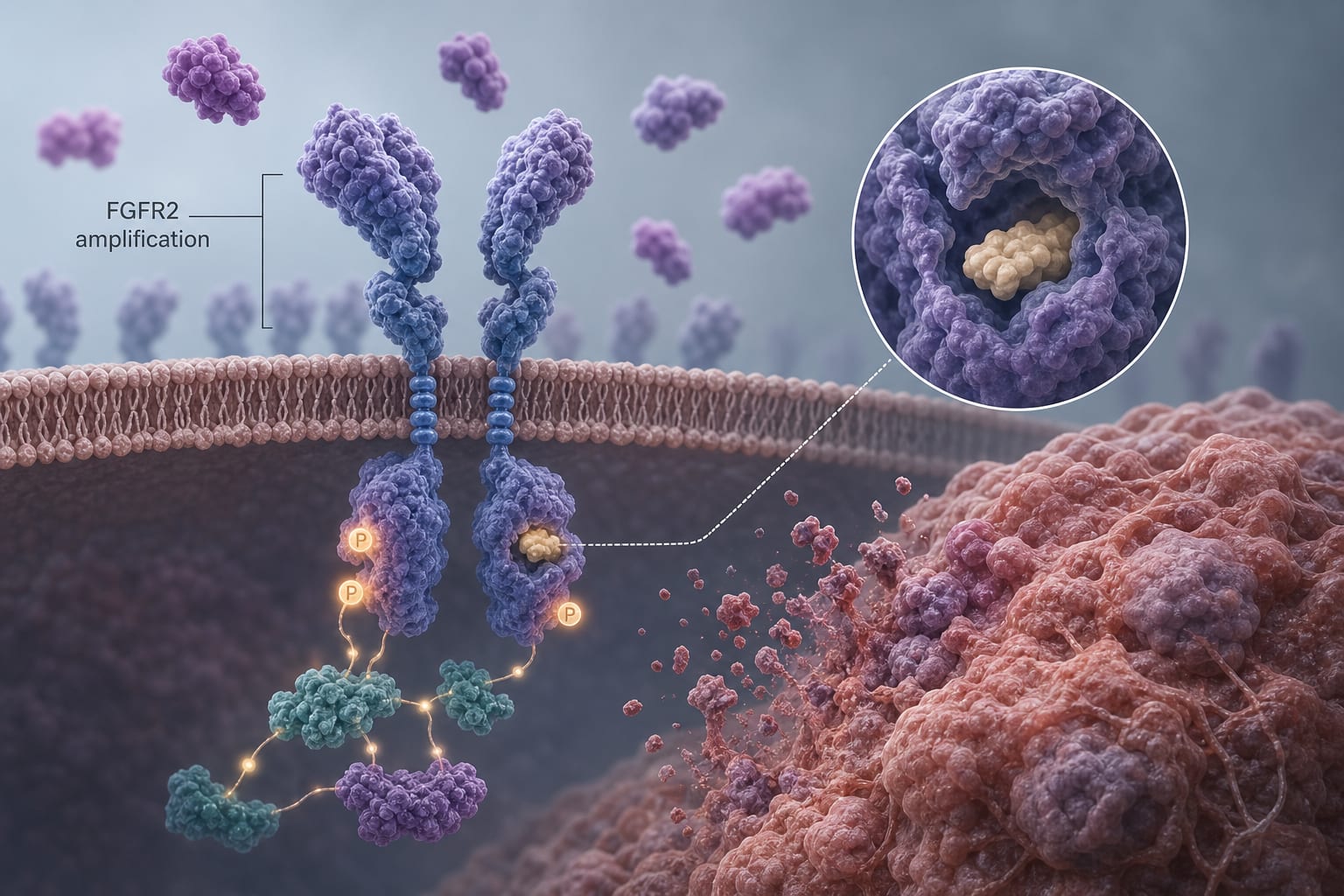
Gastric cancer is a leading cause of cancer-related mortality globally, with many patients diagnosed at advanced stages where treatment options are limited. FGFR2 amplification is associated with poor survival outcomes in gastric cancer.

Data Highlights

CaseAgeDiagnosisPFS (months)OS (months)
152Stage IVB poorly differentiated signet-ring cell carcinoma4.48.3
261Stage IVB poorly differentiated adenocarcinoma5.718.5

Key Findings

  • FGFR2 amplification is linked to significantly worse survival in gastric cancer patients.
  • Case 1 achieved a PFS of 4.4 months and OS of 8.3 months with pemigatinib.
  • Case 2 achieved a PFS of 5.7 months and OS of 18.5 months with infigratinib.
  • Both patients experienced manageable adverse events related to FGFR inhibitors.

Clinical Implications

The findings suggest that FGFR inhibitors could be a viable treatment option for advanced gastric cancer patients with FGFR2 amplification, particularly for those who cannot tolerate standard therapies. Clinicians should consider next-generation sequencing to identify suitable candidates for FGFR-targeted therapy.

Conclusion

This case series indicates the potential efficacy of FGFR inhibitors in advanced gastric cancer with FGFR2 amplification, warranting further investigation in larger cohorts.

Related Resources & Content

  1. Author(s)/Org, Source, Year -- Title
  2. The ASCO Post, 2025 -- Primary Analysis Shows Survival Benefit With Bemarituzumab Plus Chemotherapy in Gastric or Gastroesophageal Junction Cancer
  3. PubMed, 2026 -- Immunotherapy and Targeted Therapy for Advanced Gastroesophageal Cancer: ASCO Guideline Update
  4. the asco post — Primary Analysis Shows Survival Benefit With Bemarituzumab Plus Chemotherapy in Gastric or Gastroesophageal Junction Cancer
  5. The ASCO Post — FGFR2 Inhibitor Infigratinib Active in Chemotherapy-Refractory Cholangiocarcinoma
  6. Global prevalence of FGFR2b protein overexpression in advanced gastric cancer
  7. Immunotherapy and Targeted Therapy for Advanced Gastroesophageal Cancer: ASCO Guideline Update - PubMed
  8. Bemarituzumab as first-line treatment for locally advanced or metastatic gastric/gastroesophageal junction adenocarcinoma: final analysis of the randomized phase 2 FIGHT trial - PMC

Original Source(s)

Related Content