IGFBP-6 regulates SH2D4A expression to promote breast cancer cell cycle progression in response to progesterone - Report - MDSpire

IGFBP-6 regulates SH2D4A expression to promote breast cancer cell cycle progression in response to progesterone

  • By

  • Francisco J. Lariz

  • Diana C. Bautista-Tovar

  • Alejandro Lazo-Loya

  • Kevin D. Houston

  • June 30, 2026

  • 0 min

Share

Regulation of SH2D4A Expression by IGFBP-6 in Breast Cancer Cells

Overview

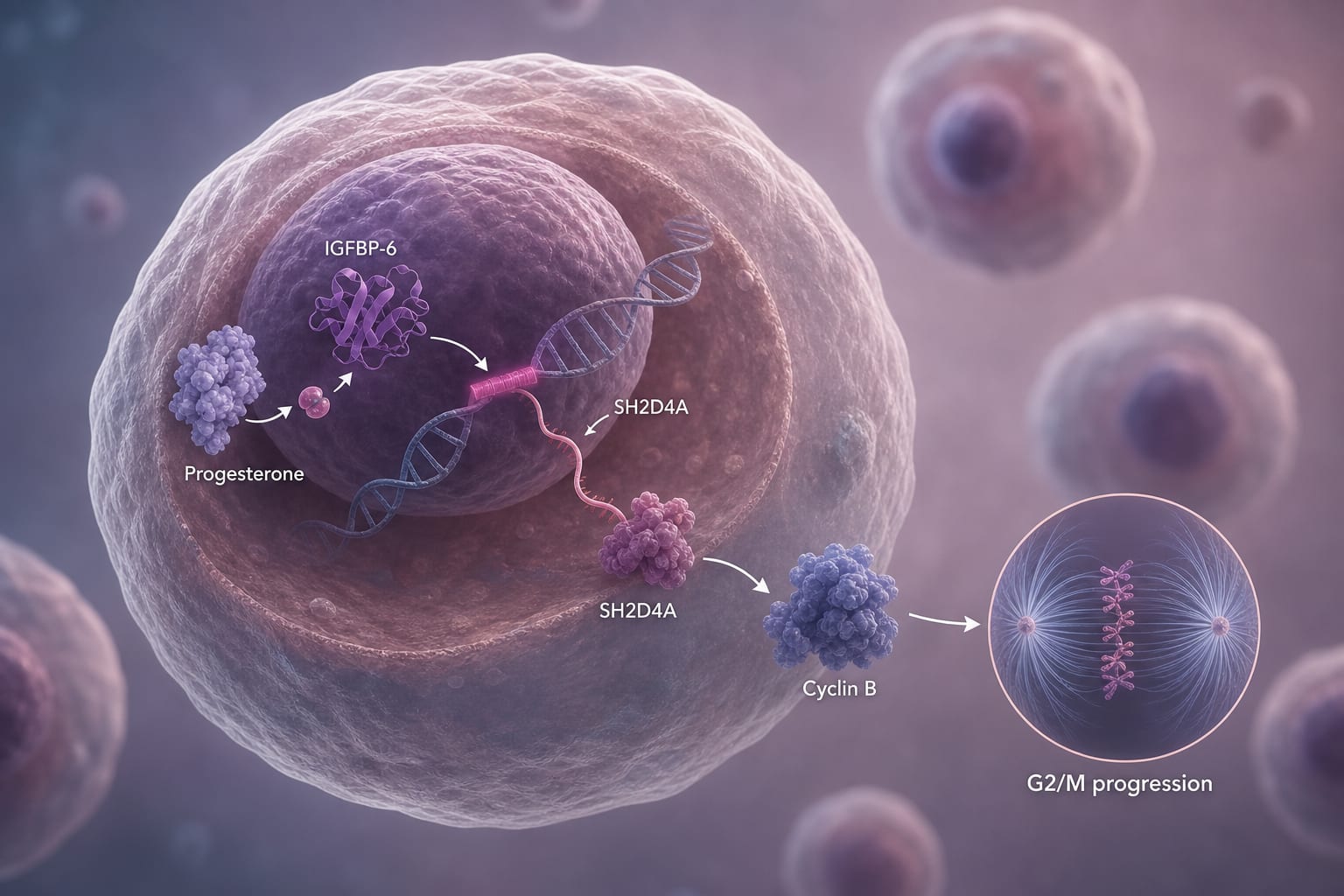
This study identifies a pathway linking progesterone, IGFBP-6, and SH2D4A to cell cycle progression in breast cancer cells. Knockdown of IGFBP-6 or SH2D4A leads to cell cycle arrest in G1.

Background

Breast cancer remains a leading cause of cancer-related mortality globally. Understanding the molecular mechanisms underlying breast cancer progression, particularly the roles of hormones like progesterone and proteins such as IGFBP-6, is crucial.

Data Highlights

Proteins IdentifiedRegulation
8638 unique proteinsIdentified in proteomic analysis
29 proteinsDownregulated after IGFBP-6 knockdown
14 proteinsUpregulated after IGFBP-6 knockdown

Key Findings

  • IGFBP-6 is induced by progesterone in breast cancer cells.
  • Knockdown of IGFBP-6 or SH2D4A leads to cell cycle arrest in G1.
  • SH2D4A induction by progesterone is dependent on IGFBP-6 levels.
  • Knockdown of IGFBP-6 decreases cyclin B1 expression and G2/M phase cell population.
  • Survival analysis indicates SH2D4A is associated with improved outcomes in luminal A breast cancers.

Clinical Implications

The findings provide insights into the interactions between IGFBP-6 and SH2D4A in breast cancer cells.

Conclusion

This study elucidates the regulatory role of IGFBP-6 and SH2D4A in progesterone-mediated cell cycle progression in breast cancer.
Related Resources & Content

  1. Frontiers in Endocrinology, 2026 -- Insulin-like growth factor 1 receptor regulates breast cancer cell adhesion through beta-1 integrin
  2. Acta Neuropathologica, 2024 -- The RNA-binding protein IGF2BP1 influences the stability of mRNA derived from FOXM1 target genes in hypermitotic meningiomas.
  3. Frontiers in Immunology, 2026 -- PIGL promotes the docetaxel resistance of prostate cancer and is regulated by E3 ubiquitin ligase HUWE1
  4. Frontiers in Oncology, 2026 -- Bulk and single-cell RNA sequencing data identified HMGB3 of chromatin regulators as a breast cancer biomarker associated with the cell cycle
  5. Estrogen and Progesterone Receptor Testing in Breast Cancer: ASCO/CAP Guideline Update - PubMed, 2023
  6. ASCO Endocrine Treatment and Targeted Therapy for HR-Positive, HER2-Negative Metastatic Breast Cancer Guideline Summary - Guideline Central, 2026
  7. US Food and Drug Administration Approval Summary: Ribociclib With an Aromatase Inhibitor in the Adjuvant Hormone Receptor–Positive, Human Epidermal Growth Factor 2–Negative Stage II and III High-Risk Early Breast Cancer Treatment Setting | Journal of Clinical Oncology, 2024
  8. Estrogen and Progesterone Receptor Testing in Breast Cancer: ASCO/CAP Guideline Update - PubMed
  9. ASCO Endocrine Treatment and Targeted Therapy for HR-Positive, HER2-Negative Metastatic Breast Cancer Guideline Summary - Guideline Central
  10. US Food and Drug Administration Approval Summary: Ribociclib With an Aromatase Inhibitor in the Adjuvant Hormone Receptor–Positive, Human Epidermal Growth Factor Receptor 2–Negative Stage II and III High-Risk Early Breast Cancer Treatment Setting | Journal of Clinical Oncology

Original Source(s)

Related Content