A review of mechanisms and optimization strategies for clinical improvement after repetitive transcranial magnetic stimulation in bipolar disorder - Report - MDSpire

A review of mechanisms and optimization strategies for clinical improvement after repetitive transcranial magnetic stimulation in bipolar disorder

  • By

  • Wojciech Korzeniowski

  • Piotr Koceniak

  • Napoleon Waszkiewicz

  • Krzysztof Walczewski

  • Gabriela Rusin

  • Jakub Antczak

  • July 2, 2026

  • 0 min

Share

Clinical Report: Exploring Mechanisms and Strategies to Enhance rTMS in BD

Overview

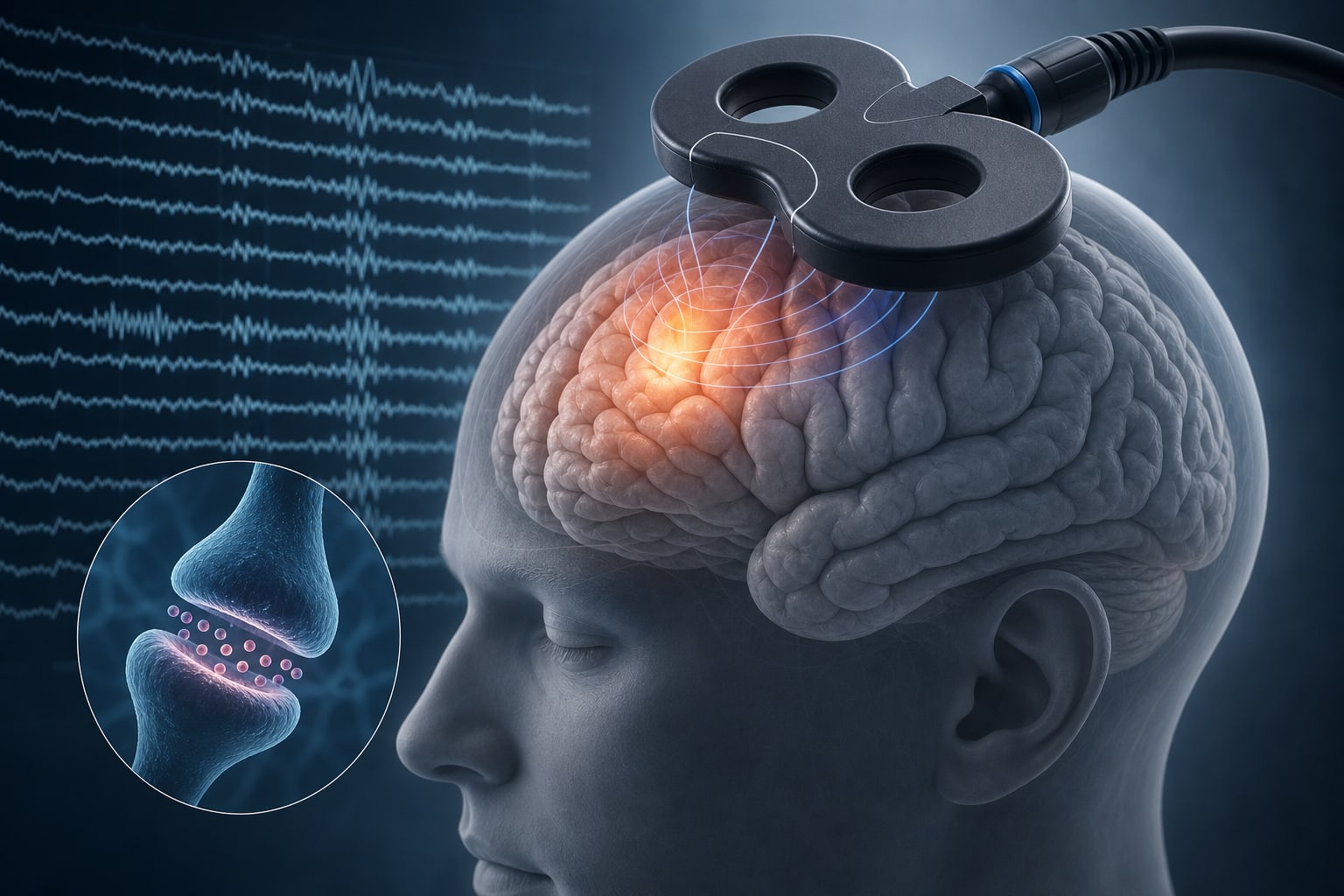
This narrative review discusses the mechanisms of action of repetitive transcranial magnetic stimulation (rTMS) in bipolar disorder (BD) and identifies predictors of treatment response.

Background

Bipolar disorder (BD) is a prevalent psychiatric condition that significantly impacts quality of life and is associated with high rates of suicide. Repetitive transcranial magnetic stimulation (rTMS) has emerged as a treatment option, particularly for drug-resistant depression, but its efficacy in BD remains less established compared to major depressive disorder (MDD). Understanding the mechanisms and predictors of response to rTMS in BD is crucial for optimizing treatment strategies.

Data Highlights

Studies indicate associations between clinical response to rTMS and neuroanatomical and neurophysiological factors, although data are limited compared to MDD.

Key Findings

  • Lower left frontal cortex volume, slower EEG activity, and reduced default mode network activity may correlate with better rTMS response in BD.
  • rTMS can induce neurochemical changes, including alterations in neurotransmitter levels and increased blood flow in stimulated areas.
  • Neuronavigation and connectivity-guided targeting may enhance the therapeutic effects of rTMS.
  • Changes in EEG patterns, such as reduced faster EEG bands, have been observed following rTMS treatment.
  • Data on rTMS efficacy in BD are still scarce, necessitating further research to establish robust treatment protocols.

Clinical Implications

Clinicians should consider anatomical and neurophysiological factors when evaluating rTMS for BD treatment.

Conclusion

While rTMS shows promise in treating BD, further studies are needed to clarify its mechanisms and optimize treatment strategies.
Related Resources & Content

  1. Carl Zhou et al., 2026 -- Transcranial Magnetic Stimulation for Bipolar Depression: A Systematic Review and Meta-Analysis
  2. Danish Psychiatric Society, 2025 -- TMS Guidelines
  3. National Network of Depression Centers et al., 2025 -- Consensus review on TMS for depression
  4. conexiant — Comparing Brain Stimulation Strategies for Depression
  5. JAMA Network Open — Intermittent Theta-Burst Stimulation for Depressive Symptoms in Parkinson Disease: A Randomized Clinical Trial
  6. Frontiers in Psychiatry — Factors associated with treatment-emergent headache occurrence following RTMS to non-motor areas and the impact on treatment outcomes: a retrospective study
  7. Frontiers in Neurology — Impacts of Repetitive Transcranial Magnetic Stimulation Parameters on Cerebral Hemodynamics in Patients with Disorders of Consciousness
  8. Comparing Brain Stimulation Strategies for Depression
  9. Intermittent Theta-Burst Stimulation for Depressive Symptoms in Parkinson Disease
  10. Factors associated with treatment-emergent headache occurrence following RTMS
  11. Transcranial Magnetic Stimulation for Bipolar Depression: A Systematic Review and Meta-Analysis of Randomized Controlled Trials: Stimulation magnétique transcrânienne dans les cas de dépression bipolaire : une revue systématique et une méta-analyse d’essais contrôlés à répartition aléatoire - Carl Zhou, Nicholas Fabiano, Stanley Wong, Mikkel Højlund, Risa Shorr, Michel Sabé, Mattia Campana, Joshua Hyde, Valerie Brandt, Samuele Cortese, Sara Tremblay, Ram Brender, Gayatri Saraf, Lakshmi N. Yatham, Marco Solmi, 2026
  12. https://dpsnet.dk/wp-content/uploads/2025/09/Danish-Psychiatric-Society-TMS-Guidelines-2025.pdf
  13. Consensus review and considerations on TMS to treat depression: A comprehensive update endorsed by the National Network of Depression Centers, the Clinical TMS Society, and the International Federation of Clinical Neurophysiology - ScienceDirect
  14. Accelerated Intermittent Theta-Burst Stimulation for Treatment-Resistant Bipolar Depression: A Randomized Clinical Trial - PMC
  15. Efficacy, Effectiveness, and Safety of Transcranial Magnetic Stimulation for Bipolar Depression: A Systematic Review and Meta-Analysis - PubMed

Original Source(s)

Related Content