Interpreting CFH Expression Across Cancers: Why Resolving the Factor H–Like 1 Isoform Matters
-
By
-
Simon J. Clark
-
October 11, 2026
Clinical Report: Interpreting CFH Expression Across Cancers
Overview
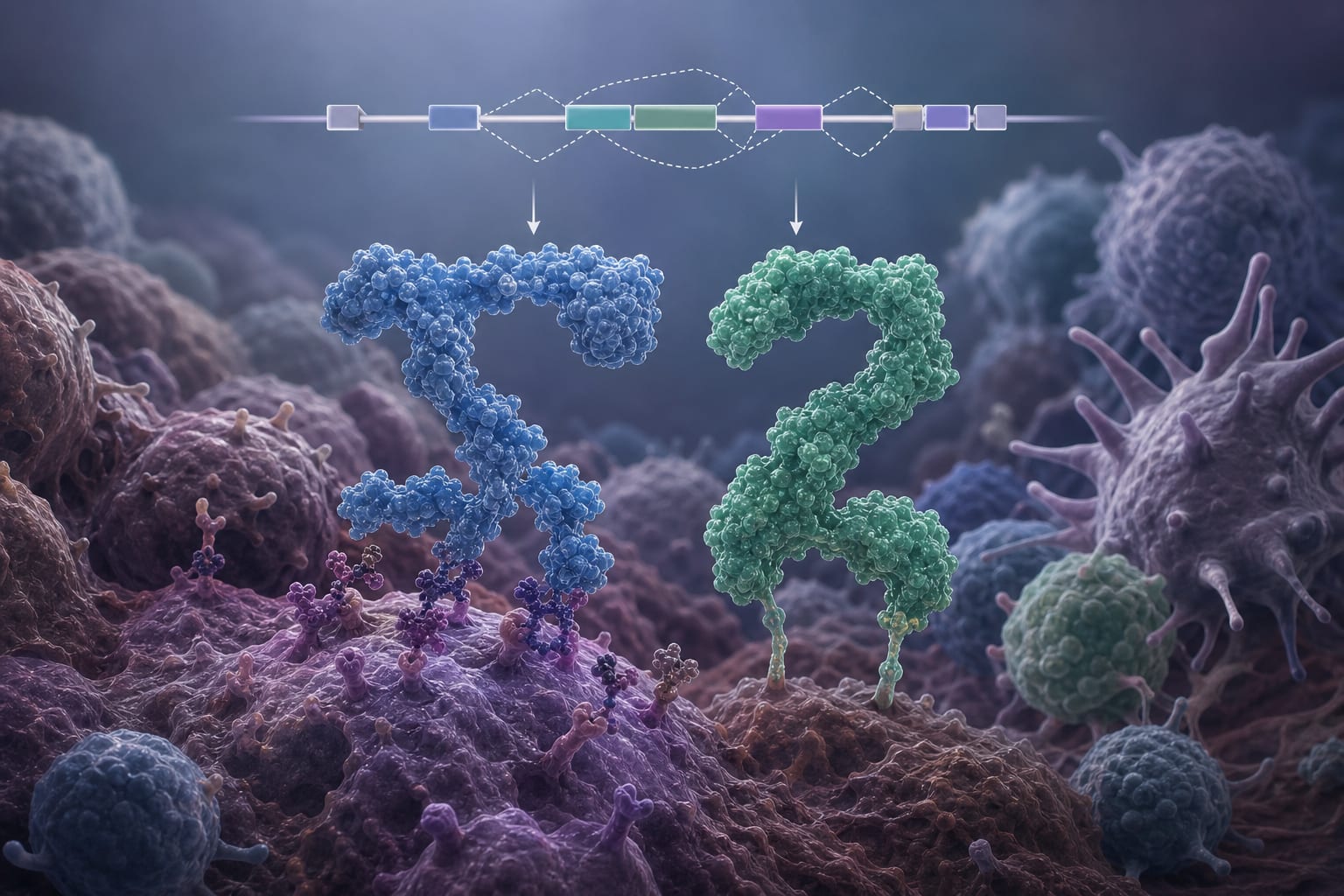
Zheng et al. reported that CFH transcription is associated with clinical and immune-related features across multiple cancers and that CFH knockdown inhibits pancreatic cancer cell proliferation and migration. However, the assays described target sequences shared by full-length factor H (FH) and factor H–like 1 (FHL-1), so the reported measurements and knockdown effects do not distinguish the two isoforms.
Background
The CFH gene encodes full-length FH and the alternatively spliced FHL-1 isoform. FHL-1 retains factor I cofactor function and regulates C3b, but lacks FH’s C-terminal host-recognition domains; it has also been detected in tumour cells and can be retained in the extracellular matrix. Because FH and FHL-1 may differ in tissue localization and biological effects, aggregate CFH measurements can be difficult to interpret as isoform-specific biomarker signals. The source describes CFH as a candidate biomarker, while the supplied guideline context does not identify CFH or FHL-1 as routine cancer biomarkers.
Data Highlights
| Study or measurement | Reported finding | Isoform interpretation |
|---|---|---|
| Zheng et al., pan-cancer analysis | CFH transcription was associated with clinical stage, survival outcomes, immune-cell infiltration, tumour mutational burden, and microsatellite instability across multiple tumour types. | The qRT-PCR primers targeted N-terminal exons shared by FH and FHL-1; the signal represents combined transcription. |
| Pancreatic cancer functional experiments | CFH knockdown inhibited cell proliferation and migration. | The shRNA constructs targeted shared N-terminal sequences and were not described as isoform-selective. |
| FHL-1 structure and function | FHL-1 comprises CCP domains 1–7 and a distinctive short tail; it retains factor I cofactor function and regulates C3b. | Unlike full-length FH, FHL-1 lacks the C-terminal domains involved in host recognition. |
Key Findings
- Zheng et al. reported associations between CFH transcription and stage, survival, immune infiltration, tumour mutational burden, and microsatellite instability across multiple cancers.
- In pancreatic cancer cells, CFH knockdown inhibited proliferation and migration; the source states that the shRNA targeted sequences shared by FH and FHL-1.
- The qRT-PCR primers used in the pan-cancer study targeted N-terminal exons common to both transcripts, so the measurements do not establish full-length FH expression alone.
- FHL-1 retains factor I cofactor activity and regulates C3b, while lacking FH’s C-terminal host-recognition domains.
- FHL-1 has been reported in tumour cells, including lung and pancreatic cancer cells, and its extracellular-matrix retention may distinguish its tissue distribution from that of full-length FH.
- The supplied guideline context reports no routine oncology recommendation for CFH or FHL-1 testing; it describes established disease-specific biomarkers instead.
Clinical Implications
The source cautions that CFH assays that do not distinguish FH from FHL-1 may yield biologically heterogeneous signals, complicating interpretation of prognostic or immune-related associations. It identifies isoform resolution as relevant to future biomarker assessment; the supplied guideline context does not support routine CFH/FHL-1 testing in cancer care.
Conclusion
The reported pan-cancer associations and pancreatic cancer experiments concern CFH-targeted measurements or perturbations that do not resolve FH from FHL-1. Isoform-specific interpretation is therefore necessary when considering these findings as biomarker evidence.
Related Resources & Content
- Zheng et al., BMC Cancer, 2025 — Comprehensive cancer analysis reveals CFH as an immune-related and prognostic marker
- ASCO, Journal of Clinical Oncology, 2026 — Therapy for Stage IV Non–Small Cell Lung Cancer With Driver Alterations: ASCO Living Guideline, Version 2026.3.2
- ASCO Publications, 2017 — Role of HSF1 expression for tumor microenvironment in intrahepatic cholangiocarcinoma
- ASCO Publications, 2006 — Expression and function of the four and a half LIM-only protein 2 (FHL2) in breast cancer
- ASCO Publications — Role of HSF1 expression for tumor microenvironment in intrahepatic cholangiocarcinoma.
- ASCO Publications — Expression and function of the four and a half LIM-only protein 2 (FHL2) in breast cancer
- Comprehensive cancer analysis reveals CFH as an immune-related and prognostic marker
- Therapy for Stage IV Non–Small Cell Lung Cancer With Driver Alterations: ASCO Living Guideline, Version 2026.3.2
- Complement system in cancer: friend or foe of immunotherapy
- Therapy for Stage IV Non–Small Cell Lung Cancer With Driver Alterations: ASCO Living Guideline, Version 2026.3.2 | Journal of Clinical Oncology
- Comprehensive cancer analysis reveals CFH as an immune-related and prognostic marker | BMC Cancer | Springer Nature Link
- Complement system in cancer: friend or foe of immunotherapy - PMC
Based on findings from:
Diagnostic interpretation of CFH expression in pan-cancer analyses: the importance of factor H–like 1 isoform resolution
Simon J. Clark. Bmc Cancer, 2026.
https://link.springer.com/article/10.1186/s12885-026-17134-4
This content is an AI-generated, fully rewritten summary based on a published scholarly article. It does not reproduce the original text and is not a substitute for the original publication. Readers are encouraged to consult the source for full context, data, and methodology.