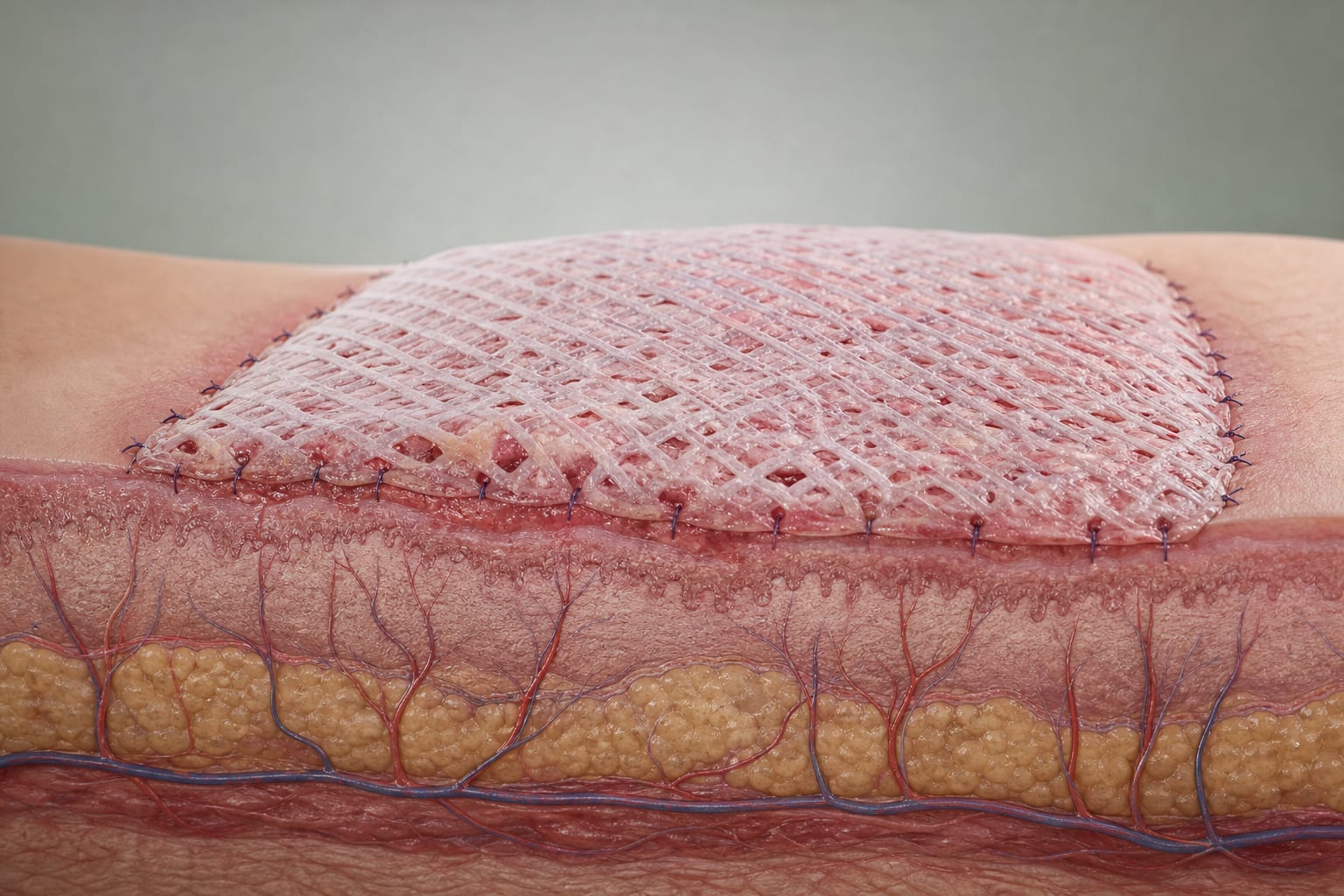
Enhanced Nursing Approaches to Improve Skin Graft Results: A Comprehensive Review of Existing Evidence
-
By
-
Wang Xing
-
Yi Huang
-
Jia Yao
-
Kan Jie
-
Tielong Xu
-
June 23, 2026
Clinical Report: Enhanced Nursing Approaches to Improve Skin Graft Results
Overview
This comprehensive review evaluates enhanced nursing strategies to optimize skin graft outcomes, focusing on graft survival, healing quality, and aesthetic results. It highlights the importance of evidence-based practices in perioperative care and the integration of novel therapies.
Background
Skin grafting is a vital surgical technique for treating various skin defects, and its success is influenced by multiple factors including graft survival and postoperative care. Advances in materials science and nursing practices have introduced new options for wound management, necessitating a thorough understanding of their efficacy and application. Optimizing nursing care can significantly impact patient outcomes and quality of life post-surgery.
Data Highlights
No numerical data or trial data was provided in the source material.
Key Findings
- Graft immobilization and adherence are critical for optimizing graft survival.
- Novel functional dressings have shown advantages in maintaining a moist environment and reducing pain.
- Bioactive agents and cell therapies can accelerate healing and improve scar quality.
- Adjunctive therapies like negative pressure wound therapy and hyperbaric oxygen therapy enhance the healing microenvironment.
- Standardized perioperative pathways are emerging to support skin grafting success.
Clinical Implications
Clinicians should adopt evidence-based practices for skin graft care, including the use of advanced dressings and adjunctive therapies. Continuous evaluation of techniques and materials is essential to tailor individualized patient care and improve surgical outcomes.
Conclusion
This review provides a structured framework for clinicians to enhance skin graft outcomes through optimized nursing approaches and evidence-based interventions.
Related Resources & Content
- Joint Trauma System, 2025 -- Clinical Practice Guideline
- Washington University, 2025 -- Burn Wound and Skin Graft Care Guidelines
- Winnipeg Regional Health Authority, 2025 -- OT/Physiotherapy Burn Guidelines
- Memorial Sloan Kettering Cancer Center -- About Your Split-Thickness Skin Graft
- Evaluating the Use of a Collagen-Elastin Scaffold with Split-Thickness Skin Grafts for Full-Thickness Soft Tissue Defects: A Retrospective Cohort Analysis and Case Study
- Hernia — Response to Commentary on: Comparison of Full-Thickness Skin Grafts and Synthetic Mesh for Repairing Giant Incisional Hernias: Results from a Randomized Controlled Multicenter Trial.
- Expert Commentary: A Comprehensive Strategy for Addressing Hypergranulation in Wound Management
- The ASCO — Diagnosing and Treating Chronic Mucocutaneous Graft-vs-Host Disease
- JOINT TRAUMA SYSTEM CLINICAL PRACTICE GUIDELINE
- Burn Wound and Skin Graft Care Guidelines
- 2025 Occupational Therapy & Physiotherapy BURN
- About Your Split-Thickness Skin Graft | Memorial Sloan Kettering Cancer Center
- Early mobilization after skin graft for burn injury in adults | Cochrane
- Benefits of negative pressure wound therapy in skin grafts: A systematic review and meta-analysis of randomised controlled trials - PubMed
- Negative Pressure Wound Therapy and its Use in Burn Wounds: An Updated Systematic Review | Journal of Burn Care & Research | Oxford Academic
- Incidence of surgical site infections at skin graft recipient sites with negative pressure wound therapy: A meta-analysis - PubMed
- Efficacy and safety of combined negative pressure therapy after skin grafting on limbs: A systematic review and meta-analysis - PMC
- RECELL Autologous Cell Harvesting Device | FDA
- Autologous Skin Cell Suspension in Burn Care: A Systematic Review and Meta-analysis of Clinical Outcomes | Journal of Burn Care & Research | Oxford Academic
- The effect of autologous platelet-rich plasma on donor site wound healing: a randomised crossover clinical trial - PubMed
- Outcome comparison of the most commonly employed wound coverage techniques in patients with massive burns ≥50% TBSA – A systematic review and meta-analysis - ScienceDirect
Based on findings from:
Optimized nursing strategies for skin graft outcomes: a narrative review of current evidence
Wang Xing, Yi Huang, Jia Yao, Kan Jie, Tielong Xu. Frontiers In Surgery, 2026.
https://www.frontiersin.org/journals/surgery/articles/10.3389/fsurg.2026.1844508/full
This content is an AI-generated, fully rewritten summary based on a published scholarly article. It does not reproduce the original text and is not a substitute for the original publication. Readers are encouraged to consult the source for full context, data, and methodology.