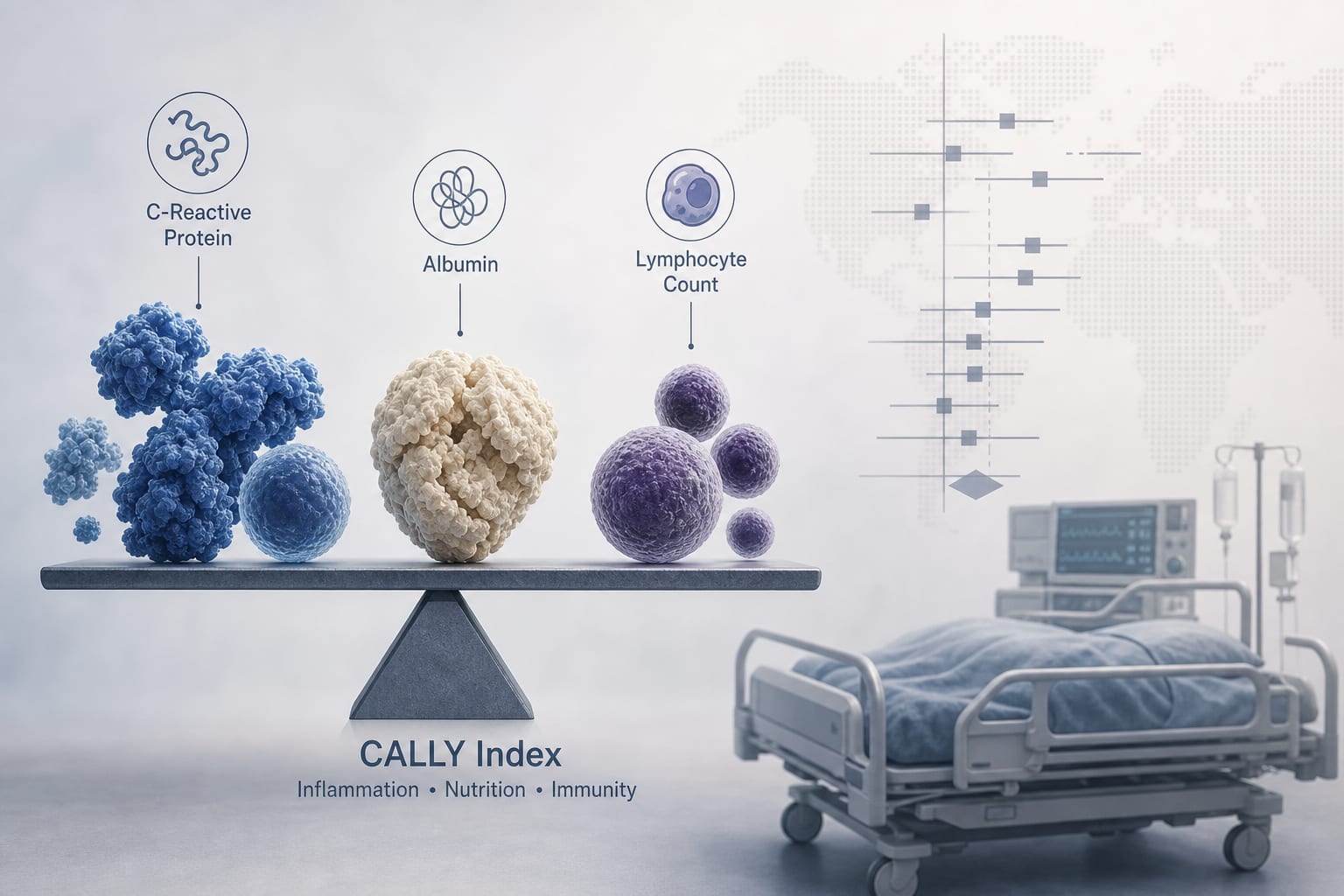
Clinical Report: Evaluating the Prognostic Significance of the CALLY Index in Sepsis
Overview
This meta-analysis evaluates the prognostic significance of the CALLY index in sepsis, revealing variable associations with mortality across different ethnic cohorts. While the overall CALLY index did not significantly differ between survivors and non-survivors, subgroup analyses indicated a correlation with survival in Chinese cohorts and mortality in Turkish cohorts.
Background
Sepsis remains a leading cause of morbidity and mortality globally, necessitating effective prognostic tools for better management. The CALLY index, which combines biomarkers of inflammation, nutrition, and immune function, has shown promise in various clinical settings. Understanding its prognostic value in sepsis is crucial for improving patient outcomes and guiding treatment strategies.
Data Highlights
Measure
Value
Pooled SMD
-0.22 (95% CI: -1.18 to 0.74)
Chinese Cohorts SMD
-1.04 (95% CI: -1.69 to -0.39)
Turkish Cohorts SMD
1.39 (95% CI: 1.02 to 1.75)
HR for Mortality
0.48 (95% CI: 0.33–0.69)
Pooled Sensitivity
0.59
Pooled Specificity
0.77
Key Findings
The CALLY index did not significantly differ between sepsis survivors and non-survivors overall.
In Chinese cohorts, a higher CALLY index was associated with improved survival outcomes.
Conversely, in Turkish cohorts, a higher CALLY index correlated with increased mortality.
Multivariate analysis indicated a significant association between a higher CALLY index and lower mortality risk.
The diagnostic accuracy of the CALLY index for predicting mortality was moderate, with a sensitivity of 0.59 and specificity of 0.77.
Significant heterogeneity was observed across all pooled analyses.
Clinical Implications
The CALLY index may serve as a low-cost biomarker for assessing prognosis in sepsis, particularly in specific ethnic populations. However, clinicians should be cautious due to its variable association with mortality and the need for further validation in larger, diverse cohorts.
Conclusion
While the CALLY index shows potential as a prognostic tool in sepsis, its inconsistent relationship with mortality across different populations highlights the necessity for further research to establish its clinical utility.