Autoantibodies combined with systemic inflammation markers for predicting bone metastases in non-small cell lung cancer patients - Report - MDSpire

Autoantibodies combined with systemic inflammation markers for predicting bone metastases in non-small cell lung cancer patients

  • By

  • Song Cheng

  • Dabin Chen

  • Rongrong Du

  • Chao Wang

  • Jiawen Xian

  • Liyuan Liu

  • Hong Wan

  • Ting Ye

  • May 26, 2026

  • 0 min

Share

Clinical Report: Integrating Autoantibodies and Inflammatory Markers to Forecast Bone Metastasis Risk in Patients with Non-Small Cell Lung Cancer

Overview

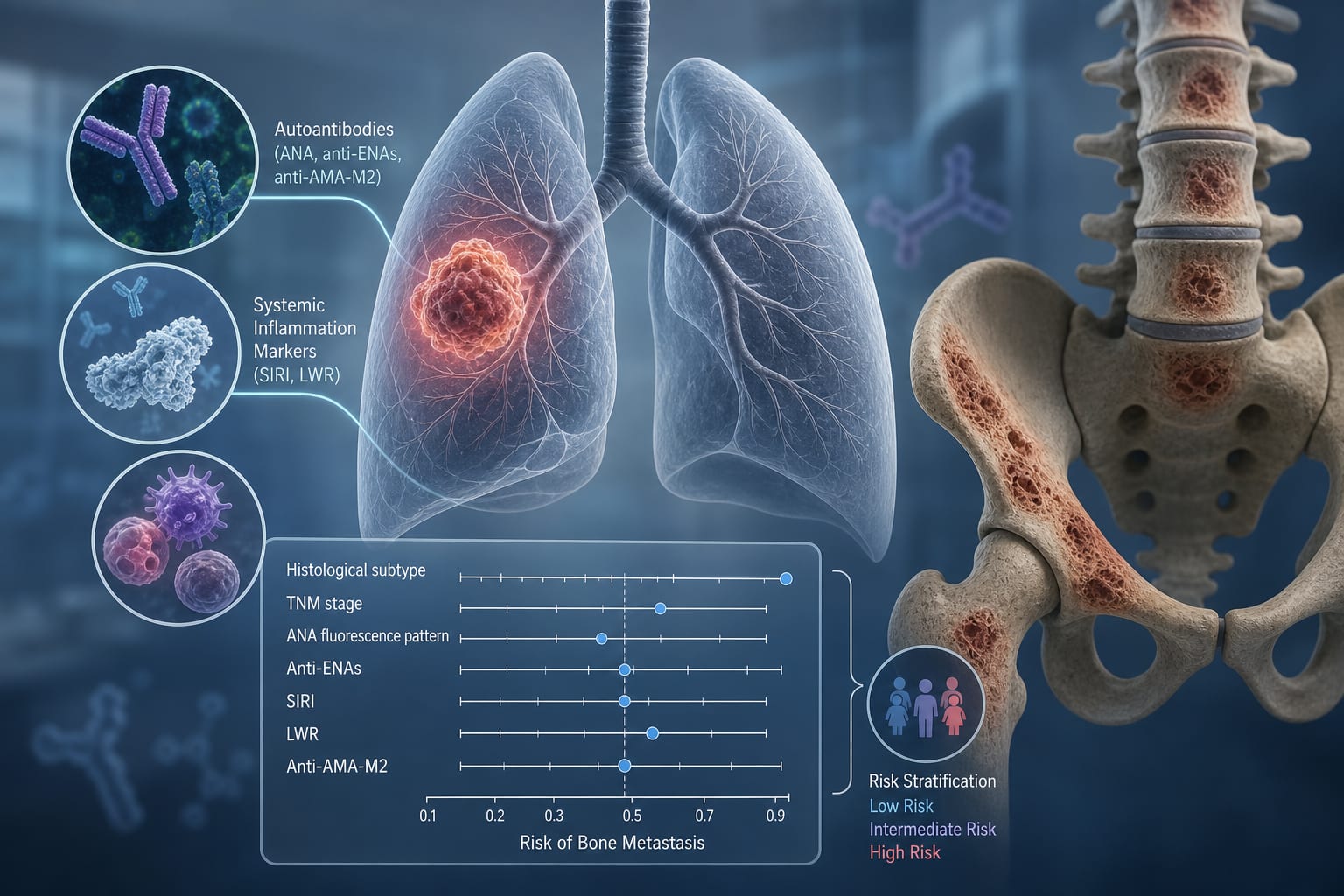
This study developed and validated a nomogram model that integrates autoantibodies and systemic inflammation markers to predict bone metastasis risk in non-small cell lung cancer (NSCLC) patients. The model demonstrated strong discriminatory ability and improved predictive performance with the inclusion of novel biomarkers.

Background

Non-small cell lung cancer (NSCLC) is a leading cause of cancer-related mortality, with a significant proportion of patients developing bone metastases, which adversely affect quality of life. Current diagnostic methods primarily rely on imaging, often identifying metastases at advanced disease stages. There is a pressing need for validated predictive models to facilitate early intervention and improve patient outcomes.

Data Highlights

VariableAUC (Training Cohort)AUC (Validation Cohort)
Nomogram0.921 (95% CI: 0.887-0.955)0.870 (95% CI: 0.795-0.945)
Continuous NRI0.822 (P< 0.001)
IDI0.121 (P<0.001)

Key Findings

  • The nomogram included seven key variables: histology, TNM stage, anti-ENAs, SIRI, LWR, anti-AMA-M2, and ANA fluorescence pattern.
  • Receiver operating characteristic curve (AUC) for the training cohort was 0.921.
  • Receiver operating characteristic curve (AUC) for the validation cohort was 0.870.
  • Calibration plots indicated good agreement between predicted and observed outcomes.
  • Decision Curve Analysis (DCA) showed higher net benefit for the nomogram compared to standard treatment strategies.
  • The inclusion of novel biomarkers significantly enhanced the model's predictive performance.

Clinical Implications

The developed nomogram provides a reliable tool for predicting bone metastasis risk in NSCLC patients, which may assist in clinical decision-making. Incorporating autoantibody and inflammation-related biomarkers can improve risk stratification and facilitate timely interventions.

Conclusion

The nomogram represents a significant advancement in predicting bone metastasis risk in NSCLC patients, integrating novel biomarkers to enhance predictive accuracy. This tool may support clinicians in making informed decisions regarding patient management.
Related Resources & Content

  1. Author(s)/Org, Source, Year -- Title
  2. the asco post — Metastatic NSCLC: Deep Learning Pathomics Platform May Help Predict Response to Immunotherapy
  3. Frontiers in Immunology — Dynamic changes in peripheral blood lymphocyte subsets predict the efficacy and prognosis of immune checkpoint inhibitors in metastatic osteosarcoma
  4. The ASCO Post — New Computational Tool May Predict Immunotherapy Outcomes in Patients With Metastatic Breast Cancer
  5. Frontiers in Oncology — Prognostic Evaluation Using Nutrition-Inflammation Biomarkers from Routine Blood Tests in Metastatic Breast Cancer: A Boruta Algorithm-Optimized Feature Selection Study
  6. Metastatic NSCLC: Deep Learning Pathomics Platform May Help Predict Response to Immunotherapy
  7. Dynamic changes in peripheral blood lymphocyte subsets predict the efficacy and prognosis of immune checkpoint inhibitors in metastatic osteosarcoma
  8. New Computational Tool May Predict Immunotherapy Outcomes in Patients With Metastatic Breast Cancer
  9. Prognostic Evaluation Using Nutrition-Inflammation Biomarkers from Routine Blood Tests in Metastatic Breast Cancer: A Boruta Algorithm-Optimized Feature Selection Study
  10. ESMO Guidelines for Non-Small Cell Lung Cancer
  11. Current diagnostic and therapeutical approaches to bone metastases in patients with non-small cell lung cancer: A cross-sectional study
  12. External Beam Radiation Therapy for Palliation of Symptomatic Bone Metastases: An ASTRO Clinical Practice Guideline
  13. NCCN Guidelines® Insights: Non-Small Cell Lung Cancer, Version 7.2025
  14. Development and validation of an early diagnosis model for bone metastasis in non-small cell lung cancer based on serological characteristics of the bone metastasis mechanism
  15. Systemic immune-inflammation index as a predictor of survival in non-small cell lung cancer patients undergoing immune checkpoint inhibition: A systematic review and meta-analysis - PubMed
  16. The role of seven tumor-associated autoantibodies in the diagnosis, staging and treatment guidance of lung cancer | BMC Pulmonary Medicine | Springer Nature Link
  17. Efficacy, safety and economy of denosumab and zoledronic acid in the treatment of bone metastases of solid tumors and multiple myeloma: a systematic review and meta-analysis - PMC

Original Source(s)

Related Content