Completion rate and safety of non-invasive brain stimulation for upper limb dysfunction after stroke: a systematic review and network meta-analysis - Report - MDSpire
Coming Soon: Introducing MDSpire News. Learn more
Conexiant’s news site is now MDSpire News. Learn more

Evaluation of Treatment Completion and Safety Profiles of Non-Invasive Brain Stimulation for Upper Limb Impairment Post-Stroke: A Systematic Review and Network Meta-Analysis

  • By

  • Juan Sun

  • ZiLe Wang

  • Yiming Huang

  • Yilin Du

  • Sijia Zhang

  • Hui Shen

  • Huimin Zhang

  • Shuxian Feng

  • September 9, 2026

Share

Clinical Report: Evaluation of Treatment Completion and Safety Profiles of NIBS

Overview

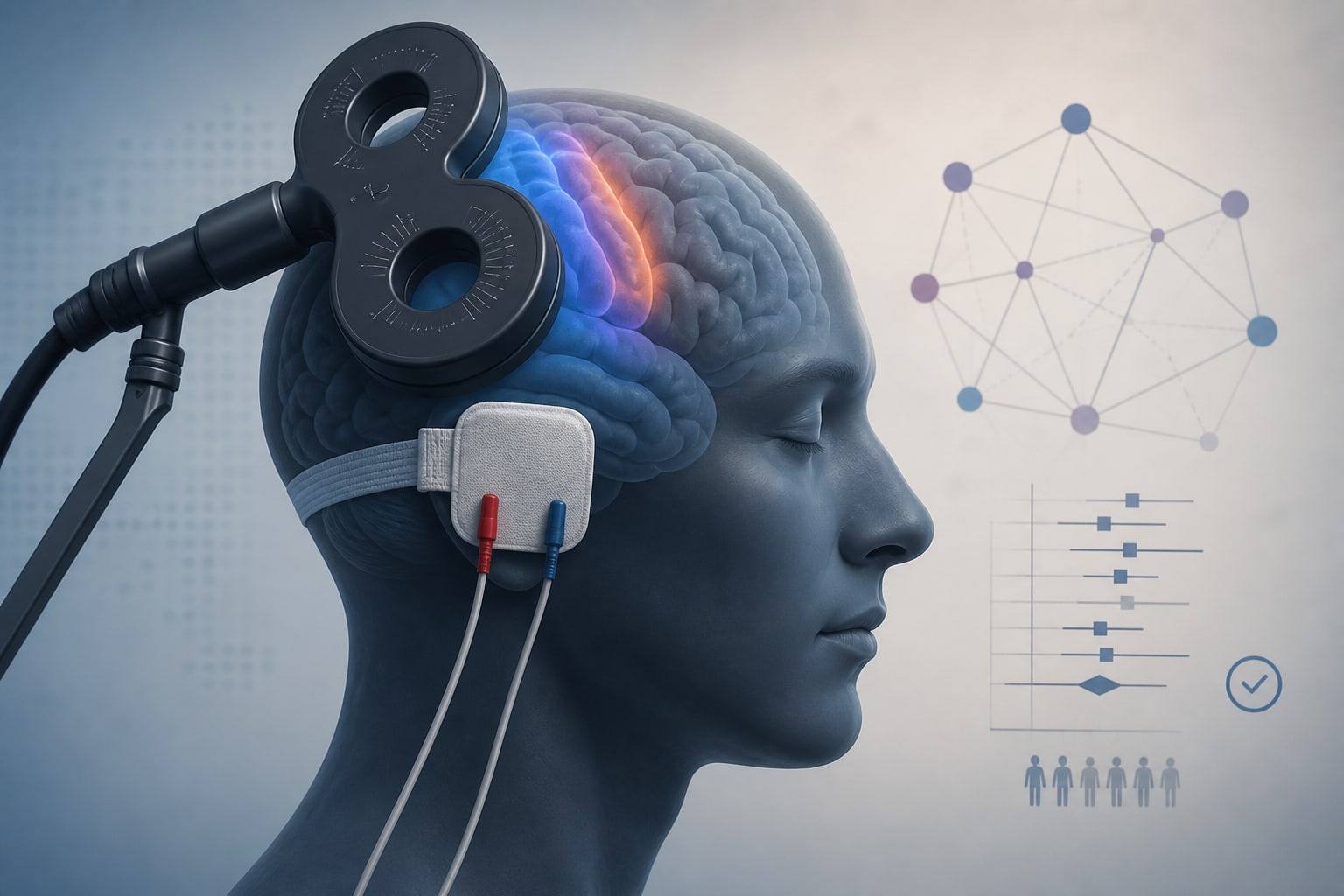
This systematic review and network meta-analysis assessed completion rates and safety profiles of non-invasive brain stimulation (NIBS) for upper limb rehabilitation post-stroke.

Background

Stroke is a leading cause of long-term disability, affecting millions globally. Upper limb motor dysfunction is prevalent among stroke survivors, significantly impacting their quality of life and daily activities. Non-invasive brain stimulation (NIBS) has emerged as a potential adjunctive treatment to enhance motor recovery, yet systematic evaluations of its completion rates and safety profiles are limited.

Data Highlights

InterventionCompletion RateAdverse Event Rate
Overall NIBS94.9% (95% CI: 93.3–96.4%)16.4% (95% CI: 8.5–26.2%)
tDCS96.8%-
rTMS93.9%-
Chronic Phase97.1%-
Mixed Phase89.1%-

Key Findings

  • The pooled completion rate for NIBS interventions was 94.9%.
  • Completion rates were higher for tDCS (96.8%) compared to rTMS (93.9%).
  • The chronic phase of stroke had the highest completion rate (97.1%).
  • The overall adverse event rate was 16.4%, with mild headaches and skin tingling being the most common.
  • Only 1.1% of participants discontinued treatment due to adverse events.
  • Intermittent theta burst stimulation (iTBS) ranked highest in exploratory SUCRA analysis (71.1%).

Clinical Implications

The high completion rates and favorable safety profiles of NIBS suggest its viability as an adjunctive treatment in upper limb rehabilitation post-stroke. Clinicians should consider stroke phase when designing adherence strategies for NIBS interventions.

Conclusion

NIBS demonstrates a high completion rate and acceptable safety profile for upper limb rehabilitation in post-stroke patients.

Related Resources & Content

  1. Frontiers in Neurology, 2026 -- Effects of Non-Invasive Neural Stimulation Modalities on Upper Limb Function in Subacute Stroke: A Systematic Review and Meta-Analysis
  2. Frontiers in Neurology, 2026 -- Efficacy Comparison of Virtual Reality, Robotics, and Brain-Computer Interface Techniques for Upper Limb Rehabilitation Post-Stroke: A Systematic Review and Network Meta-Analysis
  3. Frontiers in Neurology, 2026 -- Comparing the effects of different electromagnetic stimulation on lower limb motor impairment after stroke: a protocol for systematic review and network meta-analysis
  4. 2026 Guideline for Adult Stroke Rehabilitation and Recovery - Professional Heart Daily | American Heart Association
  5. European Stroke Organisation (ESO) guideline on motor rehabilitation
  6. VA DoD CPG for Management of Stroke Rehabilitation
  7. Frontiers in Neurology — The effect of non-invasive brain stimulation combined with motor imagery on upper limb motor function and activities of daily living in stroke patients: A systematic review and Meta-analysis
  8. 2026 Guideline for Adult Stroke Rehabilitation and Recovery - Professional Heart Daily | American Heart Association
  9. European Stroke Organisation (ESO) guideline on motor rehabilitation
  10. VA DoD CPG for Management of Stroke Rehabilitation
  11. Safety and efficacy of transcranial direct current stimulation in addition to constraint-induced movement therapy for post-stroke motor recovery (TRANSPORT2): a phase 2, multicentre, randomised, sham-controlled triple-blind trial - PMC
  12. Frontiers | Effects of non-invasive neural stimulation modalities on upper limb function in subacute stroke: a systematic review and meta-analysis
  13. Efficacy comparison of seven non-invasive brain stimulation techniques for upper limb motor dysfunction after stroke: a Bayesian network meta-analysis and systematic review - PubMed
  14. Effect of Dual‐Site Non‐Invasive Brain Stimulation on Upper‐Limb Function After Stroke: A Systematic Review and Meta‐Analysis - PMC
  15. A translational roadmap for transcranial magnetic and direct current stimulation in stroke rehabilitation: Consensus-based core recommendations from the third stroke recovery and rehabilitation roundtable - PMC

Original Source(s)

Related Content