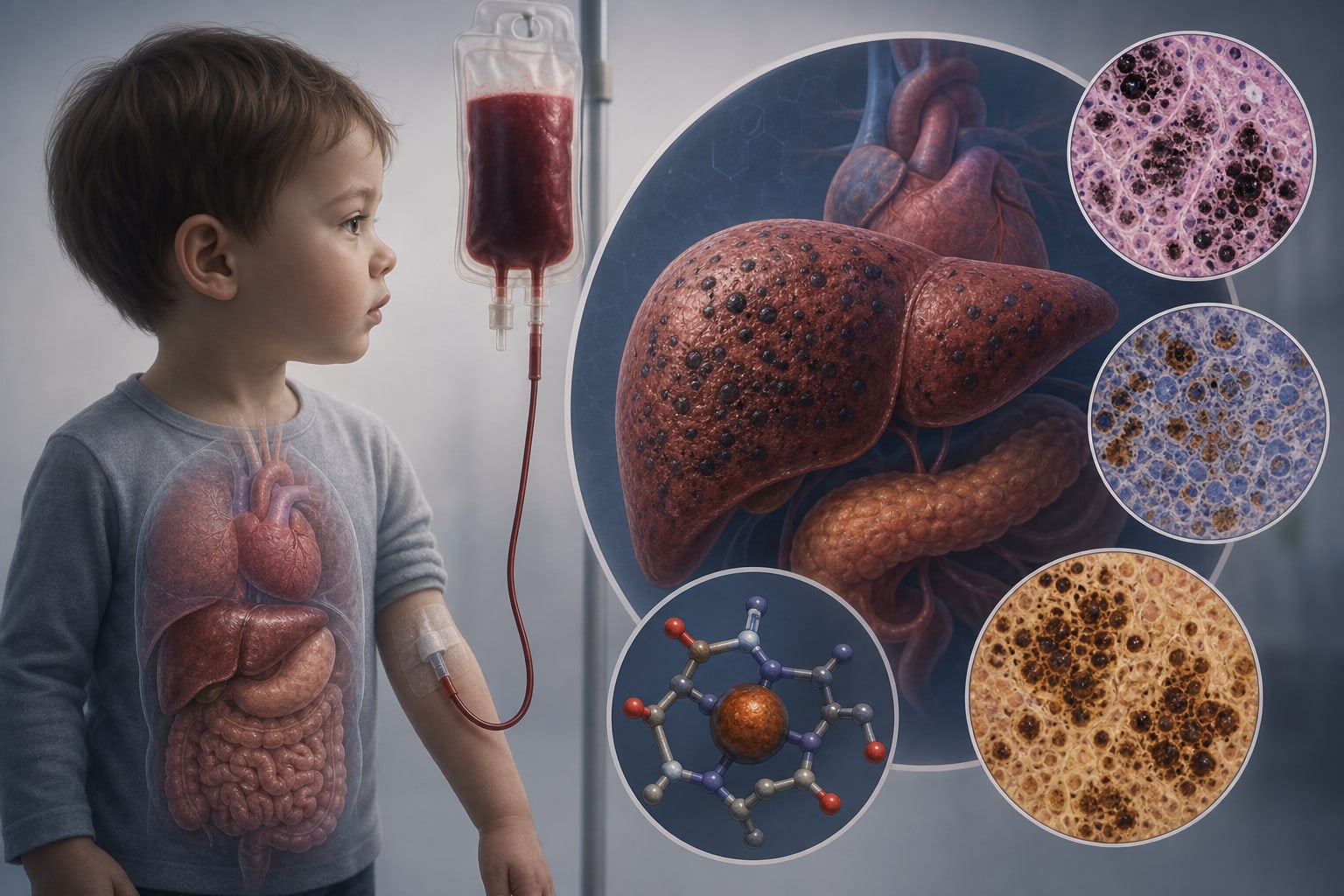
Clinical Report: Managing Iron Overload in Young Children With DBAS
Background
Diamond–Blackfan Anemia Syndrome is a rare disorder that often requires regular blood transfusions, leading to iron overload. The unique challenges in managing iron overload in DBAS patients, particularly in infants and toddlers, necessitate careful consideration of chelation therapy. Current guidelines lack specific recommendations for this age group.
Data Highlights
In a cohort study of DBAS patients, 90% required regular transfusions within the first year of life, with a significant proportion experiencing chronic iron overload. The study also indicated that severe hepatic overload was frequently observed in these patients, highlighting the urgent need for tailored chelation strategies.
Key Findings
90% of DBAS patients require regular transfusions within the first year of life.
Chronic iron overload is a significant concern due to transfusion dependence, with severe hepatic overload frequently observed.
Current guidelines lack specific recommendations for initiating chelation therapy in infants and toddlers with DBAS.
Three chelating agents are available: deferoxamine, deferasirox, and deferiprone, each with specific limitations in young patients.
Recent international consensus provides practical rules for managing iron overload in DBAS.
Clinical Implications
Healthcare providers should be aware of the increased risk of iron overload in young DBAS patients and the need for timely initiation of chelation therapy.
Conclusion
The management of iron overload in young children with DBAS remains complex.
Related Resources & Content
International Consensus Statement for Diamond–Blackfan Anemia, Lancet Haematology, 2024 -- Guidelines for Iron Chelation
American Journal of Hematology, 2026 -- Early Iron Accumulation in DBAS
Drug Safety — Evaluation of Benefit-Risk Profile for High-Dose Intravenous Iron: Comparing Ferric Carboxymaltose and Ferric Derisomaltose
JAMA Network Open — Ferritin Reference Curves and Optimal Curves in Preadolescent Children
conexiant — Iron Deficiency Guidance Varies in Premenopausal Women
BMC Cardiovascular Disorders — Iron deficiency in primary care patients with heart failure: a cross-sectional study of the heart failure in Southern Sweden (HISS) cohort
Iron Overload and Chelation - A Guide for the Haemoglobinopathy Nurse
Evaluation of the efficacy and safety of deferiprone compared with deferasirox in paediatric patients
DIAGNOSIS, TREATMENT AND SURVEILLANCE OF DIAMOND BLACKFAN ANEMIA (DBA) SYNDROME: INTERNATIONAL CONSENSUS STATEMENT - PMC
DBA Syndrome
American Journal of Hematology | Blood Research Journal | Wiley Online Library