Optimizing left atrial appendage imaging: the diagnostic value of left lateral decubitus cardiac CT angiography - Report - MDSpire

Optimizing left atrial appendage imaging: the diagnostic value of left lateral decubitus cardiac CT angiography

  • By

  • Zihao Wang

  • ChenJing Wu

  • Yi Mang

  • Zhuang Zhuang

  • Xinshi Huang

  • Zhenzhang Wang

  • June 5, 2026

  • 0 min

Share

Clinical Report: Enhancing Imaging of the Left Atrial Appendage

Overview

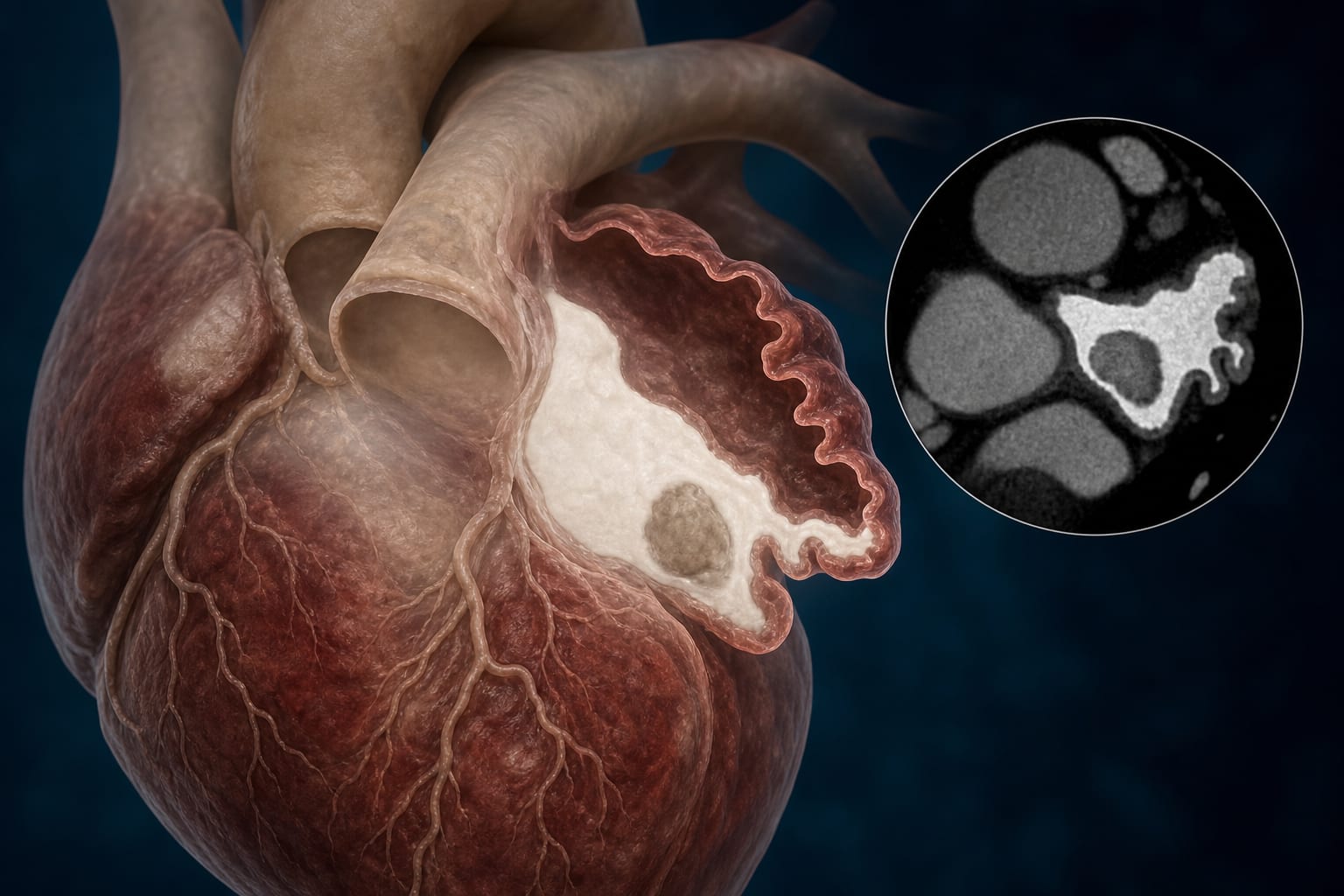
This study evaluates the diagnostic efficacy of single-phase left lateral decubitus (LLD) cardiac CT angiography (CCTA) compared to conventional biphasic supine (BS) CCTA. The LLD approach significantly improves contrast filling in the left atrial appendage (LAA) while reducing radiation exposure by approximately 50%.

Background

Atrial fibrillation is a prevalent arrhythmia linked to a high risk of thromboembolic events, with the left atrial appendage being a common site for thrombus formation. Current imaging techniques, particularly transesophageal echocardiography (TEE), are semi-invasive and operator-dependent, prompting the need for reliable non-invasive alternatives like CCTA. Optimizing CCTA protocols to enhance diagnostic accuracy while minimizing radiation exposure is crucial for improving patient safety and outcomes.

Data Highlights

ParameterBiphasic Supine (BS)Left Lateral Decubitus (LLD)
Contrast Agent Filling (HU)70.3444.8
Early Filling Defect Rate28%8.8%
Sensitivity-100%
Specificity-0.94
Mean Effective Dose (mSv)7.843.89

Key Findings

  • The LLD position significantly improved contrast filling in the LAA apex (median 444.8 HU vs. 70.3 HU, p < 0.001).
  • Early filling defect rate decreased from 28% in the BS group to 8.8% in the LLD group (p < 0.001).
  • LLD-CCTA demonstrated a sensitivity of 100% and specificity of 0.94.
  • The mean effective radiation dose was reduced from 7.84 mSv to 3.89 mSv (p < 0.001).
  • Diagnostic performance of LLD-CCTA was not statistically inferior to the biphasic protocol (p = 0.35).

Clinical Implications

The findings suggest that LLD-CCTA can be a viable alternative to BS-CCTA for assessing LAA thrombus, offering similar diagnostic accuracy with reduced radiation exposure. This may enhance patient safety and streamline imaging workflows in clinical practice.

Conclusion

Single-phase LLD-CCTA effectively maintains diagnostic accuracy while significantly lowering radiation exposure, warranting further validation for routine clinical use.

Related Resources & Content

  1. 2025 SCAI/HRS Clinical Practice Guidelines on Transcatheter Left Atrial Appendage Occlusion - PMC
  2. Cardiac Computed Tomography Versus Transesophageal Echocardiography for the Detection of Left Atrial Appendage Thrombus: A Systemic Review and Meta‐Analysis - PMC
  3. Pediatric Cardiology — Utilization of 64-Slice CT Imaging to Prevent Misdiagnosis of Anomalous Left Main Coronary Artery Origin
  4. Frontiers in Cardiovascular Medicine — Correction: A comparable efficacy and safety between intracardiac echocardiography and transesophageal echocardiography for percutaneous left atrial appendage occlusion
  5. Clinical Research in Cardiology — Assessment of Left Atrial Epicardial Adipose Tissue Volume via CMR Enhances Detection of Patients with Low Risk for Left Atrial Cardiomyopathy
  6. European Radiology — Efficacy of Photon-Counting Detector CT Iodine Mapping for Detecting Myocardial Late Enhancement
  7. 2025 SCAI/HRS Clinical Practice Guidelines on Transcatheter Left Atrial Appendage Occlusion - PMC
  8. Cardiac Computed Tomography Versus Transesophageal Echocardiography for the Detection of Left Atrial Appendage Thrombus: A Systemic Review and Meta‐Analysis - PMC

Original Source(s)

Related Content