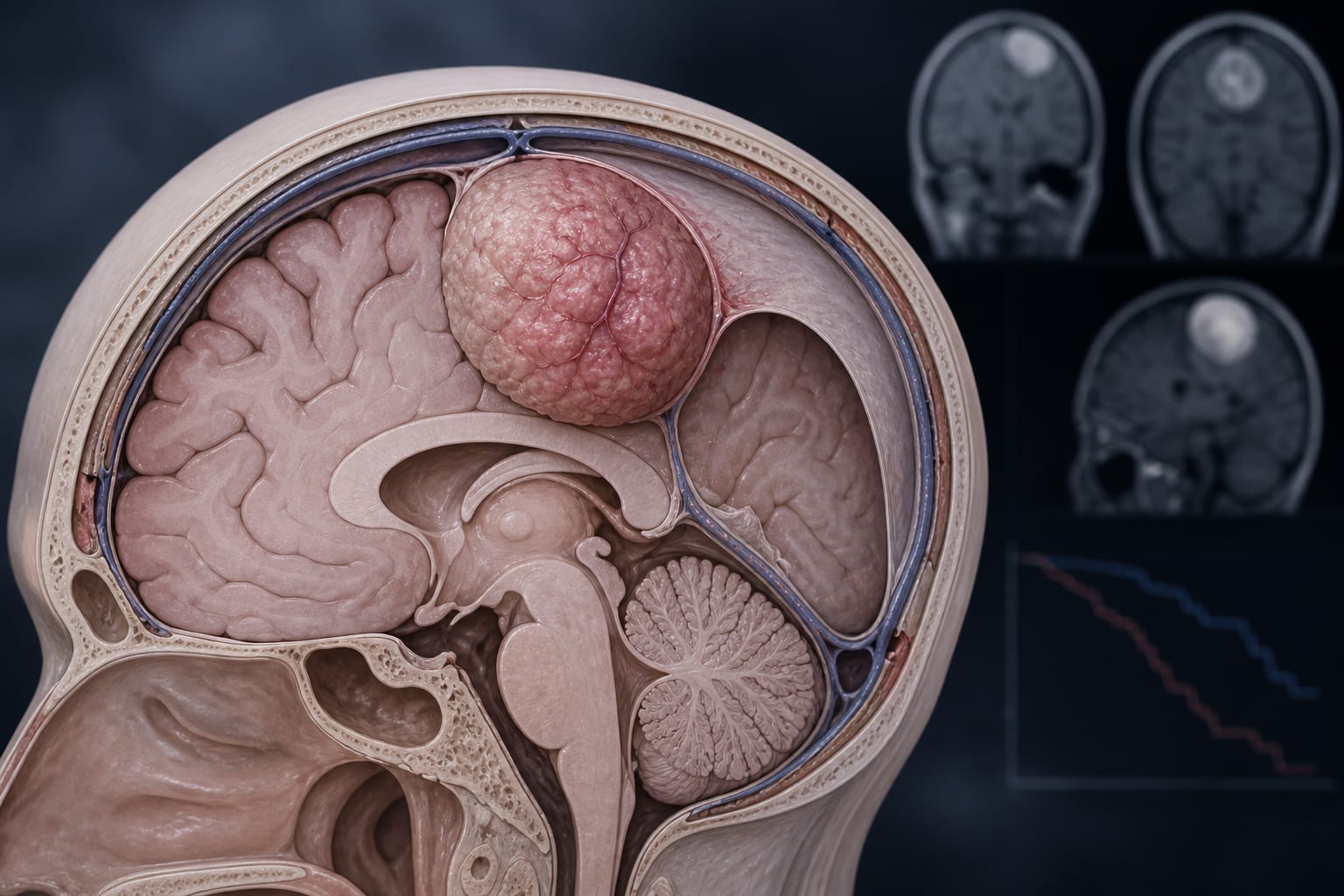
Clinical Report: Cranial Meningiomas Induced by Radiation Linked to Earlier Disease Recurrence
Overview
This study investigates the recurrence risk of radiation-induced meningiomas (RIM) compared to sporadic meningiomas using propensity score matching.
Background
Meningiomas are the most common primary intracranial tumors, with a notable subset being radiation-induced. The increasing survival rates of patients treated with radiotherapy raise concerns about the long-term development of RIMs.
Data Highlights
The study compared recurrence outcomes in patients with radiation-induced and sporadic meningiomas using a propensity score–matched cohort. The source material does not provide sample sizes, numerical recurrence rates, or effect estimates.
Key Findings
Radiation-induced meningiomas typically arise 15–35 years after cranial irradiation.
RIMs are more frequently multiple and synchronous compared to sporadic meningiomas.
RIMs have a higher proportion of atypical (WHO grade 2) histology.
Recurrence rates for RIMs are reportedly higher than those for sporadic meningiomas.
Propensity score matching can help address confounding factors in recurrence risk assessments.
Clinical Implications
Healthcare professionals should be aware of the distinct characteristics of radiation-induced meningiomas.
Conclusion
In this propensity score–matched cohort study, radiation-induced cranial meningiomas were associated with earlier relapse than sporadic meningiomas. The findings underscore the importance of recognizing the distinct recurrence patterns of RIMs, while the available source material does not provide numerical effect estimates or recurrence rates.
Related Resources & Content
Journal of Neuro-Oncology, 2023 -- Radiation-induced cranial meningiomas are associated with earlier relapse: a propensity score–matched cohort study
Journal of Neuro-Oncology — Differences in Recurrence Risk Estimates for Meningiomas Across Observational Studies: Impact of Time Period, WHO Classifications, Geographic Locations, and Healthcare Systems
Journal of Neuro-Oncology — Clinical Outcomes and Growth Rates of Meningiomas Induced by Radiation: Treatment Approaches and Active Surveillance
Journal of Neuro-Oncology — Effects of Resection Extent and Adjuvant Radiotherapy on Survival Outcomes in High-Grade Meningioma Management
Journal of Neuro-Oncology — Patterns of Recurrence and Radiation Exposure in IDH Wild-Type Glioblastoma During Initial Radiographic Relapse After Chemoradiation
CBTRUS Statistical Report: Primary Brain and Other Central Nervous System Tumors Diagnosed in the United States in 2017–2021 - PMC
The 2021 WHO classification of central nervous system tumors: what neurologists need to know - PMC
EANO guideline on the diagnosis and management of meningiomas - PMC
Radiation-induced cranial meningiomas are associated with earlier relapse: a propensity score–matched cohort study | Journal of Neuro-Oncology | Springer Nature Link
Joint EANM/EANO/RANO/SNMMI practice guideline/procedure standards for diagnostics and therapy (theranostics) of meningiomas using radiolabeled somatostatin receptor ligands: version 1.0
Radiation-induced meningiomas: A systematic review and meta-analysis of 927 meningiomas - PMC
by Leon Schmidt, Dragan Jankovic, Santhosh Thavarajasingam, Reem Fakak, Michael Kosterhon, Alice Dauth, Marc Brockmann, Clemens Sommer, Florian Ringel, Darius Kalasauskas
Mutations of the KRAS gene cause cancer cells to proliferate out of control. Present in about 25% of all cancers, they are especially prevalent in pancreatic, colorectal and lung cancers, and are associated with disease aggressiveness and poor survival.