Performance of MRI-Based vs Clinical T Staging in Localized Prostate Cancer - Report - MDSpire

Performance of MRI-Based vs Clinical T Staging in Localized Prostate Cancer

  • By

  • Arthur Peyrottes

  • Michael Baboudjian

  • Thibaut Long-Depaquit

  • Morgan Rouprêt

  • Thierry Roumeguere

  • Alexandre Peltier

  • Guillaume Ploussard

  • Romain Diamand

  • iTNM Consortium

  • Julien Anract

  • Grégoire Assenmacher

  • Francesco Barletta

  • Eric Barret

  • Edoardo Beatrici

  • Daniel Benamran

  • Vincent Benard

  • Nathan Bergier

  • Léa Bollen

  • Claudio Brancelli

  • Norbert de Brek

  • Laurent Brureau

  • Marie Chicaud

  • Mathieu Coscarella

  • Charles Dariane

  • Igor Duquesne

  • Mariaconsiglia Ferriero

  • Gaelle Fiard

  • Giorgio Gandaglia

  • Alexander Giesen

  • Ruben De Groote

  • Ruth Himmelsbach

  • Serge Holz

  • Steven Joniau

  • Marvin Jourdan

  • Romain Lefranc

  • Stéphan Lévy

  • Thibaut Long Depaquit

  • Charles Mazeaud

  • Benoit Mesnard

  • Stefano Moretto

  • Yann Neuzillet

  • Myky Nguyen

  • Marco Oderda

  • Jonathan Olivier

  • Dimitri Paillusson

  • Frédéric Panthier

  • Maxime Pattou

  • Andreas Røder

  • Maj Sanson-Stern

  • Alberto Sasia

  • Pietro Scilipoti

  • August Sigle

  • Hein Vincent Stroomberg

  • Fayek Taha

  • Gabrielle Tissot

  • Julien Van Damme

  • Thibaut Waeckel

  • Olivier Windisch

  • July 15, 2026

Share

Clinical Report: Comparison of MRI-Based Staging and Clinical T Staging in Localized Prostate Cancer

Overview

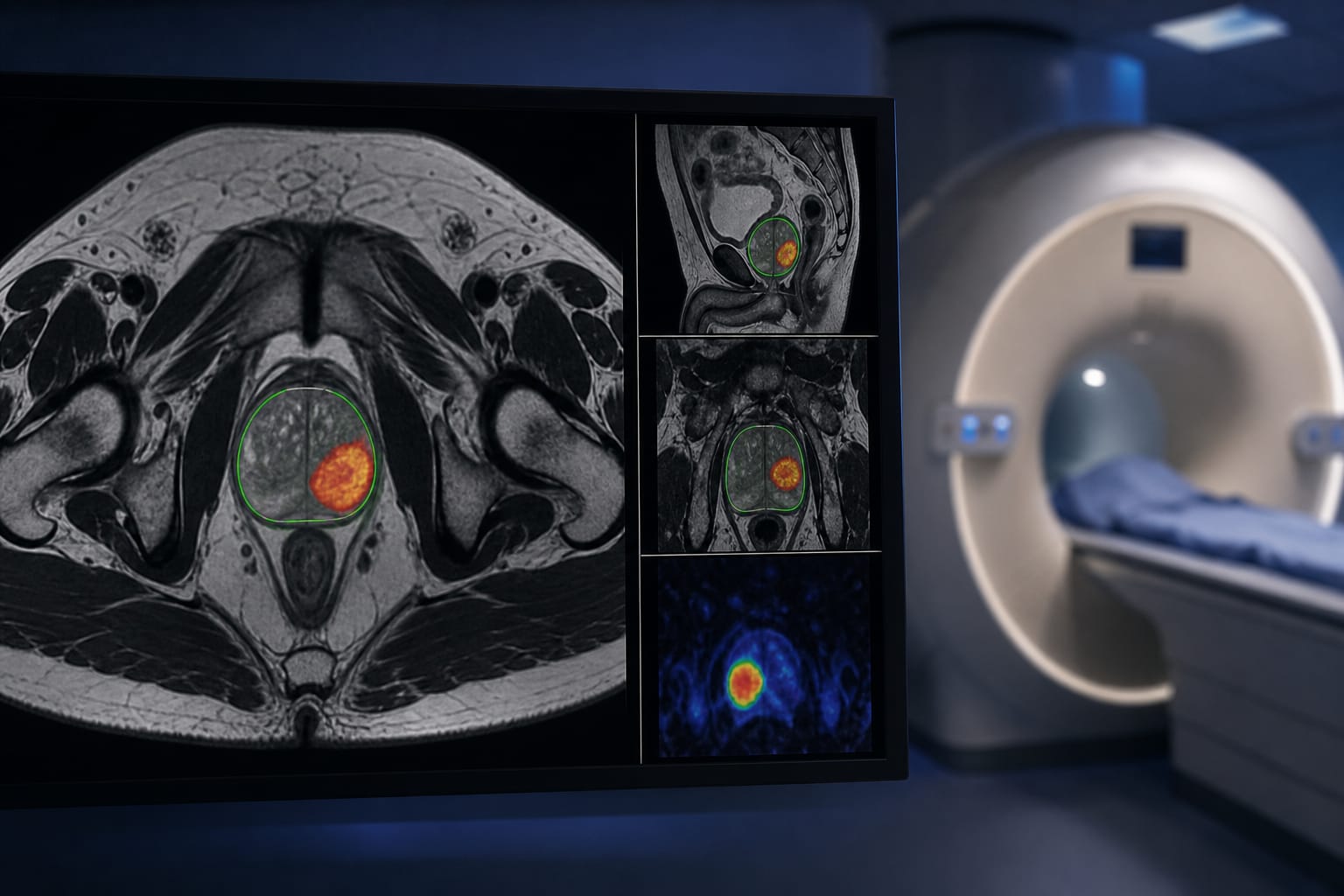
This study evaluates the performance of MRI-based staging versus traditional DRE-based staging in men with localized prostate cancer undergoing radical prostatectomy. The findings suggest that MRI may provide more accurate anatomical information.

Background

Accurate staging of prostate cancer is crucial for treatment planning and prognostic counseling. Traditional methods, such as digital rectal examination (DRE), have limitations that MRI can address, including better assessment of tumor extent and invasion.

Data Highlights

No specific numerical data was provided in the source material.

Key Findings

  • MRI provides detailed anatomical information on local tumor extent, surpassing DRE in assessing extracapsular extension and seminal vesicle invasion.
  • Despite its advantages, the clinical implications of MRI-derived staging in predicting outcomes like biochemical recurrence remain unclear.
  • The study included patients from 31 institutions across Europe, ensuring robust data collection.
  • Prior studies on MRI staging have been limited by small sample sizes and lack of long-term follow-up.
  • Current guidelines continue to define clinical T stage based solely on DRE findings.

Clinical Implications

Understanding the limitations of DRE may prompt a reevaluation of current staging practices.

Conclusion

Further research is needed to clarify the impact of MRI-based staging on clinical outcomes.

Related Resources & Content

  1. European Radiology, ESR Essentials: MRI-based T-staging in prostate cancer—practice recommendations by the European Society of Urogenital Radiology, 2026 -- https://link.springer.com/article/10.1007/s00330-026-12397-8
  2. JAMA Network Open, Magnetic Resonance Imaging–Based Staging in Prostate Cancer—Are We Ready?, 2026 -- https://jamanetwork.com/journals/jamanetworkopen/fullarticle/2851655
  3. Utilizing Preoperative MRI to Identify Unilateral and Bilateral Extraprostatic Disease in Prostate Cancer Patients, 2014 -- https://link.springer.com/article/10.1007/s00345-014-1362-x
  4. EAU Guidelines on Prostate Cancer - CLASSIFICATION AND STAGING SYSTEMS, 2026 -- https://uroweb.org/guidelines/prostate-cancer/chapter/classification-and-staging-systems
  5. European Radiology — ESR Essentials: MRI-based T-staging in prostate cancer—practice recommendations by the European Society of Urogenital Radiology
  6. JAMA Network Open — Magnetic Resonance Imaging–Based Staging in Prostate Cancer—Are We Ready?
  7. Utilizing Preoperative MRI to Identify Unilateral and Bilateral Extraprostatic Disease in Prostate Cancer Patients
  8. Utilizing Multiparametric MRI for Local Staging in Routine Clinical Settings: Assessing Diagnostic Precision and Radiologist Learning Progression
  9. EAU Guidelines on Prostate Cancer - CLASSIFICATION AND STAGING SYSTEMS
  10. Performance of MRI-Based vs Clinical T Staging in Localized Prostate Cancer | Oncology | JAMA Network Open | JAMA Network
  11. Pretreatment MRI as a Prognostic Factor After Radical Prostatectomy: A Systematic Review and Meta-Analysis | Oncology | JAMA Oncology | JAMA Network

Original Source(s)

Related Content