Preparing AI chatbots to respond to patient distress and suicidality in high-risk healthcare settings - Report - MDSpire
Coming Soon: Introducing MDSpire News. Learn more
Conexiant’s news site is now MDSpire News. Learn more

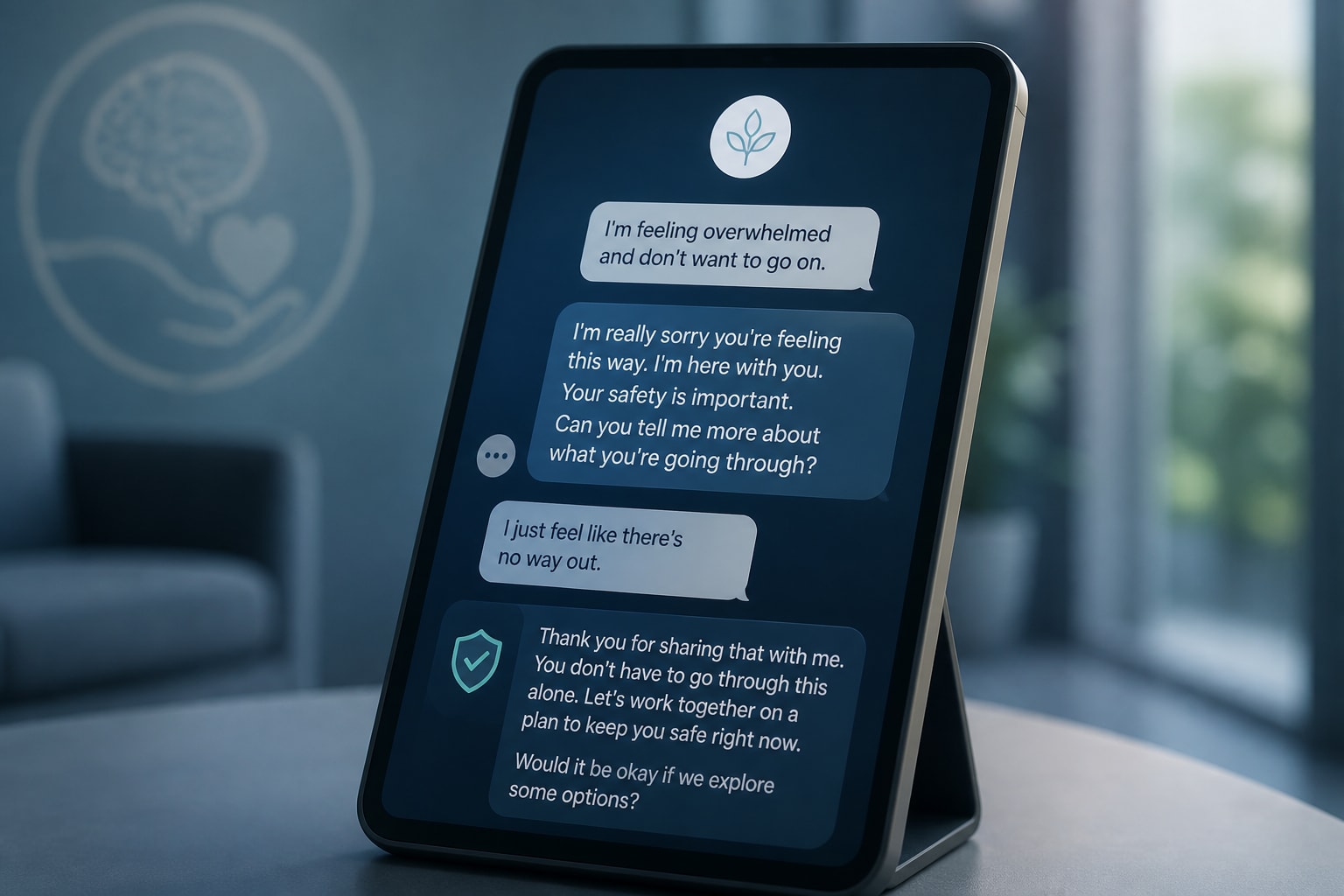
Equipping AI Chatbots to Address Patient Distress and Suicidal Thoughts in High-Risk Healthcare Environments

  • By

  • Joanna M. Streck

  • Dallas Swendeman

  • W. Scott Comulada

  • Y. Xian Ho

  • Julia Cannistraro

  • Gladys N. Pachas

  • Danielle Alves-Back

  • Wei Sum Li

  • Jonathan L. Jackson

  • Delta-Marie Lewis

  • Namrata Tomar

  • David Warren

  • Douglas E. Levy

  • Lillian Gelberg

  • September 22, 2026

Share

Clinical Report: Equipping AI Chatbots to Address Patient Distress and Suicidal Thoughts

Background

The integration of AI chatbots in behavioral health support is gaining traction, particularly in settings with limited access to mental healthcare. These tools can provide immediate assistance but also pose risks, including the potential for harmful advice and inadequate monitoring of suicide risk. Establishing effective safety protocols is crucial, especially for vulnerable populations such as those with substance use disorders.

Data Highlights

No numerical data was provided in the source material.

Key Findings

  • The AI chatbot 'Suzy' was developed to provide support for substance use disorder recovery and wellness.
  • Safety guardrails were implemented, including a safety disclaimer and a 'Safety Router' for monitoring user inputs.
  • Human oversight is essential for effective suicide risk monitoring and safety triage.
  • There is a lack of established recommendations for suicide risk monitoring in AI chatbots.
  • Empirical validation of the chatbot's safety measures is necessary beyond initial pilot studies.

Clinical Implications

Healthcare providers should be aware of the potential risks associated with AI chatbots in mental health settings. Implementing robust safety protocols and human oversight can enhance the effectiveness of these tools in managing patient distress and suicide risk.

Conclusion

The development of AI chatbots like 'Suzy' highlights the need for careful attention to safety and monitoring to mitigate risks.

Related Resources & Content

  1. JAMA Network Open, 2026 -- Frequency of Mental Health Topics in Open-Access Generative AI Interactions
  2. Stat News, 2026 -- Teens are turning to chatbots for mental health help. We need rules to keep them safe
  3. npj Digital Medicine, 2026 -- Exploring the Mental Health Risks Associated with LLM-Driven Chatbots: A Scoping Review
  4. VA/DoD Clinical Practice Guideline for Assessment and Management of Patients at Risk for Suicide, 2024
  5. National Performance Goals | Joint Commission, 2026
  6. Journal of Medical Internet Research (JMIR) — Factors Shaping Trust and Satisfaction With AI Medical Chatbots: A Mixed Methods Vignette Survey of Caregivers Seeking Guidance on Pediatric Infectious Diseases
  7. Building safer artificial intelligence mental health chatbots
  8. An AI-based mental health guardrail and dataset for identifying psychiatric crises
  9. VA/DoD Clinical Practice Guideline for Assessment and Management of Patients at Risk for Suicide
  10. National Performance Goals | Joint Commission
  11. Systematic review and meta analysis of chatbots in the management of depressive and anxiety symptoms | npj Digital Medicine
  12. A scoping review on the mental health harms of LLM-based chatbots | npj Digital Medicine
  13. Evaluating Alignment between Large Language Models and Expert Clinicians in Suicide Risk Assessment - PMC
  14. Performance of mental health chatbot agents in detecting and managing suicidal ideation - PubMed
  15. The Goldilocks Zone: Finding the right balance of user and institutional risk for suicide-related generative AI queries | PLOS Digital Health
  16. WHO releases AI ethics and governance guidance for large multi-modal models
  17. 2024 National Strategy for Suicide Prevention

Original Source(s)

Related Content