Decoding autoimmune disease with single-cell immune repertoire and transcriptome sequencing: mechanisms and therapeutic opportunities - Report - MDSpire

Decoding autoimmune disease with single-cell immune repertoire and transcriptome sequencing: mechanisms and therapeutic opportunities

  • By

  • Shuqing Wang

  • Zhao Dong

  • Yuefang Liu

  • Xianhe Ren

  • Xin Wang

  • Hongsong Yu

  • June 16, 2026

  • 0 min

Share

Clinical Report: Unraveling Autoimmune Disorders Through Single-Cell Analysis

Overview

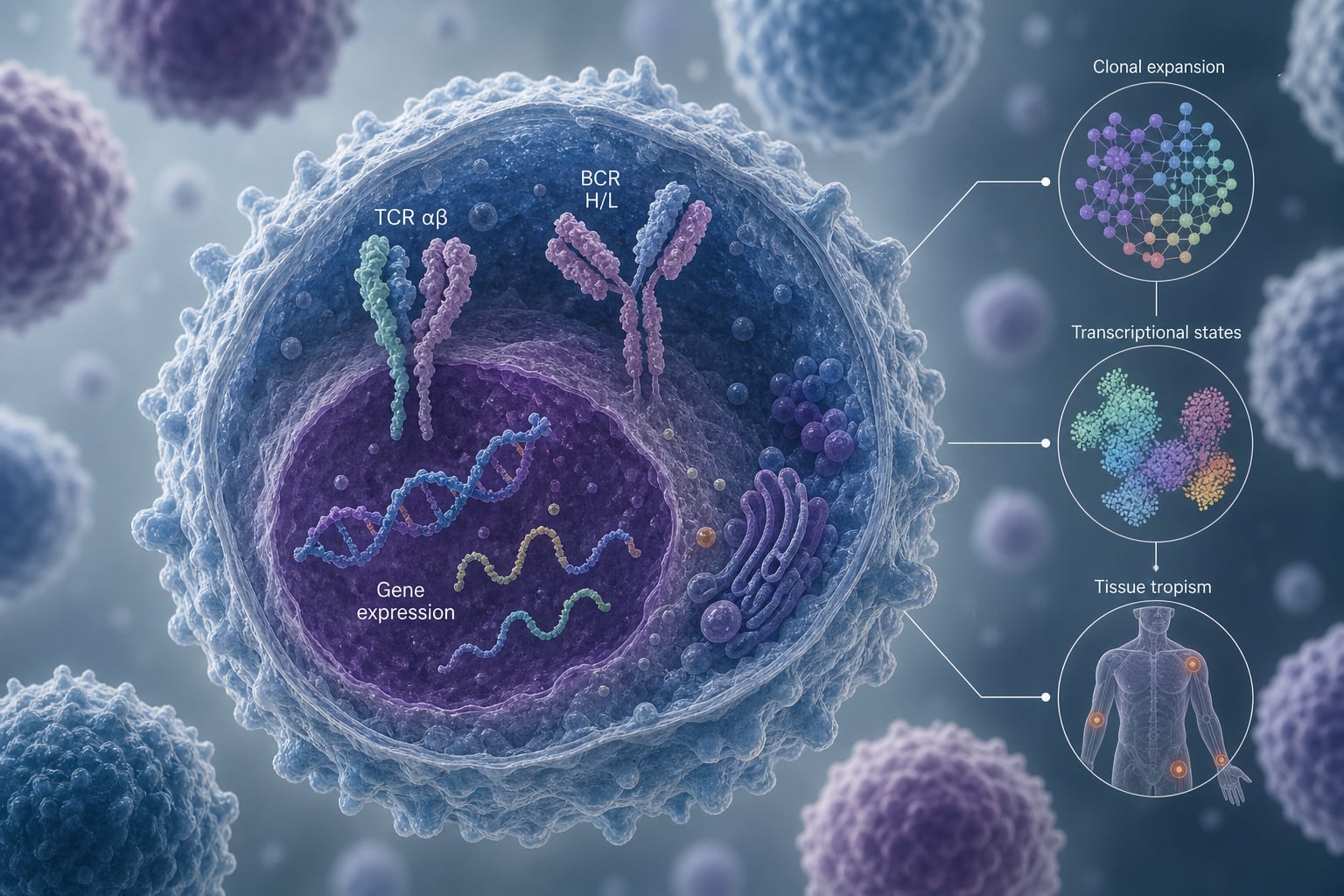
Single-cell T- and B-cell receptor sequencing (scTCR/BCR-seq) provides critical insights into the clonal dynamics and functional states of immune cells in autoimmune diseases. This methodology enhances our understanding of disease heterogeneity and informs therapeutic strategies, potentially leading to more precise and effective treatments.

Background

Autoimmune diseases arise from a failure of immune tolerance, resulting in the activation of self-reactive T and B cells. These conditions are prevalent and can lead to significant morbidity, highlighting the need for improved therapeutic approaches. Current treatments often lack specificity and can have variable efficacy, underscoring the importance of understanding the underlying immune mechanisms.

Data Highlights

No numerical data provided in the source material.

Key Findings

Link findings more directly to the implications of scTCR/BCR-seq and rephrase for clarity.

Clinical Implications

The application of scTCR/BCR-seq in clinical settings can enhance the identification of pathogenic clones, leading to more targeted therapies for autoimmune diseases. Understanding clonal dynamics may also improve patient prognosis and treatment responses.

Conclusion

Reiterate the significance of precision medicine in the context of specific autoimmune disorders.

Related Resources & Content

  1. Frontiers in Medicine, 2026 -- Cross-disease immune cells atlas reveals the similarities and differences of cell characteristics and interactions in rheumatic diseases
  2. Frontiers in Immunology, 2026 -- Microbiome-orchestrated cross-organ immunity in autoimmunity: from metabolites to therapeutic targets
  3. Frontiers in Immunology, 2026 -- Single-cell transcriptomic insights into the immune heterogeneity of immune checkpoint inhibitors related organ toxicities
  4. EULAR recommendations for the management of rheumatoid arthritis with synthetic and biologic disease-modifying antirheumatic drugs: 2025 update - PubMed
  5. Lupus Clinical Practice Guidelines | American College of Rheumatology
  6. First American Gastroenterological Association living guideline for moderate-to-severe ulcerative colitis - American Gastroenterological Association
  7. Frontiers in Immunology — CFD+CD14+ monocytes: potential pathogenic subset in myasthenia gravis uncovered by multi-omics integration and machine learning analysis
  8. EULAR recommendations for the management of rheumatoid arthritis with synthetic and biologic disease-modifying antirheumatic drugs: 2025 update - PubMed
  9. Lupus Clinical Practice Guidelines | American College of Rheumatology
  10. First American Gastroenterological Association living guideline for moderate-to-severe ulcerative colitis - American Gastroenterological Association
  11. Efficacy and Safety of Obinutuzumab in Active Lupus Nephritis | New England Journal of Medicine
  12. Risankizumab versus Ustekinumab for Moderate-to-Severe Crohn’s Disease | New England Journal of Medicine
  13. Clonal associations between lymphocyte subsets and functional states in rheumatoid arthritis synovium | Nature Communications
  14. Single-cell transcriptomics reveal potent extrafollicular B cell response linked with granzyme K+ CD8 T cell activation in lupus kidney - ScienceDirect
  15. Single-cell and spatial multi-omics highlight effects of anti-integrin therapy across cellular compartments in ulcerative colitis - PMC

Original Source(s)

Related Content