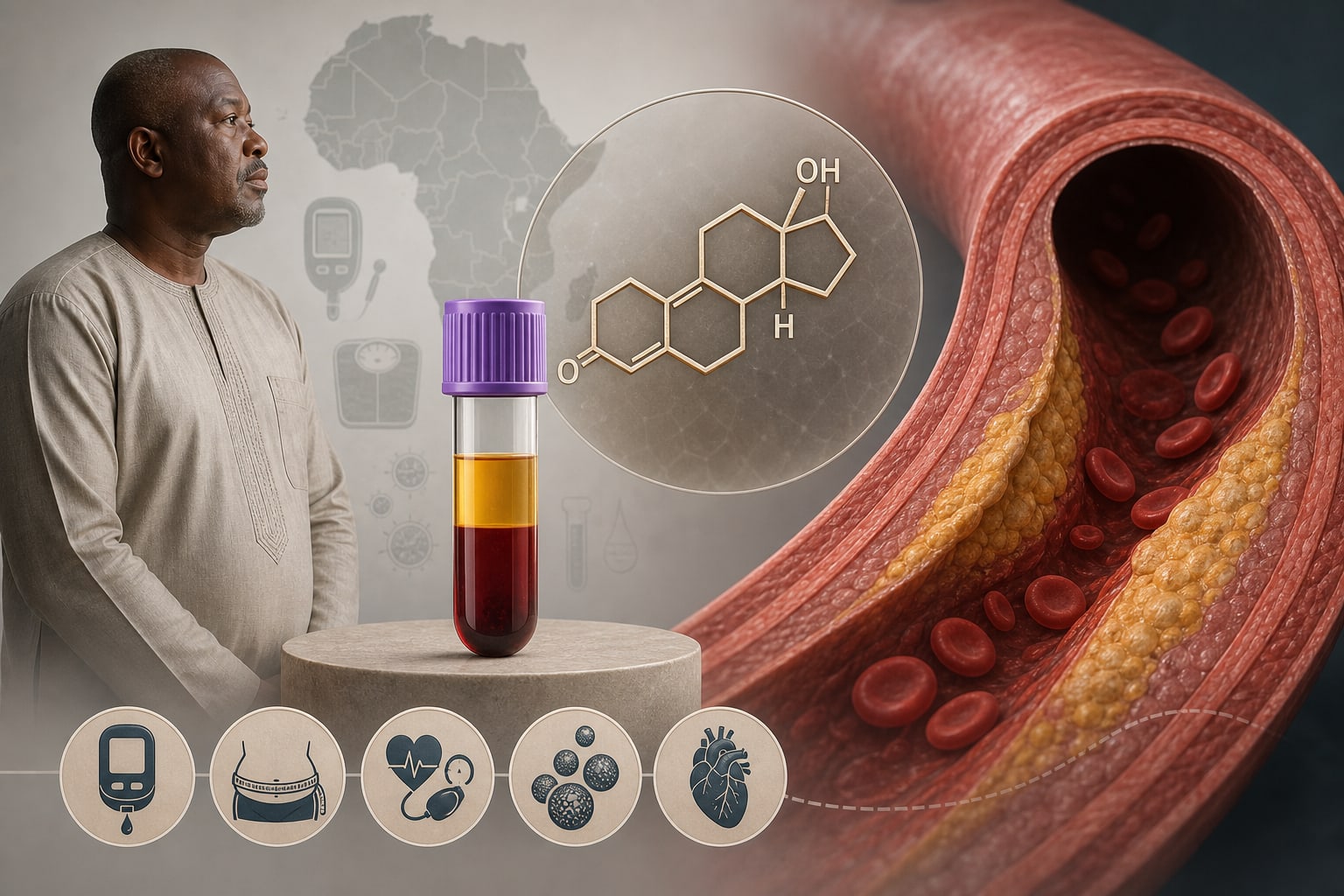
Serum testosterone and cardiometabolic risk in Nigerian men with type 2 diabetes: a cross−sectional study - Report - MDSpire

Serum testosterone and cardiometabolic risk in Nigerian men with type 2 diabetes: a cross−sectional study

  • By

  • Ezekiel Musa

  • Esteban Salazar-Petres

  • Glory Chinuru Musa

  • Fatima Bello

  • Adamu Girei Bakari

  • June 16, 2026

  • 0 min

Share

Clinical Report: Association of Serum Testosterone Levels with Cardiometabolic Risk

Overview

Revise to include source attribution for the statement regarding testosterone levels and ASCVD risk.

Background

Remove unsupported claims about low testosterone and adverse profiles or provide direct sources.

Data Highlights

GroupASCVD 10-Year ScoreBMITotal CholesterolLDL CholesterolHDL Cholesterol
T2DMHigherHigherHigherHigherLower
Non-Diabetic ControlsLowerLowerLowerLowerHigher

Key Findings

  • Men with T2DM had a significantly higher ASCVD 10-year risk score than non-diabetic controls (PT2DM<0.0001).
  • Hypogonadal T2DM men exhibited higher BMI and central obesity compared to non-diabetic men.
  • Hypogonadal T2DM men had elevated total and LDL cholesterol levels and reduced HDL cholesterol levels.
  • Serum testosterone was not independently associated with ASCVD risk score or individual cardiometabolic risk factors in T2DM men.
  • Metabolic risk factors related to T2DM were identified as the primary drivers of cardiovascular risk rather than testosterone levels.

Clinical Implications

Clinicians should be aware that while testosterone deficiency is prevalent among men with T2DM, it may not independently contribute to ASCVD risk after accounting for other metabolic factors. This highlights the importance of addressing the broader cardiometabolic profile in managing patients with T2DM.

Conclusion

The findings suggest that while low testosterone levels correlate with adverse cardiometabolic profiles in men with T2DM, they do not serve as independent predictors of ASCVD risk. Further longitudinal studies are necessary to explore these relationships.

Related Resources & Content

  1. The Journal of Clinical Endocrinology & Metabolism, 2023 -- Impact of Testosterone Therapy on Male Sexual Function: A Secondary Analysis from the T4DM Trial
  2. The Journal of Clinical Endocrinology & Metabolism, 2023 -- The Impact of Natural Testosterone Levels and Supplementation on Cardiovascular Health in Men
  3. The Journal of Clinical Endocrinology & Metabolism, 2023 -- Changes in Aromatase and Estrogen Receptor Expression in Adipose Tissue of Obese Men and Those with Type 2 Diabetes
  4. Nigeria Diabetes Trends & Health Data | IDF Atlas, 2025
  5. The Journal of Clinical Endocrinology & Metabolism — Elevated Testosterone Levels Associated with Increased Risk of Coronary Artery Disease in Males: Insights from Mendelian Randomization and Survival Studies
  6. American Diabetes Association Standards of Care in Diabetes—2026
  7. European Association of Urology Sexual and Reproductive Health Guidelines
  8. Nigeria Diabetes Trends & Health Data | IDF Atlas
  9. MALE HYPOGONADISM
  10. Cardiovascular Safety of Testosterone-Replacement Therapy | New England Journal of Medicine
  11. Cardiovascular Safety of Testosterone-Replacement Therapy - American College of Cardiology
  12. https://cardiab.biomedcentral.com/counter/pdf/10.1186/s12933-025-02930-2.pdf

Original Source(s)

Related Content