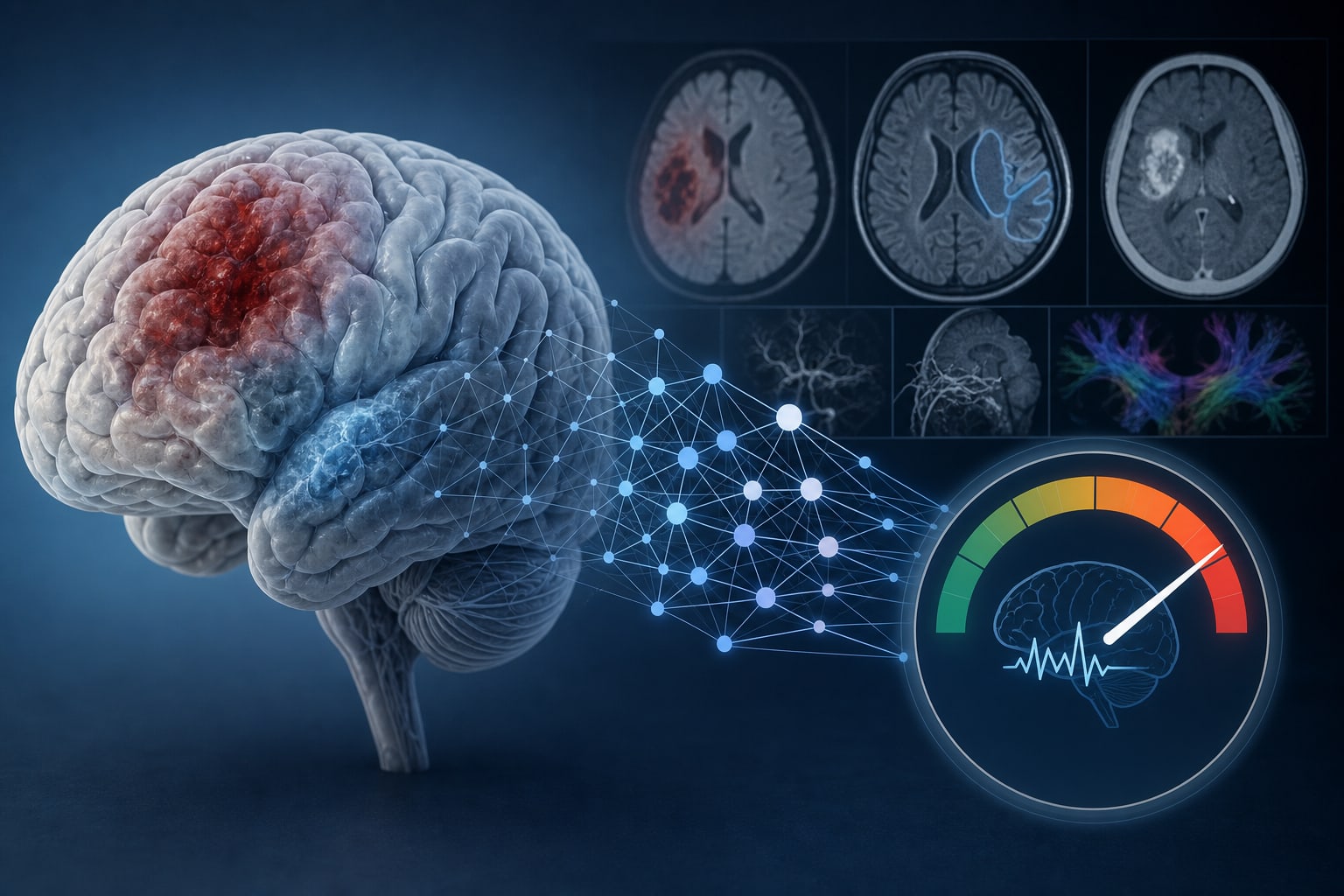
Advancements in Predictive Models for Epilepsy Following Stroke
-
By
-
Hao Chen
-
Lei Ge
-
July 9, 2026
Clinical Report: Advancements in Predictive Models for Epilepsy Following Stroke
Background
Post-stroke epilepsy is a significant complication affecting stroke survivors, with varying incidence rates depending on stroke type. Accurate prediction of PSE is crucial for timely intervention and management. The integration of predictive models, particularly those utilizing machine learning, may enhance risk stratification.
Data Highlights
No numerical or trial data provided in the source material.
Key Findings
- Post-stroke epilepsy affects 2–14% of ischemic stroke survivors and 10–20% of hemorrhagic stroke survivors.
- Predictive models for hemorrhagic stroke include CAVE, CAVS, CAV+, and CAVE2, focusing on lesion characteristics and early seizures.
- For ischemic stroke, models such as SeLECT and PSEiCARe emphasize cortical involvement and early seizure occurrence.
- Machine learning-based approaches have improved predictive accuracy for PSE, although further validation is necessary for clinical application.
- Integration of multimodal data may enhance seizure prediction.
Clinical Implications
Clinicians should consider the application of machine learning approaches to improve risk stratification.
Conclusion
Advancements in predictive modeling for post-stroke epilepsy highlight the importance of risk assessment and intervention.
Related Resources & Content
- Frontiers in Medicine, 2026 -- Clinically oriented dual-tier screening for post-stroke epilepsy with interpretable machine learning in a severely imbalanced cohort
- Brain, 2026 -- Prediction of tissue and clinical thrombectomy outcome in acute ischaemic stroke using deep learning
- JMIR Medical Informatics, 2026 -- Prediction of Early Hospital Admission (≤24 Hours) After Stroke Using Machine Learning and Deep Learning: Multicenter Study From China
- Frontiers in Neurology, 2026 -- Prediction Models for Post-Stroke Delirium: A Systematic Review with an Exploratory Meta-Analysis of Predictors
- European Stroke Organisation guidelines for the management of post-stroke seizures and epilepsy - PMC, 2026
- Risk factors for seizures after intracerebral hemorrhage: Ethnic/Racial Variations of Intracerebral Hemorrhage (ERICH) Study - ScienceDirect, 2026
- Validation of SeLECT score and its modification for predicting unprovoked epileptic seizures in patients after ischemic stroke - PMC, 2026
- European Stroke Organisation guidelines for the management of post-stroke seizures and epilepsy - PMC
- Risk factors for seizures after intracerebral hemorrhage: Ethnic/Racial Variations of Intracerebral Hemorrhage (ERICH) Study - ScienceDirect
- Validation of SeLECT score and its modification for predicting unprovoked epileptic seizures in patients after ischemic stroke - PMC
Based on findings from:
The progress in predictive modeling of post-stroke epilepsy
Hao Chen, Lei Ge. Frontiers In Neurology, 2026.
https://www.frontiersin.org/journals/neurology/articles/10.3389/fneur.2026.1877573/full
This content is an AI-generated, fully rewritten summary based on a published scholarly article. It does not reproduce the original text and is not a substitute for the original publication. Readers are encouraged to consult the source for full context, data, and methodology.