Non-canonical and induced neoantigens as emerging sources of cancer-specific immunotherapy targets - Report - MDSpire

Non-canonical and induced neoantigens as emerging sources of cancer-specific immunotherapy targets

  • By

  • Viacheslav V. Kudriavskii

  • Valeriia A. Koss

  • Victoria O. Shender

  • Georgij P. Arapidi

  • July 2, 2026

  • 0 min

Share

Emerging Sources of Cancer-Specific Immunotherapy Targets: Non-Canonical and Induced Neoantigens

Overview

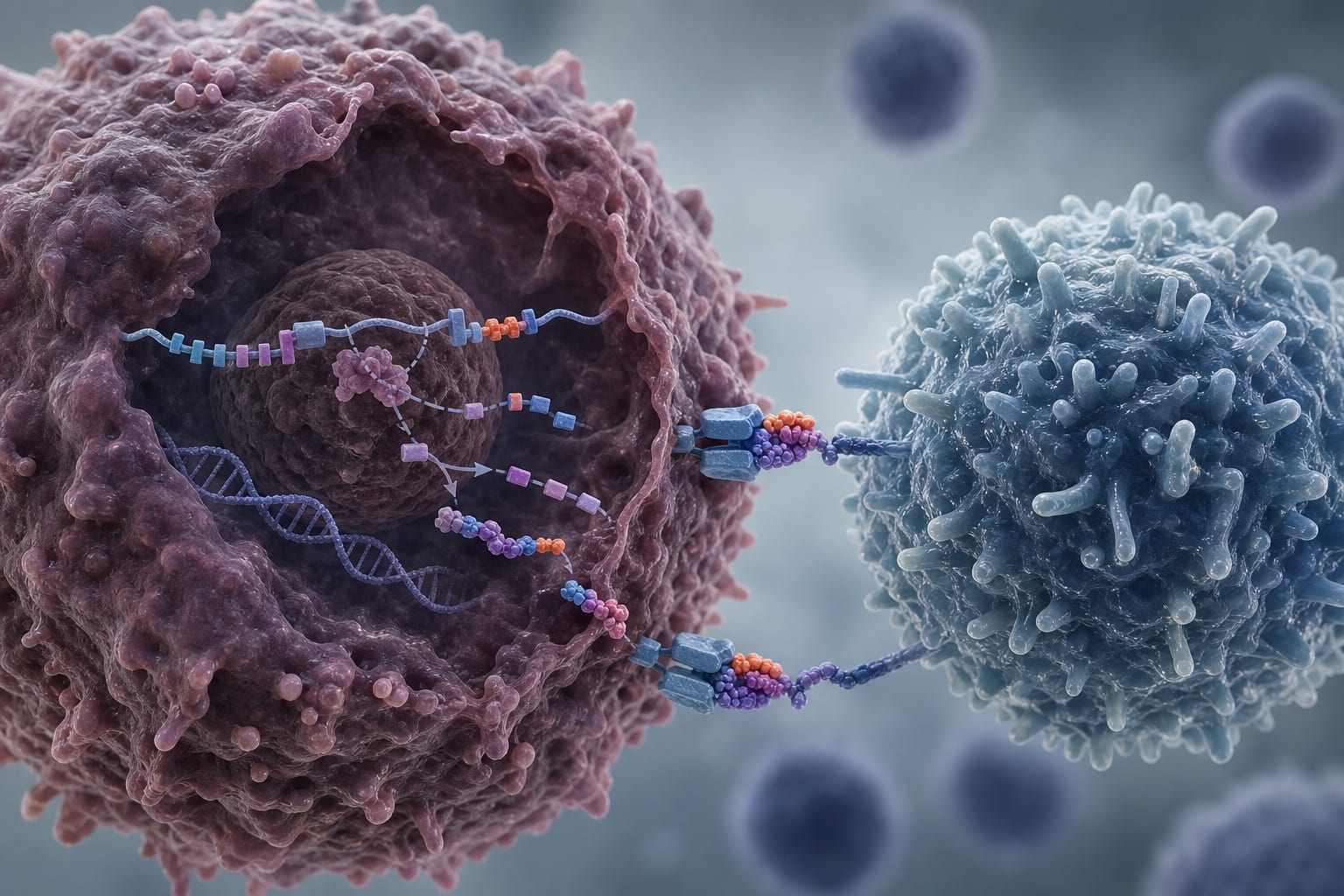
This review discusses the potential of non-canonical and therapy-induced neoantigens as emerging sources of immunotherapy targets.

Background

Immunotherapy has significantly changed cancer treatment paradigms, yet many tumors, especially those with low mutational burden, show limited responses. This review focuses on non-canonical and induced neoantigens as potential sources of immunotherapy targets.

Data Highlights

No numerical data or trial data provided in the source material.

Key Findings

  • Non-canonical neoantigens arise from mechanisms such as alternative splicing and RNA editing.
  • Therapy-induced neoantigens can be generated through splicing modulation and epigenetic drugs.
  • Current immunotherapy strategies primarily focus on mutation-derived neoantigens.
  • Integration of non-canonical and induced neoantigens may enhance antitumor efficacy.
  • Low mutational burden tumors, like glioblastoma, may have emerging targets.

Clinical Implications

Clinicians should consider non-canonical and induced neoantigens in developing immunotherapy strategies for tumors with low mutational loads.

Conclusion

Incorporating non-canonical and therapy-induced neoantigens into immunotherapy frameworks could represent a significant advancement in cancer treatment.

Related Resources & Content

  1. The ASCO Post, 2016 -- Personalized Vaccines May Protect Patients With High-Risk Melanoma
  2. The ASCO Post, 2016 -- Personalized Vaccines May Protect Patients With High-Risk Melanoma Neoantigens in High-Risk Melanoma Related Articles
  3. Advancements in Renal Cell Carcinoma Treatment: Transitioning from Molecular Therapies to Targeted Immunotherapy
  4. Journal of Gastroenterology, 2020 -- Modulating the Immune Environment in Cancers of the Gastrointestinal Tract
  5. Society for Immunotherapy of Cancer (SITC) clinical practice guideline on immunotherapy for the treatment of lung cancer and mesothelioma - PMC
  6. Intismeran Autogene Plus Pembrolizumab Versus Pembrolizumab Alone in High-Risk Resected Melanoma: 5-Year Update of the Randomized Phase 2b KEYNOTE-942 Study | Journal of Clinical Oncology
  7. Nous-209 neoantigen vaccine for cancer prevention in Lynch syndrome carriers: a phase 1b/2 trial
  8. Society for Immunotherapy of Cancer (SITC) clinical practice guideline on immunotherapy for the treatment of lung cancer and mesothelioma - PMC
  9. Intismeran Autogene Plus Pembrolizumab Versus Pembrolizumab Alone in High-Risk Resected Melanoma: 5-Year Update of the Randomized Phase 2b KEYNOTE-942 Study | Journal of Clinical Oncology
  10. Nous-209 neoantigen vaccine for cancer prevention in Lynch syndrome carriers: a phase 1b/2 trial

Original Source(s)

Related Content