Gut microbiota profiling for risk stratification of surgical intervention in preterm infants with necrotizing enterocolitis: a retrospective cohort study - Report - MDSpire
Advertisement
Gut microbiota profiling for risk stratification of surgical intervention in preterm infants with necrotizing enterocolitis: a retrospective cohort study
Clinical Report: Profiling Gut Microbiota to Assess Surgical Risk in Preterm Infants
Overview
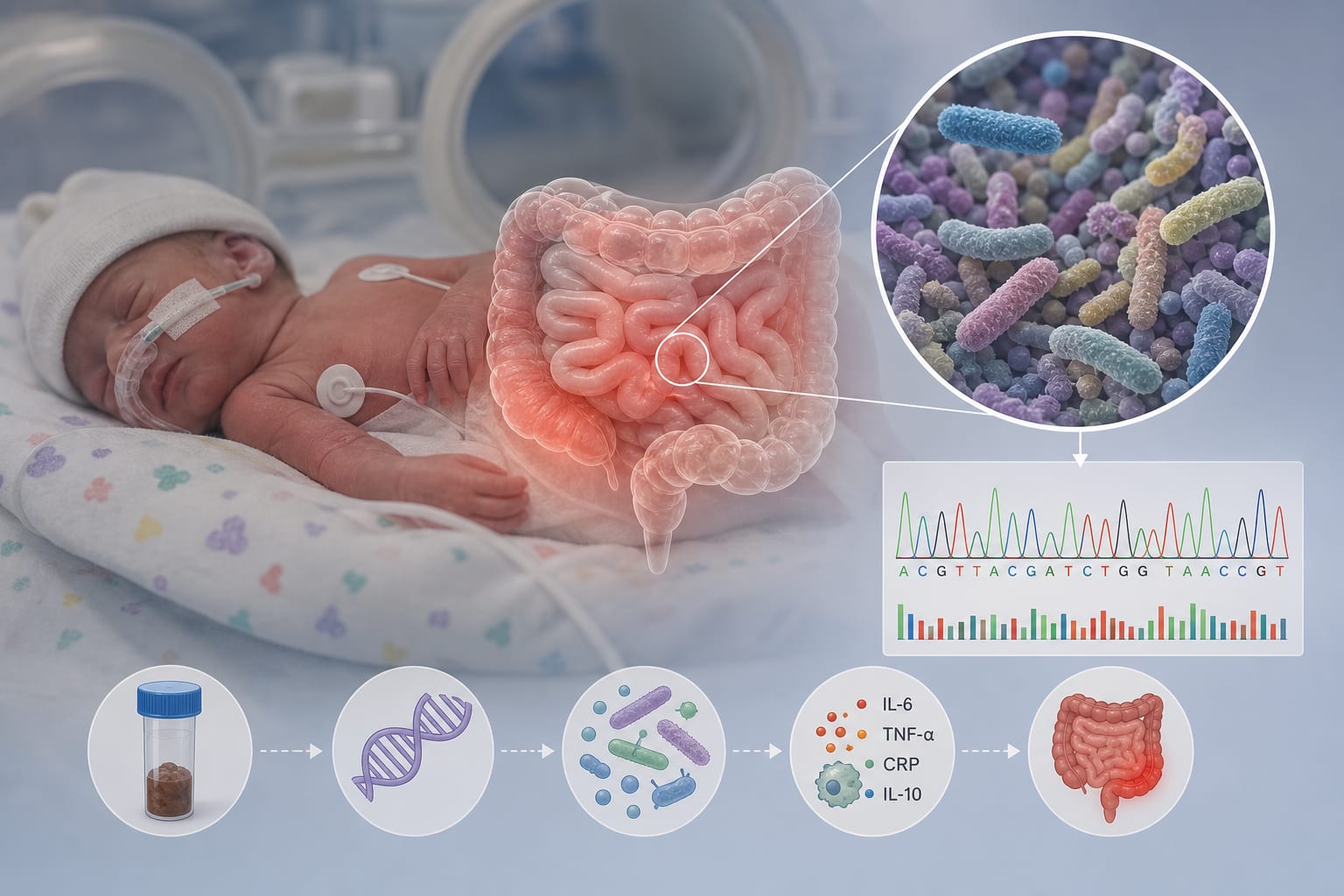
This study investigates the association between gut microbiota characteristics and surgical intervention in preterm infants with necrotizing enterocolitis (NEC).
Background
Necrotizing enterocolitis (NEC) is a critical gastrointestinal emergency in preterm infants, with significant morbidity and mortality. Early identification of infants at risk for surgical intervention is essential for improving outcomes. Current assessment methods may benefit from the inclusion of gut microbiota profiling.
Data Highlights
Group
IL-6
IL-10
CRP
TNF-α
Chao Index
Shannon Index
Surgical
Higher
Higher
Higher
Higher
Lower
Lower
Non-surgical
Lower
Lower
Lower
Lower
Higher
Higher
Control
Lower
Lower
Lower
Lower
Higher
Higher
Key Findings
Infants in the surgical group had a younger postnatal age at NEC diagnosis and a higher proportion of Bell stage III disease.
Significantly higher levels of inflammatory markers (IL-6, IL-10, CRP, TNF-α) were observed in the surgical group compared to non-surgical and control groups.
The surgical group exhibited lower microbial diversity, indicated by reduced Chao and Shannon indices.
Specific taxa such as Bifidobacterium and Firmicutes were inversely associated with surgical intervention, while Proteobacteria and Clostridium were positively associated.
A combined microbiota-based model achieved an AUC of 0.904 for distinguishing surgical from non-surgical NEC.
Clinical Implications
Gut microbiota profiling may serve as a tool for assessing surgical risk in preterm infants with NEC.
Conclusion
Gut microbiota dysbiosis is associated with surgical intervention status in preterm infants with NEC.