Association between the HALP score and survival of patients with esophageal or gastro-esophageal junction cancer: a meta-analysis - Report - MDSpire

Association between the HALP score and survival of patients with esophageal or gastro-esophageal junction cancer: a meta-analysis

  • By

  • Wu Wang

  • Junhai Chen

  • Tianbao Yang

  • June 23, 2026

  • 0 min

Share

Clinical Report: Evaluating the Relationship Between HALP Scores and Survival Outcomes

Overview

This meta-analysis investigates the prognostic significance of initial HALP scores in patients with esophageal cancer (EC) and gastro-esophageal junction cancer (GEC).

Background

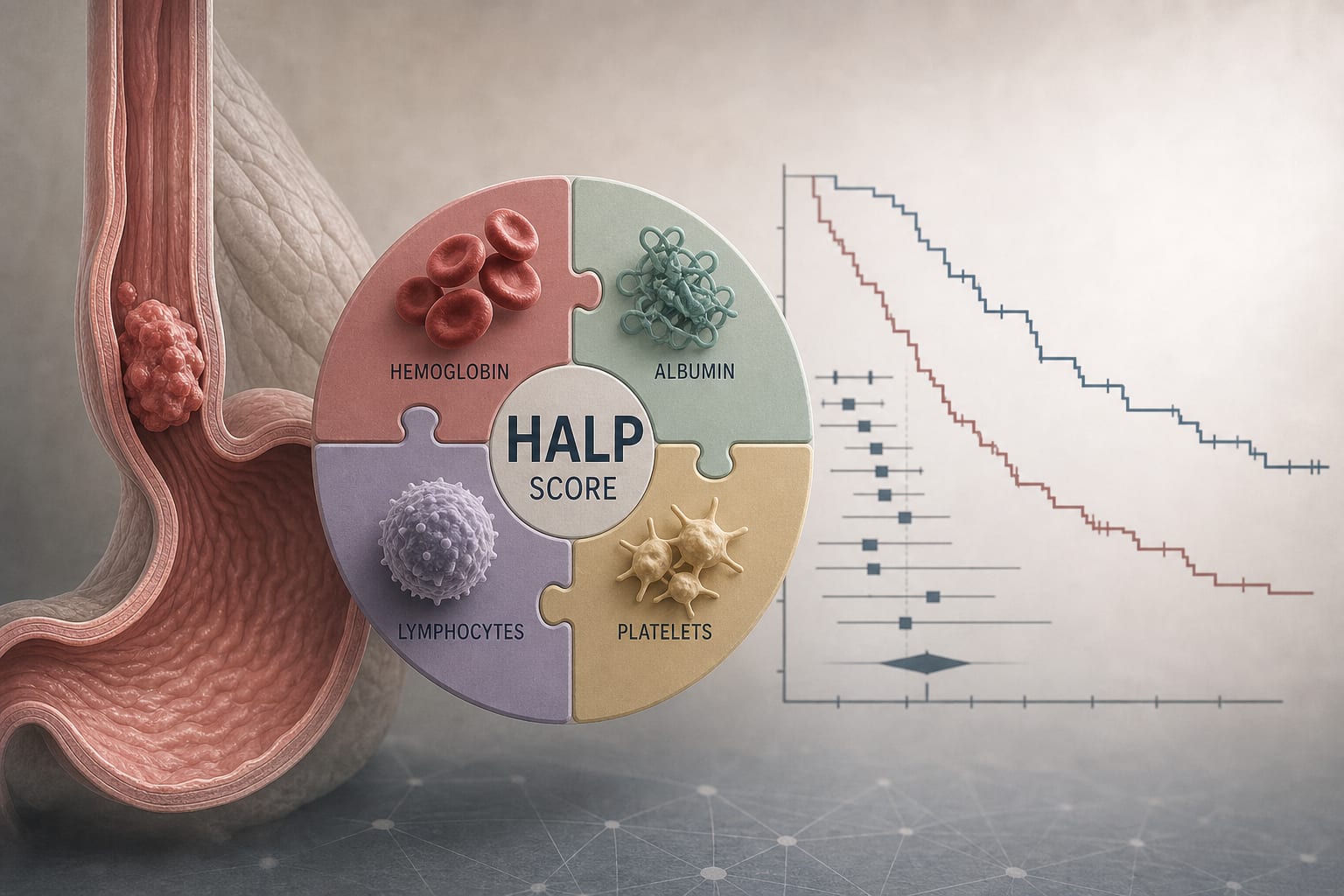
Esophageal cancer and gastro-esophageal junction cancer are among the most aggressive gastrointestinal cancers, with low long-term survival rates despite advancements in treatment. Traditional staging systems often fail to reflect biological variances, prompting the need for reliable prognostic biomarkers. The HALP score, which incorporates hemoglobin, albumin, lymphocyte, and platelet levels, may serve as a valuable tool for predicting patient outcomes.

Data Highlights

OutcomeHazard Ratio (HR)95% Confidence Interval (CI)
Overall Survival1.741.53-1.98
Progression-Free Survival1.821.40-2.37

Key Findings

  • Low HALP scores correlate with inferior overall survival in EC and GEC patients.
  • Patients with low HALP scores have a hazard ratio of 1.74 for overall survival compared to those with high scores.
  • Low HALP scores are associated with diminished progression-free survival, with a hazard ratio of 1.82.
  • The relationship between HALP scores and survival outcomes is consistent across various subgroups.
  • The analysis included data from ten cohort studies involving 1,953 patients.

Clinical Implications

The HALP score may be a useful prognostic tool for clinicians managing patients with esophageal and gastro-esophageal junction cancers.

Conclusion

Reduced baseline HALP scores are correlated with inferior OS and PFS in EC or GEC patients.
Related Resources & Content

  1. Frontiers in Oncology, 2026 -- Preoperative HALP and LMR predict disease-free survival in stage III colon cancer and enable nomogram-based risk stratification
  2. Updates in Surgery, 2024 -- Influence of Postoperative Pulmonary Issues After Esophagectomy on Long-Term Survival: A Multivariate Meta-Analysis and Evaluation of Restricted Mean Survival Time
  3. Updates in Surgery, 2023 -- The complexity of laparoscopic hepatectomy in hepatocellular carcinoma is linked to long-term patient outcomes
  4. Gastric Cancer, 2017 -- Quality of Life Outcomes Following Gastrectomy, Esophagectomy, and Esophagogastrectomy in Patients with Gastroesophageal Junction Adenocarcinoma
  5. ESMO Clinical Practice Guideline interim update on the treatment of locally advanced oesophageal and oesophagogastric junction adenocarcinoma and metastatic squamous-cell carcinoma - PMC
  6. Frontiers, 2026 -- Association between the HALP score and survival of patients with esophageal or gastro-esophageal junction cancer: A meta-analysis
  7. The ASCO Post, 2026 -- New First-Line Targeted Therapy Recommendations Among Updated ASCO Guidance on Gastroesophageal Cancer Management
  8. ESMO Clinical Practice Guideline interim update on the treatment of locally advanced oesophageal and oesophagogastric junction adenocarcinoma and metastatic squamous-cell carcinoma - PMC
  9. Frontiers | Association between the HALP score and survival of patients with esophageal or gastro-esophageal junction cancer: A meta-analysis
  10. New First-Line Targeted Therapy Recommendations Among Updated ASCO Guidance on Gastroesophageal Cancer Management - The ASCO Post

Original Source(s)

Related Content