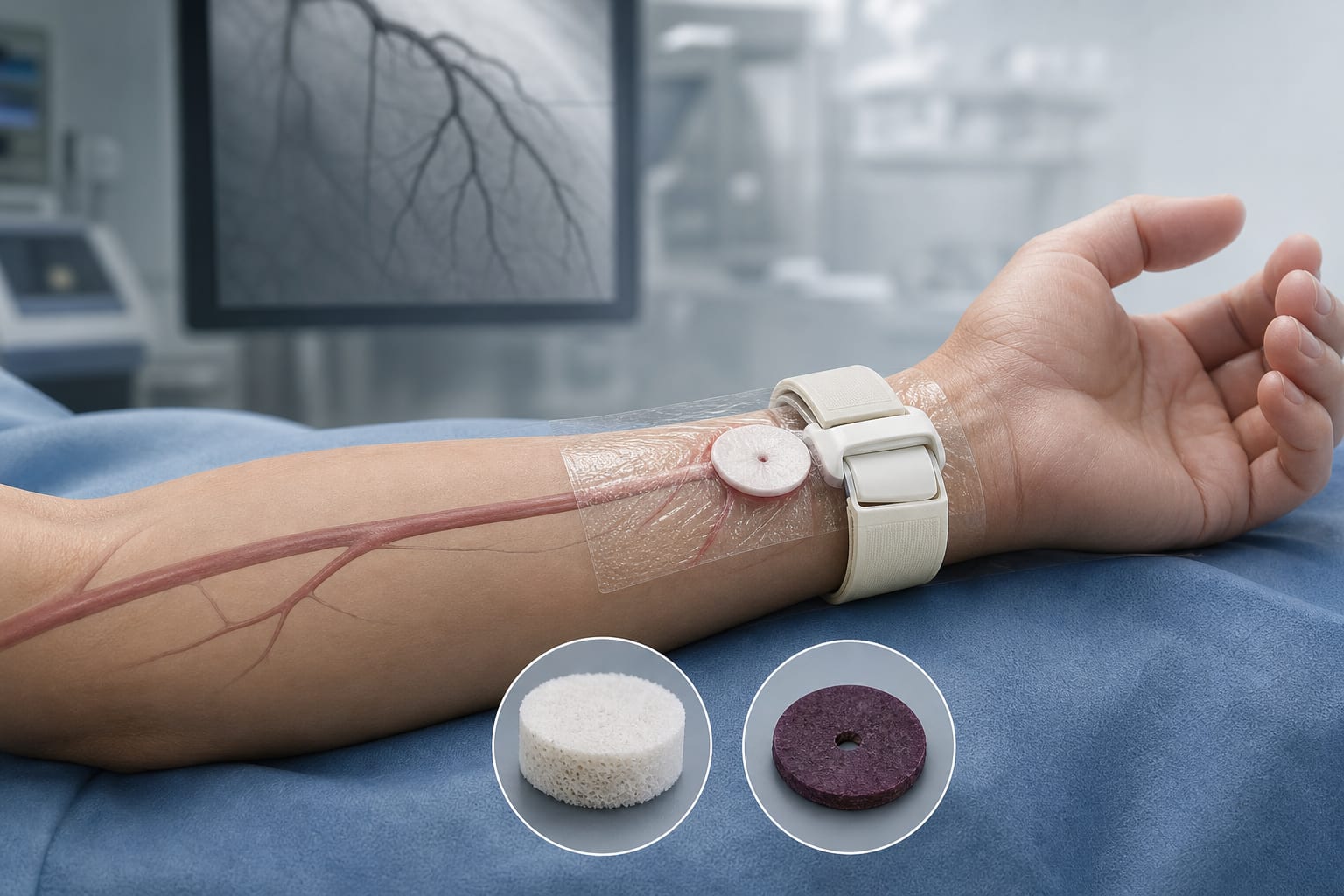
Clinical Report: Evaluation of Non-Compressible Dressings for Radial Artery Haemostasis
Overview
The RAPHE trial assessed the safety and efficacy of two novel non-compression haemostasis devices compared to a standard pneumatic device. Results indicated that these novel devices could achieve comparable outcomes with reduced compression times, suggesting a potential shift in post-TRA management protocols.
Background
Transradial access (TRA) has become the preferred method for coronary procedures due to its advantages over femoral access, including reduced bleeding and lower mortality rates. However, complications such as radial artery occlusion (RAO) remain a concern, necessitating effective haemostasis strategies. The RAPHE trial investigates innovative haemostasis devices that could simplify post-procedural care while maintaining safety.
Data Highlights
No numerical data provided in the article.
Key Findings
The RAPHE trial compared a chitosan sponge dressing and a potassium ferrate-based disc against a pneumatic balloon MCD.
Both novel devices demonstrated non-inferiority in safety and efficacy compared to the standard MCD.
Utilization of the novel devices resulted in significantly shorter compression times.
Facilitated haemostasis may allow for a more permissive protocol without increasing complication rates.
The trial was conducted in high-volume tertiary centers, enhancing the generalizability of the findings.
Clinical Implications
The findings from the RAPHE trial suggest that healthcare providers may consider adopting non-compression haemostasis devices to streamline post-TRA management. This could lead to reduced resource utilization while maintaining patient safety and efficacy in haemostasis.
Conclusion
The RAPHE trial supports the use of novel haemostasis devices as effective alternatives to traditional methods, potentially transforming post-procedural care in transradial access procedures.
by Péter Márton Kulyassa, Balázs Tamás Németh, Zoltán Ruzsa, Tibor Szűk, Réka Ehrenberger, Brúnó Balázs, Kornél Manó Kákonyi, Dávid Becker, Béla Péter Merkely, István Ferenc Édes
National survey findings suggest many US adults report making health decisions based on social media despite widespread concerns about the accuracy of health information shared to the platforms.