Multidisciplinary team care and outcomes in FNCLCC grade 3 soft tissue sarcoma: a propensity score–matched and weighted cohort study - Report - MDSpire
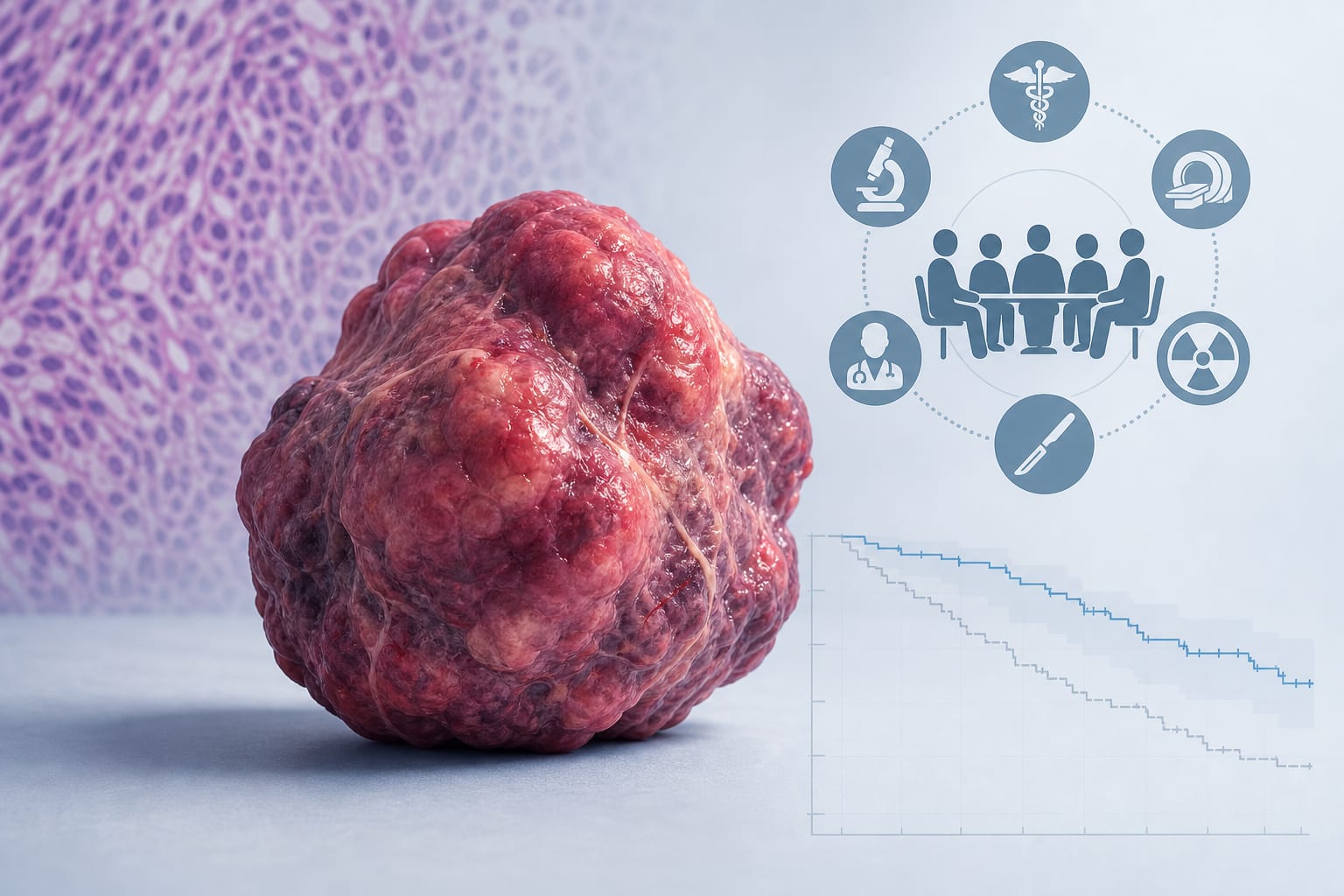
Outcomes of FNCLCC Grade 3 Soft Tissue Sarcoma with MDT Management
Overview
This study evaluates the impact of multidisciplinary team (MDT) care on outcomes in patients with FNCLCC grade 3 soft tissue sarcoma (STS). Results indicate that MDT care is associated with significantly lower rates of local recurrence at three years, although no significant difference in distant metastasis was observed.
Background
Soft tissue sarcomas (STS) are rare malignancies with a high risk of local recurrence and metastasis, particularly in high-grade cases. The FNCLCC grading system is crucial for prognostic stratification, and multidisciplinary team (MDT) management is recommended to optimize treatment outcomes. Understanding the effectiveness of MDT care in high-grade STS is essential for improving patient prognosis and treatment strategies.
Data Highlights
Outcome
MDT Care
Non-MDT Care
P-value
3-Year Local Recurrence
6.8%
21.2%
0.002
3-Year Distant Metastasis
Not significantly different
Not significantly different
0.643
Key Findings
MDT care resulted in a 6.8% local recurrence rate compared to 21.2% in non-MDT care.
The odds ratio for local recurrence with MDT care was 0.272 (P = 0.002).
After propensity score matching, the paired odds ratio for local recurrence was 0.259 (P = 0.021).
No significant difference in 3-year distant metastasis rates was found between MDT and non-MDT groups (weighted OR = 0.846, P = 0.643).
MDT care is associated with improved local control in high-grade STS.
Clinical Implications
The findings suggest that implementing MDT care for patients with FNCLCC grade 3 STS may significantly reduce local recurrence rates. Clinicians should consider MDT approaches in treatment planning to enhance patient outcomes, particularly in high-risk sarcoma cases.
Conclusion
Reiterate the importance of MDT care in the context of overall patient management.