Abnormal Cardiac Magnetic Resonance Imaging Mapping Parameters in Pediatric Heart Transplant Patients with Elevated Donor-Derived Cell Free DNA - Report - MDSpire

Abnormal Cardiac Magnetic Resonance Imaging Mapping Parameters in Pediatric Heart Transplant Patients with Elevated Donor-Derived Cell Free DNA

  • By

  • Kae Watanabe

  • Defne A. Magnetta

  • Christina Laternser

  • Alona Birjiniuk

  • Joshua D. Robinson

  • Cynthia K. Rigsby

  • Nazia Husain

  • July 9, 2026

  • 0 min

Share

Altered Cardiac MRI Mapping Metrics in Pediatric Heart Transplant Recipients

Overview

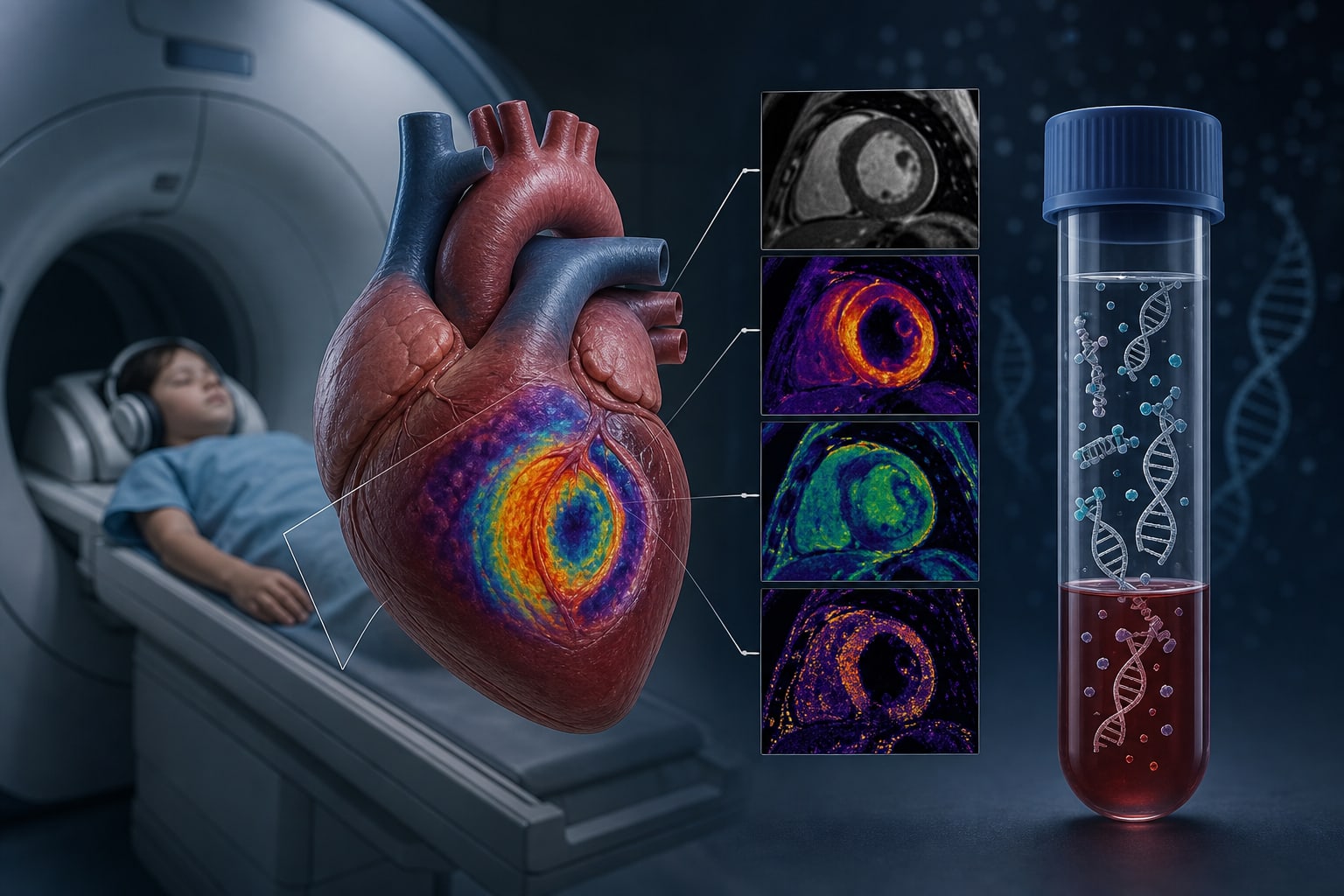
This study investigates the relationship between multiparametric cardiac magnetic resonance imaging (CMR) and donor-derived cell-free DNA (ddcfDNA) levels in pediatric heart transplant recipients.

Background

Heart transplantation is the standard treatment for end-stage heart failure in children, yet rejection remains a significant concern. Traditional methods like endomyocardial biopsy have limitations, prompting the exploration of non-invasive techniques such as ddcfDNA and CMR.

Data Highlights

No numerical data or trial data was provided in the source material.

Key Findings

  • Heart transplant is the gold standard for pediatric end-stage heart failure.
  • ddcfDNA testing has gained traction as a non-invasive method for rejection surveillance.
  • CMR allows for comprehensive tissue characterization of the myocardium.
  • Utilization of CMR is increasing as part of routine surveillance in pediatric heart transplant patients.
  • High levels of ddcfDNA may correlate with altered CMR metrics.

Clinical Implications

The findings suggest that integrating CMR with ddcfDNA testing could provide a more comprehensive approach to monitoring graft health in pediatric heart transplant recipients. This may reduce reliance on invasive procedures while improving detection of graft injury.

Conclusion

The study underscores the potential of combining CMR and ddcfDNA testing for enhanced surveillance of rejection in pediatric heart transplant recipients, warranting further research in this area.

Related Resources & Content

  1. Pediatric Cardiology, 2017 -- Altered Myocardial Function Post Pediatric Heart Transplantation Assessed by Cardiac MRI
  2. European Radiology, 2023 -- Assessment of Perivascular Fat Density via Coronary CT Angiography in Heart Transplant Recipients: A Potential Imaging Biomarker for Predicting Cardiac Mortality and Need for Re-Transplantation
  3. the pathologist, 2026 -- Earlier Detection of Organ Rejection
  4. ISHLT Guidelines, 2022 -- The International Society for Heart and Lung Transplantation guidelines for the care of heart transplant recipients
  5. ISHLT Consensus Summary, 2025 -- Summary of the International Society for Heart and Lung Transplantation consensus conference on emerging understanding of antibodies and antibody-mediated rejection in heart transplantation
  6. Pediatric Cardiology — Longitudinal Myocardial Strain Fails to Predict Ejection Fraction in Children with Total Cavopulmonary Connection as Evaluated by Cardiac MRI
  7. The International Society for Heart and Lung Transplantation (ISHLT) guidelines for the care of heart transplant recipients
  8. Summary of the International Society for Heart and Lung Transplantation consensus conference on emerging understanding of antibodies and antibody-mediated rejection in heart transplantation
  9. Donor–derived cell–free dna as a diagnostic biomarker for acute rejection in heart transplantation: A systematic review and meta–analysis - ScienceDirect
  10. Absolute quantification of donor-derived cell-free DNA following pediatric and adult heart transplantation - ScienceDirect
  11. Multiparametric cardiovascular magnetic resonance is associated with outcomes in pediatric heart transplant recipients - ScienceDirect
  12. Diagnostic Performance of Native T1, T2, and Extracellular Volume Mapping for Cardiac Allograft Rejection | JACC: Heart Failure
  13. Cardiac magnetic resonance in heart transplant recipients: histological, clinical and cell-free DNA validation - PubMed
  14. Frontiers | Diagnostic approach to elevated dd-cfDNA with reassuring EMB in heart transplantation

Original Source(s)

Related Content