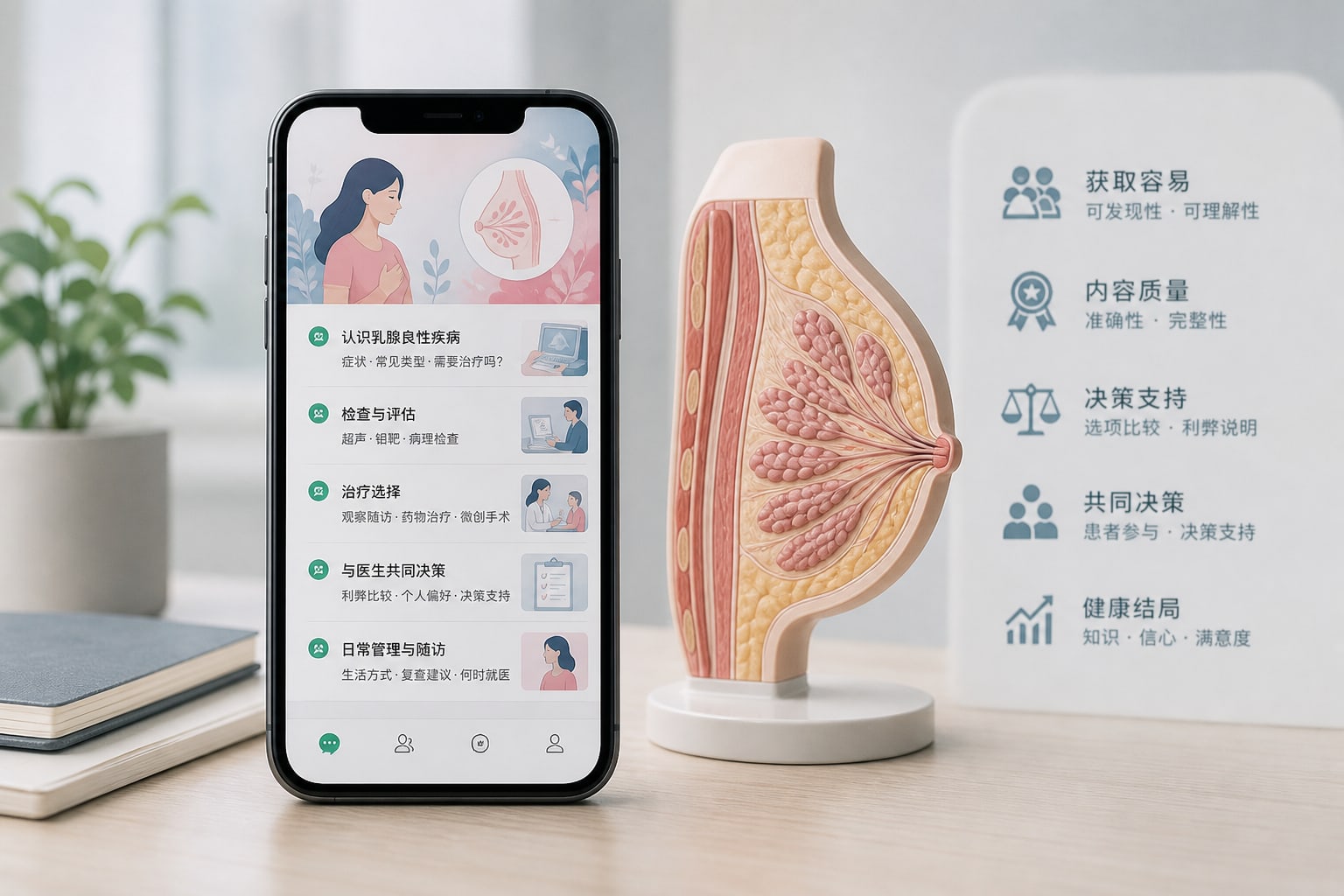
Accessibility and Decision-Supportive Quality of Benign Breast Disease Articles on Chinese Hospital WeChat Public Accounts: Nationwide Cross-Sectional Study - Report - MDSpire
Clinical Report: Accessibility and Decision-Support Quality of BBD Content on WeChat
Overview
The supplied article context describes a nationwide cross-sectional study examining accessibility and decision-support quality of benign breast disease (BBD) content on Chinese hospital WeChat accounts. The provided material does not include the study’s methods, sample size, numerical results, or conclusions, so findings about account performance cannot be reported.
Background
BBD accounts for an estimated 55% to 90% of breast lesions, and subsequent breast cancer risk varies with epithelial proliferation and atypia. Unlike malignancy, BBD does not have uniform evidence-based management protocols, and care may involve surveillance, biopsy, surgery, or follow-up. The source describes shared decision-making as important when choices depend on individual risk and patient preferences, while noting that decision aids can be difficult to incorporate into routine care, particularly in resource-constrained settings. Telemedicine is identified as a means of supporting interactive decision-making.
Data Highlights
The supplied article excerpt contains no study-specific numerical results, sample characteristics, or measures of accessibility or decision-support quality. It reports background estimates that BBD comprises 55% to 90% of breast lesions.
Key Findings
The article is identified as a nationwide cross-sectional study of BBD content on Chinese hospital WeChat accounts.
The supplied excerpt does not report the study’s sample size, assessment methods, or results; no account-level quality findings can therefore be summarized.
BBD represents an estimated 55% to 90% of breast lesions, according to the cited background literature.
Breast cancer risk after BBD varies according to epithelial proliferation and atypia.
The source describes BBD management as potentially involving surveillance, biopsy, surgery, or follow-up, with individualized approaches in the absence of uniform evidence-based protocols.
The source cites professional guidance recommending shared decision-making for relevant breast lesion management; it also notes that integrating patient decision aids into routine clinical workflows remains a challenge.
Clinical Implications
The supplied material supports the relevance of accessible, decision-supportive BBD information, but it does not provide results that establish the quality or adequacy of WeChat content. Clinical decisions should be framed around the individual lesion, risk, and patient preferences, consistent with the shared decision-making context described in the source.
Conclusion
The excerpt establishes the clinical rationale for evaluating BBD information on hospital WeChat accounts but does not provide the study’s findings. Conclusions about accessibility or decision-support quality require the full study results.
Related Resources & Content
Codd R, Gateley CA, Surgery (Oxford), 2007 -- Management of benign disease of the breast
Rao R et al, Annals of Surgical Oncology, 2018 -- Select choices in benign breast disease: an initiative of the American Society of Breast Surgeons for the American Board of Internal Medicine Choosing Wisely Campaign
Rubio IT et al, European Journal of Surgical Oncology, 2024 -- European guidelines for the diagnosis, treatment and follow-up of breast lesions with uncertain malignant potential (B3 lesions)
Bussey LG, Sillence E, DIGITAL HEALTH, 2019 -- The role of internet resources in health decision-making: a qualitative study
Coronary artery disease develops when plaque accumulates within the arteries that supply blood to the heart muscle. Genetics can play an important role, while smoking, diabetes, uncontrolled high blood pressure, inactivity, poor diet and other factors can accelerate the process.
Breast cancer management is becoming increasingly biology-driven, with treatment decisions extending well beyond anatomic stage and conventional receptor classification.