Adjunctive role of p16/Ki-67 dual-stain cytology in colposcopy referral pathways for cervical precancer and persistent high-risk HPV infection - Report - MDSpire

Adjunctive role of p16/Ki-67 dual-stain cytology in colposcopy referral pathways for cervical precancer and persistent high-risk HPV infection

  • By

  • Yingying Yue

  • Xuewang Guo

  • Yu Dou

  • Xiaowen Wu

  • Weina Yang

  • Yanying Xu

  • July 13, 2026

Share

Clinical Report: The Complementary Role of p16/Ki-67 Dual-Stain Cytology

Overview

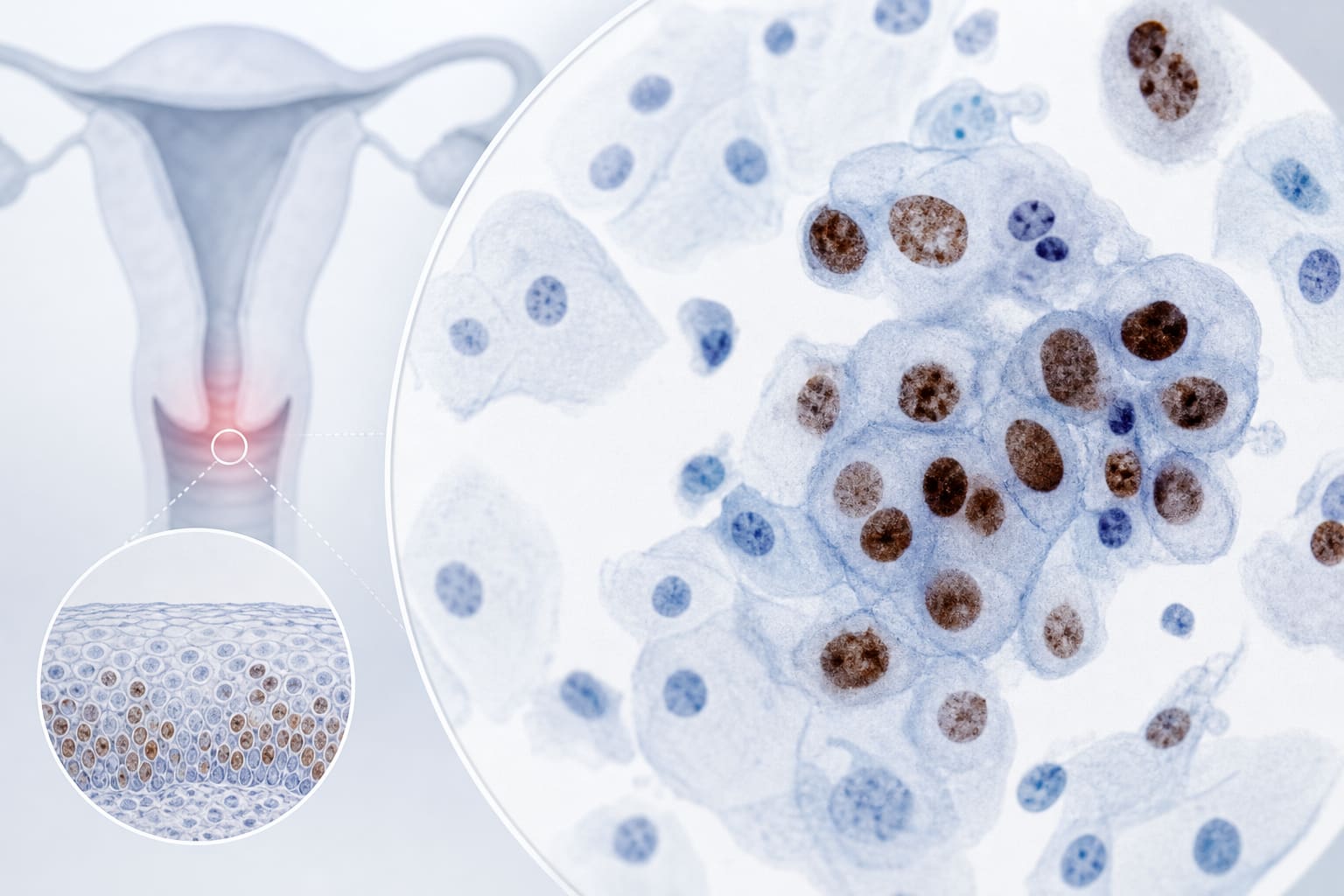
This study evaluates the effectiveness of p16/Ki-67 dual-stain cytology in triaging cervical lesions in a colposcopy-referred cohort. It demonstrates significant correlations with lesion severity and predictive value for persistent high-risk HPV infection.

Background

Cervical cancer remains a major health concern, particularly in developing countries where screening coverage is low. Accurate stratification of cervical lesions is crucial to prevent overtreatment and missed diagnoses. Current screening methods have limitations.

Data Highlights

MeasureCIN2+CIN3+
Sensitivity77.8%93.3%
Specificity88.6%81.3%
Accuracy84.4%81.7%
AUC0.822 ± 0.0520.823 ± 0.056

Key Findings

  • The positivity rate of p16/Ki-67 DS cytology increased with cervical lesion severity (P<0.001).
  • For CIN2+, sensitivity was 77.8% and specificity was 88.6%.
  • For CIN3+, sensitivity was 93.3% and specificity was 81.3%.
  • Among HR-HPV-positive CIN1/lower lesions, 87.1% of DS-positive patients had persistent infection compared to 62.9% of DS-negative patients (P = 0.025).
  • The odds ratio for persistent infection in DS-positive patients was 4.515 (P = 0.028).

Clinical Implications

The findings indicate that p16/Ki-67 dual-stain cytology may enhance the triage process for cervical lesions in patients referred for colposcopy.

Conclusion

p16/Ki-67 dual-stain cytology requires further prospective validation for clinical applications.

Related Resources & Content

  1. Archives of Gynecology and Obstetrics, 2026 -- The predictive role of Ki67 in pathological complete response (pCR) and invasive disease-free survival (IDFS) in HER2-positive breast cancer: a bi-centric retrospective cohort study of 244 cases
  2. Frontiers in Oncology -- Peripheral Immune Cell Profiles and Tumor Marker Expression in High-Risk HPV-Infected Cervical Lesions: A Comparative Study
  3. The ASCO Post -- Early-Stage Cervical Cancer: Defining Follow-up After Fertility-Sparing Surgery
  4. Recommendations on dual-stain cytology to triage women after a positive HPV nucleic acid test (NAT) result - WHO guideline for screening and treatment of cervical pre-cancer lesions for cervical cancer prevention - NCBI Bookshelf
  5. The ASCO Post — HPV Screening Intervals for Cervical Cancer May Be Safely Extended Beyond Current 5-Year Recommendation, Study Finds
  6. New Cervical Cancer Screening Guidelines Strengthen Women’s Preventive Health | HRSA
  7. Premarket Approval (PMA)
  8. Recommendations on dual-stain cytology to triage women after a positive HPV nucleic acid test (NAT) result - WHO guideline for screening and treatment of cervical pre-cancer lesions for cervical cancer prevention - NCBI Bookshelf
  9. Recommendations for Use of p16/Ki67 Dual Stain for Management of Individuals Testing Positive for Human Papillomavirus - PMC
  10. :: JGO :: Journal of Gynecologic Oncology
  11. Italian guidelines for cervical cancer screening. Multisocietal recommendations on the use of biomarkers in HPV screening with risk-based approach and GRADE methodology | British Journal of Cancer
  12. Frontiers | Adjunctive Role of p16/Ki-67 Dual-Stain Cytology in Colposcopy Referral Pathways for Cervical Precancer and Persistent High-Risk HPV Infection
  13. Colposcopy Standards: Guidelines for Endocervical Curettage at Colposcopy - PMC

Original Source(s)

Related Content