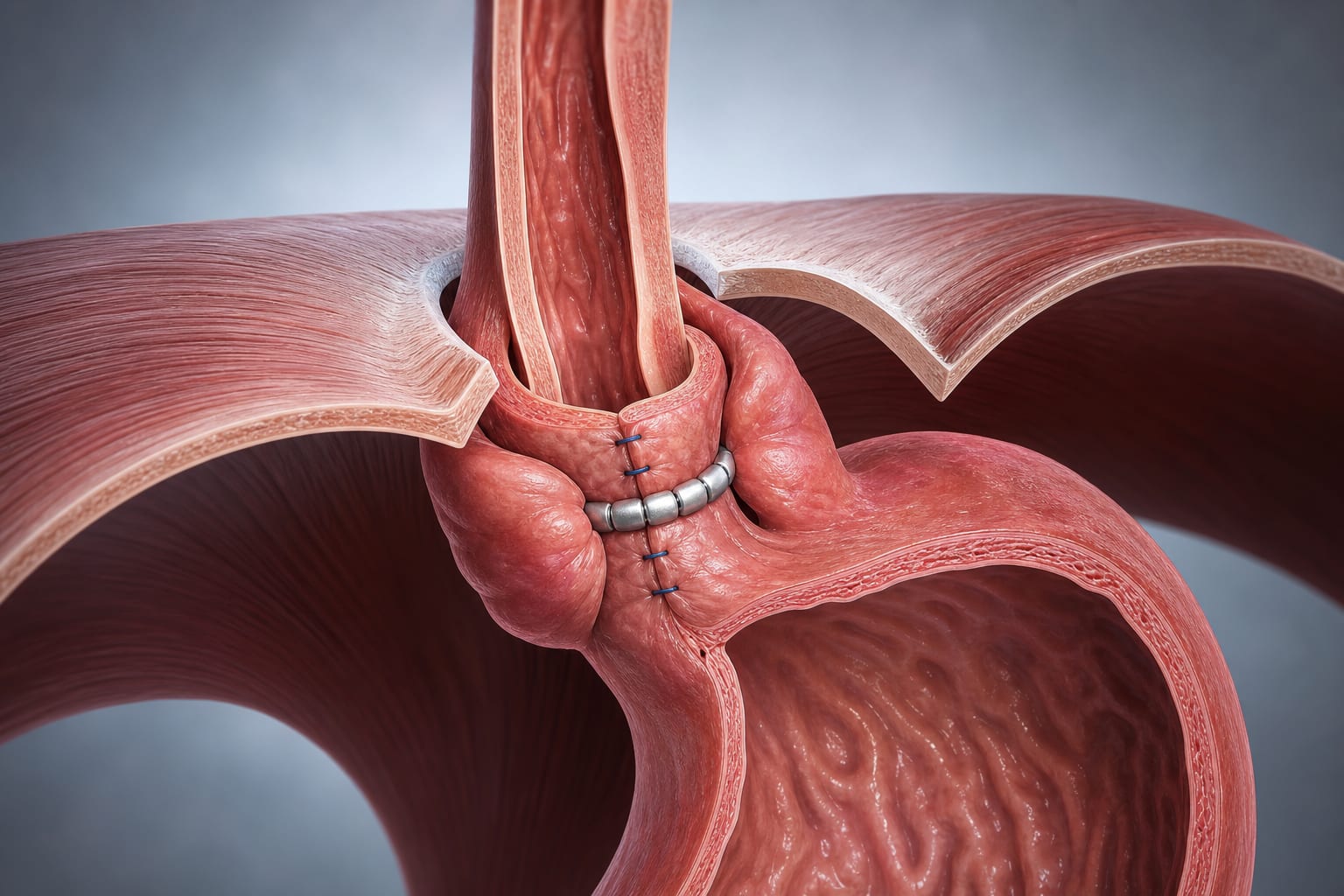
Clinical Report: Magnetic Sphincter Augmentation for GERD Post-Sleeve Gastrectomy
Overview
Magnetic sphincter augmentation (MSA) shows promise as a safe and effective treatment for gastroesophageal reflux disease (GERD) following laparoscopic sleeve gastrectomy (LSG). A systematic review of 14 studies involving 109 patients demonstrated symptom improvement and reduced proton pump inhibitor (PPI) use, with a low incidence of adverse events.
Background
GERD is a common and challenging complication after LSG, with up to 23% of patients developing new reflux symptoms postoperatively. Anatomical changes from LSG often result in a reflux phenotype resistant to medical therapy. While Roux-en-Y gastric bypass is a common surgical conversion, many patients decline due to its invasiveness. MSA, using the LINX™ device, is an emerging alternative for managing post-LSG GERD but lacks routine approval in bariatric populations.
Data Highlights
Parameter
Value
Number of studies included
14
Total patients
109
Study types
7 case reports, 5 retrospective, 2 prospective observational
Geographic distribution
96.3% USA
De novo GERD incidence post-LSG
Up to 23%
Esophagitis incidence post-LSG
Up to 30%
Barrett’s esophagus incidence post-LSG
Up to 6%
Key Findings
MSA implantation after LSG is feasible and generally safe with a low rate of serious adverse events.
Patients experienced significant reduction in GERD symptoms and decreased reliance on PPIs post-MSA.
MSA addresses the regurgitation-dominant GERD phenotype often seen after LSG, which is less responsive to medical therapy.
High patient refusal rates for conversion to Roux-en-Y gastric bypass highlight the need for less invasive alternatives like MSA.
Most evidence derives from small observational studies and case reports, predominantly from the USA.
Further large-scale, controlled studies are needed to establish long-term efficacy and safety of MSA in this population.
Clinical Implications
MSA offers a promising minimally invasive option for managing GERD in patients post-LSG, especially for those unwilling to undergo conversion to Roux-en-Y gastric bypass. Clinicians should consider MSA for patients with refractory reflux symptoms and anatomical alterations after sleeve gastrectomy. Careful patient selection and counseling regarding the current evidence base are essential.
Conclusion
Magnetic sphincter augmentation appears to be a safe and effective therapeutic alternative for GERD following sleeve gastrectomy, with encouraging early outcomes. However, further high-quality research is required to confirm its role in routine clinical practice.
References
Yeung et al. 2024 -- Meta-analysis on GERD incidence post-LSG
by Francesco Cammarata, Martina Novia, Alberto Aiolfi, Riccardo Damiani, Michele Manara, Alessandro Giovanelli, Rossana Daniela Berta, Marco Anselmino, Cristina Ogliari, Davide Bona, Luigi Bonavina