A computational pipeline for a neurotransmitter-centric analysis of the effects of psychiatric medication on EEG spectral power - Report - MDSpire

A computational pipeline for a neurotransmitter-centric analysis of the effects of psychiatric medication on EEG spectral power

  • By

  • Samar Samy Zekerallah

  • Anna Alexandra Maxion

  • Jana Zweerings

  • Paula Teucher

  • Klaus Mathiak

  • Ekaterina Kutafina

  • Arnim Johannes Gaebler

  • June 19, 2026

  • 0 min

Share

Clinical Report: A Neurotransmitter-Focused Computational Approach to Analyze the Impact of Psychiatric Medications on EEG Spectral Power

Overview

This study investigates the effects of psychotropic medications on EEG spectral power by modeling changes according to neurotransmitter systems. Findings reveal distinct EEG patterns associated with various neurotransmitter receptor engagements, enhancing the understanding of psychotropic drug effects in clinical populations.

Background

Understanding the effects of psychotropic medications on brain activity is crucial for improving psychiatric care and developing biomarkers. Traditional studies often focus on drug classes rather than the specific neurotransmitter mechanisms, which can obscure the pharmacodynamic complexity of treatments. This research aims to provide a more nuanced understanding of how different neurotransmitters influence EEG patterns.

Data Highlights

No numerical data presented in the source material.

Key Findings

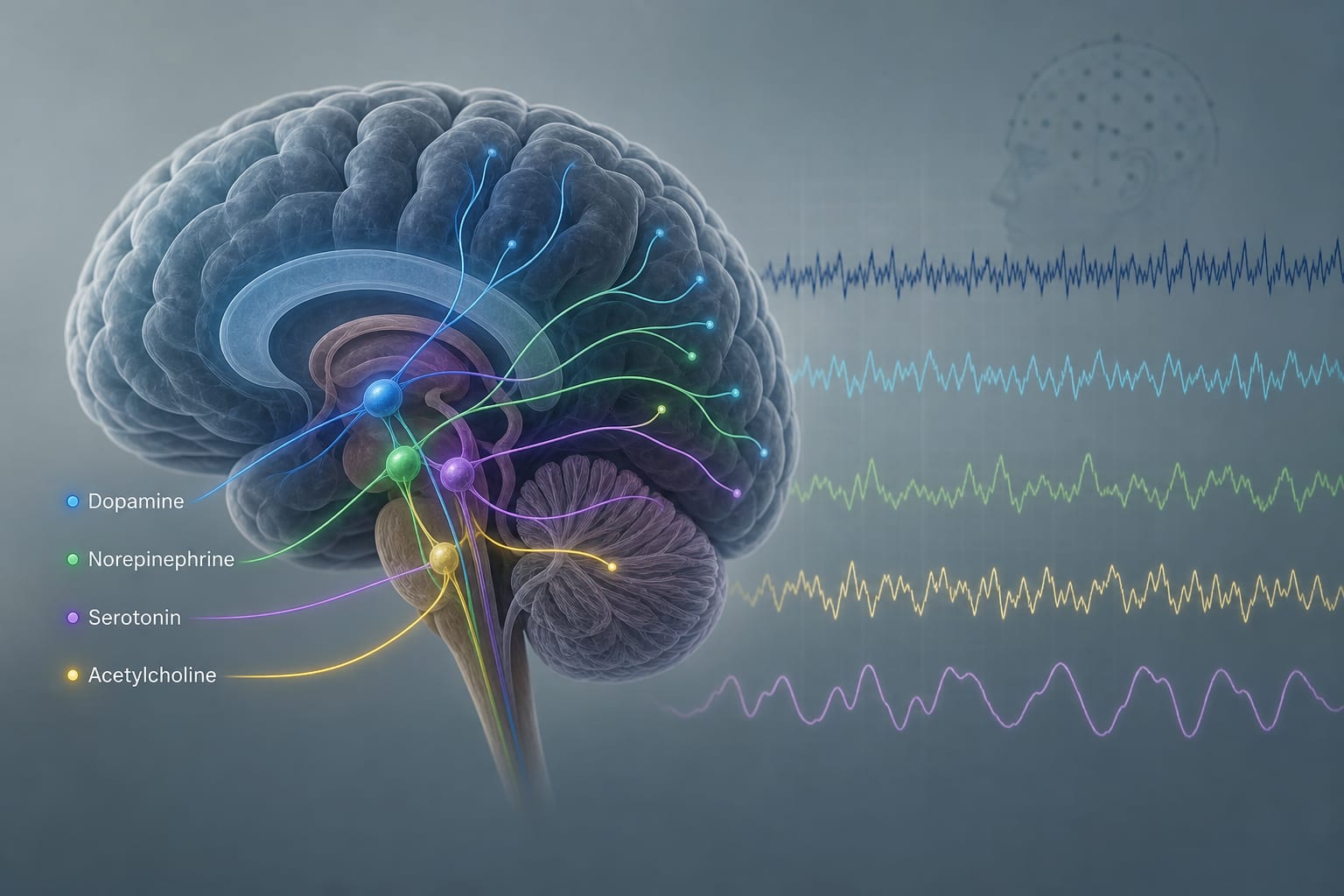
  • Dopamine antagonists are linked to higher delta and theta power at central locations and lower alpha power at occipital and temporal locations.
  • Dopamine agonists are associated with increased delta activity at occipital locations and enhanced frontal gamma power.
  • Serotonin antagonists show elevated slow-wave and alpha power, while agonists are linked to increased frontal alpha and decreased occipital alpha.
  • Norepinephrine antagonists correlate with higher delta power and lower temporal alpha, while agonists show a negative association with delta power.
  • Histamine antagonists are associated with lower delta, theta, and alpha power.
  • Acetylcholine antagonists are linked to higher delta, theta, and alpha power across electrode locations.

Clinical Implications

This neurotransmitter-centric approach may facilitate the development of EEG biomarkers that can inform personalized psychiatric care. Understanding specific neurotransmitter effects on EEG patterns could enhance treatment strategies and monitoring.

Conclusion

Modeling the effects of psychotropic medications at the neurotransmitter level offers a more biologically grounded understanding of their impact on EEG spectral power, potentially leading to improved clinical applications.
Related Resources & Content

  1. npj Digital Medicine, 2025 -- A Systems Dynamics Approach to Tailored Psychiatry
  2. Frontiers in Psychiatry, 2026 -- Quantitative electroencephalography as a potential neurophysiological diagnostic biomarker of schizophrenia and first-episode psychosis: a systematic review of clinical implications
  3. BMC Psychiatry (Springer), 2025 -- A Comprehensive Review of EEG Biomarkers for Depression, Anxiety, and Bipolar Disorder: Insights into Explainable Artificial Intelligence (XAI) Trends
  4. Update information | Depression in adults: treatment and management | Guidance | NICE
  5. Frontiers in Psychiatry — Associations of Multi-Voxel MR Spectroscopy Findings with EEG Network Hyperexcitability and Clinical Features in Borderline Personality Disorder
  6. Nonpharmacologic and Pharmacologic Treatments of Adults in the Acute Phase of Major Depressive Disorder: A Living Clinical Guideline From the American College of Physicians
  7. Bringing Imaging Biomarkers Into Clinical Reality in Psychiatry | Neurology | JAMA Psychiatry
  8. Update information | Depression in adults: treatment and management | Guidance | NICE
  9. EEG Biomarkers for Treatment Response Prediction in Major Depressive Illness | American Journal of Psychiatry
  10. Electroencephalography (EEG) spectral signatures of selective serotonin reuptake inhibitors (SSRIs), selective norepinephrine reuptake inhibitors (SNRIs) and vortioxetine in major depressive disorder: A systematic review - PubMed
  11. Meta-analysis on QEEG Changes to Antidepressant Treatment Among Patients with Depression - PMC
  12. Periodic and aperiodic changes to cortical EEG in response to pharmacological manipulation | Journal of Neurophysiology | American Physiological Society
  13. EEG vigilance and response to oral prolonged-release ketamine in treatment-resistant depression – A double-blind randomized validation study - ScienceDirect
  14. Using deep learning and pretreatment EEG to predict response to sertraline, bupropion, and placebo - ScienceDirect
  15. Machine Learning-Enabled EEG Biomarkers Predict Divergent Antidepressant and Placebo Response in a Clinical Trial of Major Depression | Sciety Labs (Experimental)
  16. Spectral changes in electroencephalography linked to neuroactive medications: A computational pipeline for data mining and analysis - ScienceDirect
  17. Pharmaco-EEG analysis of ligands varying in selectivity for α1 subunit-containing GABAA receptors during the active phase in rats - PMC

Original Source(s)

Related Content