Non-contact REM/NREM sleep staging from piezoelectric signals using respiratory and body-movement features with auxiliary TWED-based respiratory stability measures - Report - MDSpire
Advertisement
Non-contact REM/NREM sleep staging from piezoelectric signals using respiratory and body-movement features with auxiliary TWED-based respiratory stability measures
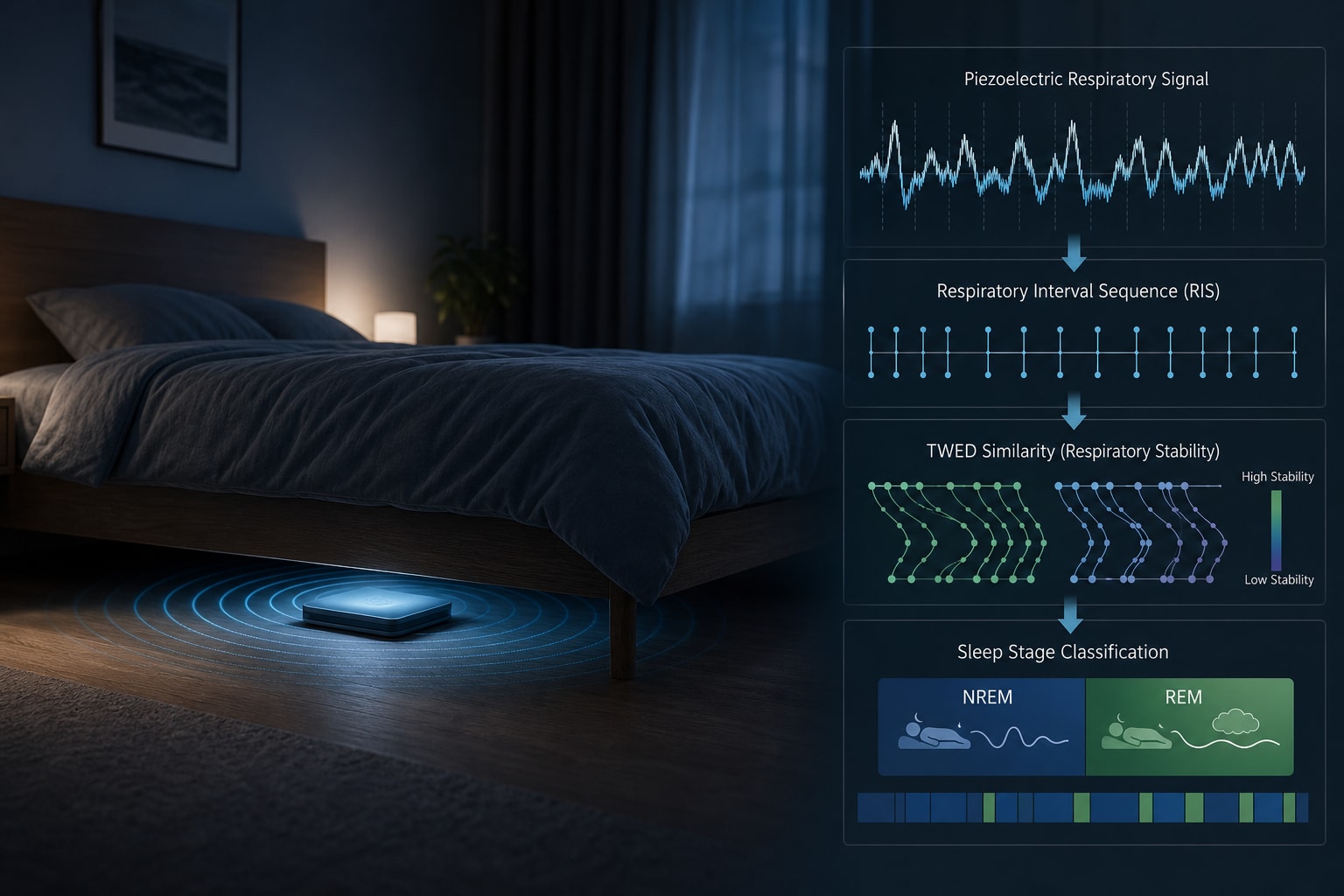
Remote Sleep Stage Classification of REM and NREM Using Piezoelectric Sensors
Overview
Revise to specify how respiratory stability metrics contribute to classification accuracy.
Background
Accurate sleep staging is crucial for diagnosing and managing sleep disorders, yet traditional polysomnography (PSG) is often impractical for home monitoring due to its cost and complexity. Non-contact methods, such as piezoelectric sensing, offer a promising alternative for continuous sleep assessment. This study investigates the potential of respiratory pattern stability as a means to differentiate between REM and NREM sleep stages effectively.
Data Highlights
Adjust table for clarity and completeness; consider including additional metrics.
Key Findings
Feature normalization improved performance across all feature sets.
The combination of conventional body-movement and respiratory variability features with TWED-based features yielded the highest classification accuracy.
Adding TWED-based features improved both Kappa and REM F1-score compared to conventional feature sets alone.
Respiratory signal extraction showed low detection error and good agreement with PSG airflow.
The proposed method is suitable for offline longitudinal monitoring rather than real-time clinical diagnosis.
Clinical Implications
The findings suggest that non-contact piezoelectric sensors can serve as a valuable adjunct for monitoring sleep stages in home settings. Clinicians may consider these tools for long-term sleep assessments, while recognizing their limitations compared to traditional PSG.
Conclusion
Strengthen the conclusion by linking findings to advancements in sleep monitoring.