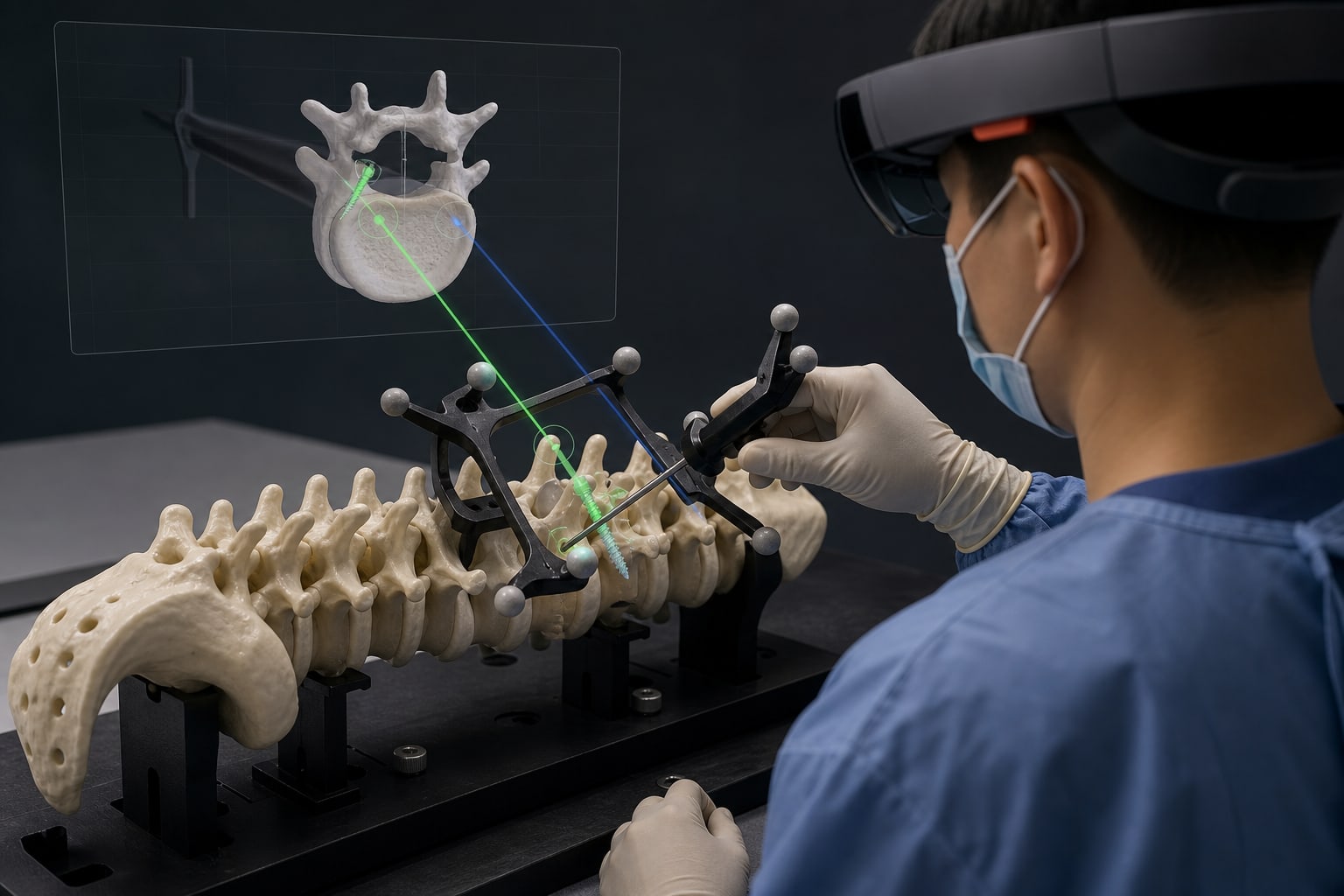
Improving Pedicle Screw Placement Training Using a Visual Tracking Guide Template in Augmented Reality Navigation
-
By
-
Zhang, Peihai
-
zhang, Kai
-
Liu, Huiting
-
Yang, Xuejun
-
May 19, 2026
Clinical Report: Improving Pedicle Screw Placement Training Using a Visual Tracking Guide Template in Augmented Reality Navigation
Overview
This study evaluates the feasibility of a visual tracking guide template (VTGT) for augmented reality (AR) navigation in surgical training for pedicle screw placement. Results indicate that the VTGT is effective in reducing navigation errors and enhancing user experience among junior residents.
Background
Spinal fusion surgery has seen a significant increase in procedures, necessitating improved training methods for junior surgeons. The complexity of pedicle screw placement, due to anatomical variability and proximity to vital structures, underscores the need for enhanced training tools. Augmented reality (AR) technology presents a promising avenue for improving surgical training and accuracy.
Data Highlights
| Metric | Value |
|---|---|
| Average time per K-wire | 36.4 seconds |
| User experience score | 87.8 points |
| Deviation value of entry point (DVEP) | 2.20 mm ± 0.55 mm |
| Deviation value of trajectory angle (DVTA) | 2.30° ± 0.78° |
Key Findings
- The VTGT was used for real-time tracking of AR images during pedicle screw placement.
- Five junior residents participated, placing a total of 100 K-wires.
- All screws met clinical safety requirements according to the Gertzbein-Robbins scale.
- The average user experience score was high at 87.8 points.
- The navigation error metrics (DVEP and DVTA) were within acceptable ranges.
Clinical Implications
The findings suggest that VTGT-based AR navigation can enhance the training experience for junior residents in pedicle screw placement. This technology may contribute to improved surgical outcomes by reducing navigation errors.
Conclusion
The study demonstrates that the VTGT-based AR navigation technology is feasible and beneficial for training in pedicle screw placement, potentially enhancing surgical education.
Related Resources & Content
- Impact of Various Augmented Reality Visualizations on Trajectory Deviation, Visual Focus, and User Experience in Drilling Procedures, 2022
- Assessment of Augmented Reality Assistance for Glenoid Pin Placement in Total Shoulder Replacement Surgery, 2025
- Assessment of Augmented Reality Training for Navigation Devices in CT-Guided Needle Insertion, 2024
- Utilizing Augmented Reality Headsets for Radiation-Free Navigation in Pelvic Surgical Procedures, 2025
- Spine Surgery and Related Research, 2024
- Building consensus: development of a best practice guideline (BPG) for avoiding errors in robotic-assisted spine surgery (RASS), 2025
- Augmented Reality in Navigated Surgery: A Systematic Review of Clinical Accuracy and System Performance, 2026
- Spine Surgery and Related Research
- Building consensus: development of a best practice guideline (BPG) for avoiding errors in robotic-assisted spine surgery (RASS) - PubMed
- Augmented Reality in Navigated Surgery: A Systematic Review of Clinical Accuracy and System Performance - ScienceDirect
- Augmented Reality Navigation System Enhances the Accuracy of Spinal Surgery Pedicle Screw Placement: A Randomized, Multicenter, Parallel-Controlled Clinical Trial
- Augmented reality navigation technology in atlantoaxial pedicle screw fixation for atlantoaxial dislocation treatment
- An immersive mixed reality surgical self-training system for precise pedicle screw placement: a randomized controlled trial | BMC Medical Education | Springer Nature Link
- Augmented Reality and Virtual Reality in Medical Devices | FDA
Based on findings from:
Enhancing Pedicle Screw Placement Training with a Visual Tracking Guide Template in Augmented Reality Navigation
Zhang, Peihai , zhang, Kai , Liu, Huiting , Yang, Xuejun . Frontiers In Medicine, 2026.
https://www.frontiersin.org/journals/medicine/articles/10.3389/fmed.2026.1802255/full
This content is an AI-generated, fully rewritten summary based on a published scholarly article. It does not reproduce the original text and is not a substitute for the original publication. Readers are encouraged to consult the source for full context, data, and methodology.