NAFLD-associated immune remodeling in colorectal cancer liver metastasis: mechanisms and implications for immunotherapy
-
By
-
Hui Wang
-
Guoqing Gu
-
June 29, 2026
-
0 min
Clinical Report: Immune Microenvironment Alterations in Colorectal Cancer Liver Metastasis Linked to NAFLD
Overview
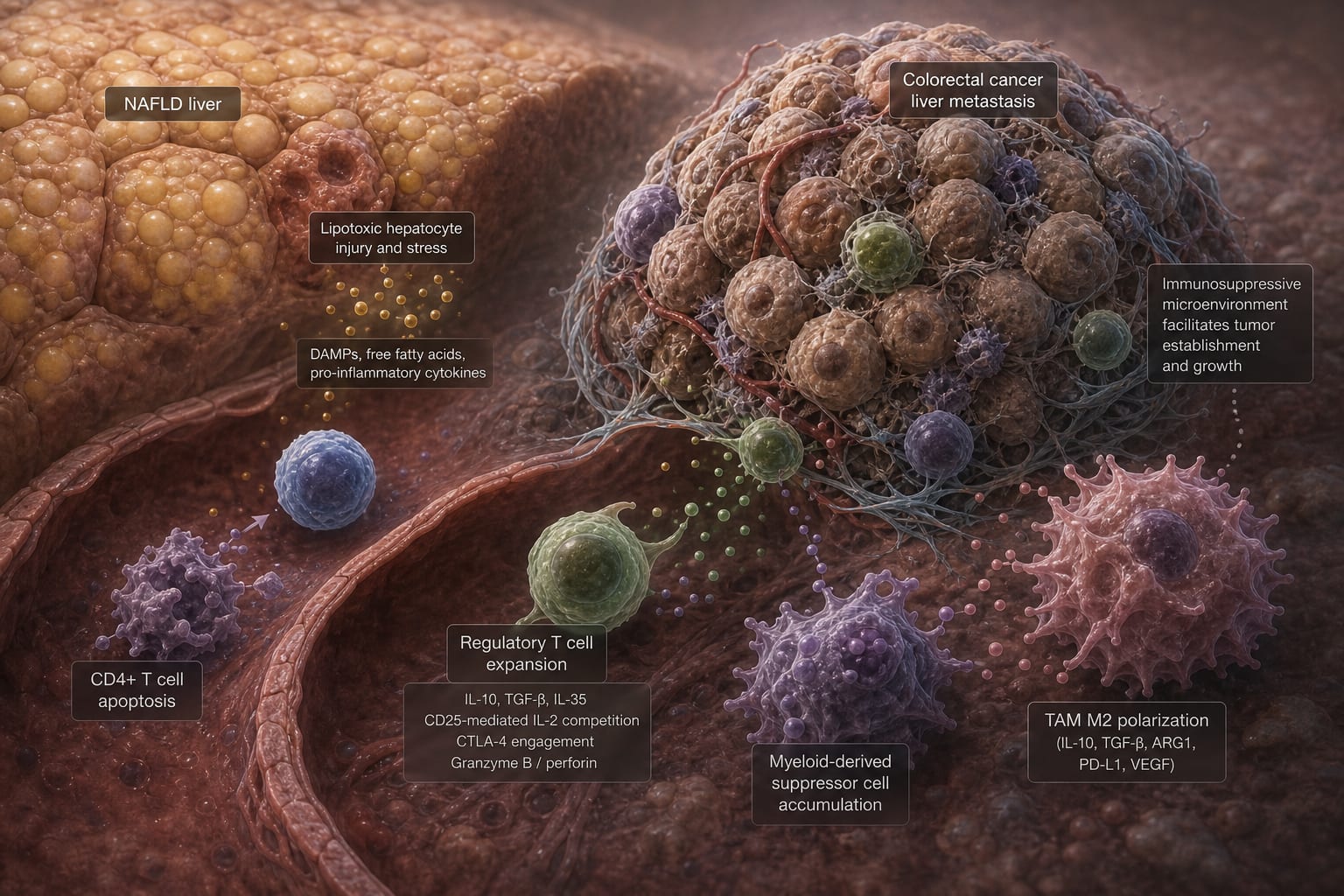
This review explores the immune mechanisms by which non-alcoholic fatty liver disease (NAFLD) influences colorectal cancer liver metastasis (CRLM). It highlights how NAFLD-induced lipotoxicity alters the hepatic immune microenvironment.
Background
NAFLD affects over 30% of adults globally and is increasingly recognized as a negative prognostic factor for CRLM. The liver's unique role in metabolism and immunity makes it a critical site for understanding cancer metastasis.
Data Highlights
No numerical data or trial results were provided in the source material.
Key Findings
- NAFLD-induced lipotoxicity leads to lipotoxic apoptosis of CD4+ T cells, depleting the helper T cell pool.
- Regulatory T cells (Tregs) expand and become functionally reinforced through various mechanisms, including IL-10 and TGF-β.
- M2 polarization of tumor-associated macrophages occurs, contributing to an immunosuppressive environment.
- Myeloid-derived suppressor cells (MDSCs) are recruited via the CXCL5/CXCR2 axis, suppressing CD8+ T cell function.
- CD8+ T cell exhaustion is marked by the upregulation of PD-1, LAG-3, and TIM-3.
- NAFLD-driven immune dysregulation is linked to reduced responsiveness to immune checkpoint inhibitors.
Clinical Implications
Understanding the immune alterations in the context of NAFLD and CRLM may inform future research directions.
Conclusion
The review provides insights into the immune microenvironment changes associated with NAFLD and their implications for colorectal cancer liver metastasis, highlighting potential therapeutic targets.
Related Resources & Content
- Frontiers in Immunology, 2026 -- Organ-specific pre-metastatic and metastatic niches in colorectal cancer: “discrepancy in response to immune checkpoint inhibitors in liver and lung metastasis”
- Journal of Gastroenterology, 2026 -- Stage-associated remodeling of CD169 macrophage states is linked to immune regulation in colitis-associated colorectal cancer
- Frontiers in Oncology, 2026 -- Immune microenvironment evolution across the serrated neoplasia pathway and its relevance to immunotherapy
- Introducing AGA’s new MASLD clinical care pathway – American Gastroenterological Association
- EORTC consensus recommendations on the optimal management of colorectal cancer liver metastases - PubMed
- Journal of Gastroenterology (Springer) — Single-cell analysis reveals crosstalk between TREM1-positive myeloid cells and cancer-associated fibroblasts in colorectal cancer progression
- Diagnostic value of Gd-EOB-DTPA-enhanced MRI versus contrast-enhanced CT for detecting liver metastasis in colorectal cancer: a systematic review and meta-analysis - PMC
- Liver‐directed therapies for colorectal liver metastases - Folkerts - 2025 - Cancer - Wiley Online Library
- Introducing AGA’s new MASLD clinical care pathway – American Gastroenterological Association
- EORTC consensus recommendations on the optimal management of colorectal cancer liver metastases - PubMed
- The association between metabolic-associated fatty liver diseases and risk of colorectal polyps, neoplasia, and cancer: A systematic review and meta-analysis of over 56 million individuals - PubMed
- Metabolic dysfunction-associated steatotic liver disease increases the incidence of metachronous liver metastases from TNM stage 0-II colorectal cancer
- Lipid metabolism as a central driver of immune remodeling and therapeutic vulnerability in metastatic colorectal cancer | Lipids in Health and Disease | Springer Nature Link
- ‘Triple-Punch’ Combo Therapy Slows Progressions of Some Metastatic Colorectal Cancers - ASCO
This content is an AI-generated, fully rewritten summary based on a published scholarly article. It does not reproduce the original text and is not a substitute for the original publication. Readers are encouraged to consult the source for full context, data, and methodology.