Severe asparaginase-associated hypertriglyceridemia in pediatric acute lymphoblastic leukemia: a single-center experience - Report - MDSpire

Severe asparaginase-associated hypertriglyceridemia in pediatric acute lymphoblastic leukemia: a single-center experience

  • By

  • Maha Barbar

  • Dana Kanaan

  • Zebin AlZebin

  • Ammar Al Hmood

  • Sima Kalaldeh

  • Lana Amer

  • Saja Al Zghoul

  • Dana Aroury

  • June 23, 2026

  • 0 min

Share

Clinical Report: Severe Hypertriglyceridemia Linked to Asparaginase in Children

Overview

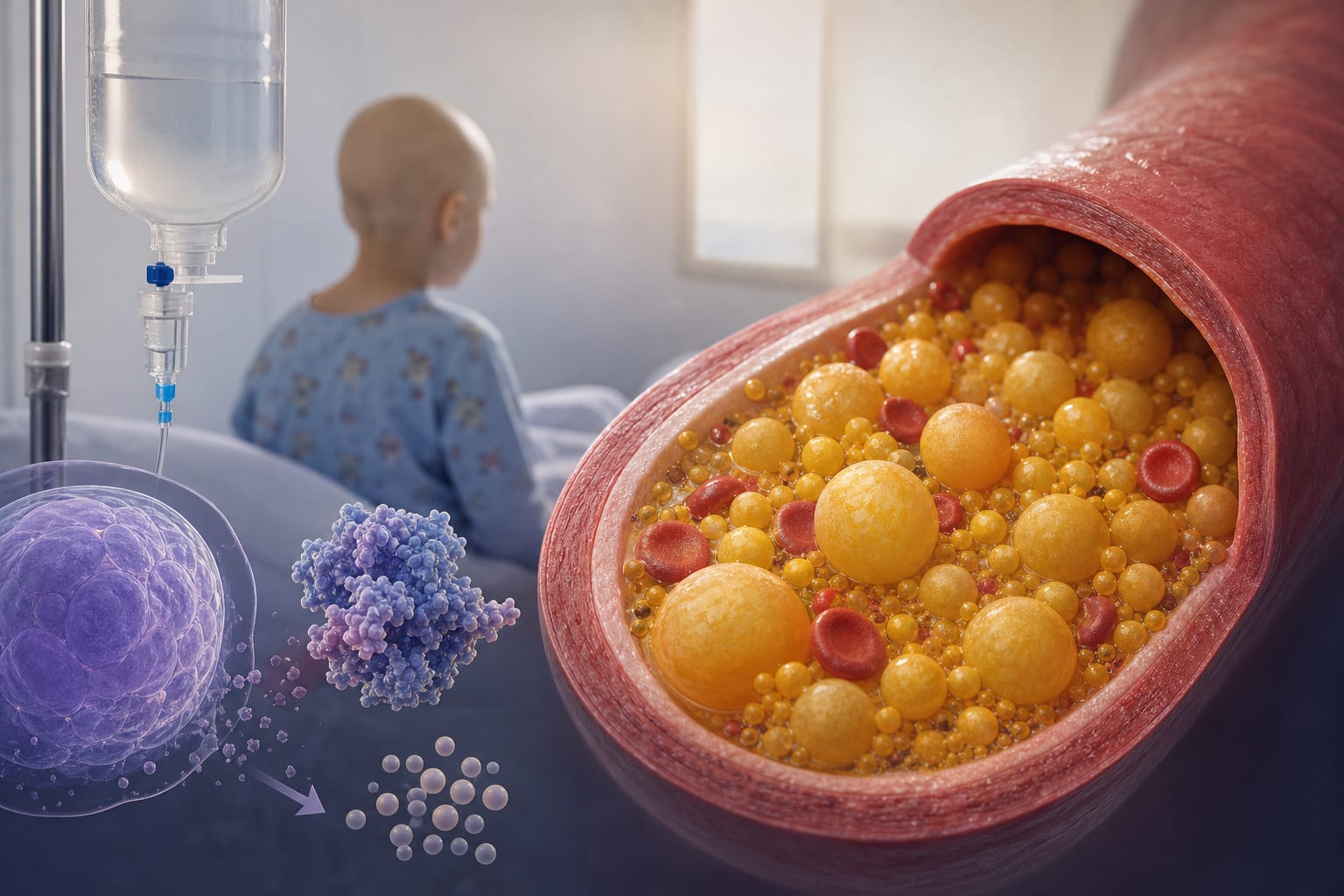
This study examines the incidence and management of severe asparaginase-induced hypertriglyceridemia (AIHTG) in pediatric patients with acute lymphoblastic leukemia (ALL). Among 598 patients treated, 12 experienced severe AIHTG, primarily asymptomatic.

Background

Asparaginase is a critical component of ALL treatment, but it is associated with various metabolic adverse effects, including hypertriglyceridemia. This study provides insights into the clinical characteristics and outcomes of severe AIHTG in a single-center cohort.

Data Highlights

ParameterValue
Incidence of severe AIHTG2%
Median age of patients9.5 years
Median peak triglyceride concentration2,645 mg/dL
Asymptomatic cases83%
Management interventionsIV fluids, omega-3 fatty acids, fibrates, insulin infusion

Key Findings

  • 12 out of 598 pediatric ALL patients developed severe AIHTG (2% incidence).
  • 83% of cases were asymptomatic, identified through routine lab tests.
  • Median peak triglyceride levels reached 2,645 mg/dL.
  • Management included intravenous fluids, omega-3 fatty acids, fibrates, and insulin infusion.
  • Plasmapheresis was performed in three patients with triglyceride levels exceeding 6,000 mg/dL.
  • Asparaginase was resumed in eight patients after ensuring triglyceride levels were below 1,000 mg/dL.

Clinical Implications

Timely detection of AIHTG is crucial, as most cases are asymptomatic and can lead to significant complications if not managed properly.

Conclusion

Severe AIHTG is a significant concern in pediatric ALL treatment, often asymptomatic but requiring intervention.
Related Resources & Content

  1. Kjeld Schmiegelow, MD, The ASCO Post, 2017 -- Asparaginase-Associated Pancreatitis in Childhood Acute Lymphoblastic Leukemia
  2. Frontiers in Hematology, 2026 -- A pilot study on therapeutic drug monitoring of asparaginase in Indian children with high-risk ALL: evidence for suboptimal exposure
  3. Frontiers in Pediatrics, 2026 -- Cerebrovascular thrombosis during pediatric ALL therapy: a case series highlighting temporal association with PEG-asparaginase exposure
  4. Blood Cancer Journal, 2014 -- The optimal use of PEG-Asparaginase in relapsed ALL—lessons from the ALLR3 Clinical Trial
  5. NCCN Pediatric Acute Lymphoblastic Leukemia Guidelines, 2025 -- Asparaginase Toxicity Management
  6. PubMed, 2019 -- Asparaginase formulation impacts hypertriglyceridemia during therapy for acute lymphoblastic leukemia
  7. Frontiers, 2026 -- Severe Asparaginase-Associated Hypertriglyceridemia in Pediatric Acute Lymphoblastic Leukemia: A Single-Center Experience
  8. https://medfind.link/wp-content/uploads/2025/04/PediatricAcuteLymphoblasticLeukemia_2025.V3_EN.pdf
  9. Asparaginase formulation impacts hypertriglyceridemia during therapy for acute lymphoblastic leukemia - PubMed
  10. Frontiers | Severe Asparaginase-Associated Hypertriglyceridemia in Pediatric Acute Lymphoblastic Leukemia: A Single-Center Experience

Original Source(s)

Related Content