A connectome-based neural correlate of pediatric ADHD hyperactivity–impulsivity symptoms - Report - MDSpire

A connectome-based neural correlate of pediatric ADHD hyperactivity–impulsivity symptoms

  • By

  • Jie Tao

  • Yue Wu

  • Ping Liu

  • Rong Wang

  • Ranran Gao

  • Dai Zhang

  • Qing Zhang

  • Feng Geng

  • June 17, 2026

  • 0 min

Share

Clinical Report: Neural Connectome Associations with Hyperactivity and Impulsivity in Pediatric ADHD

Overview

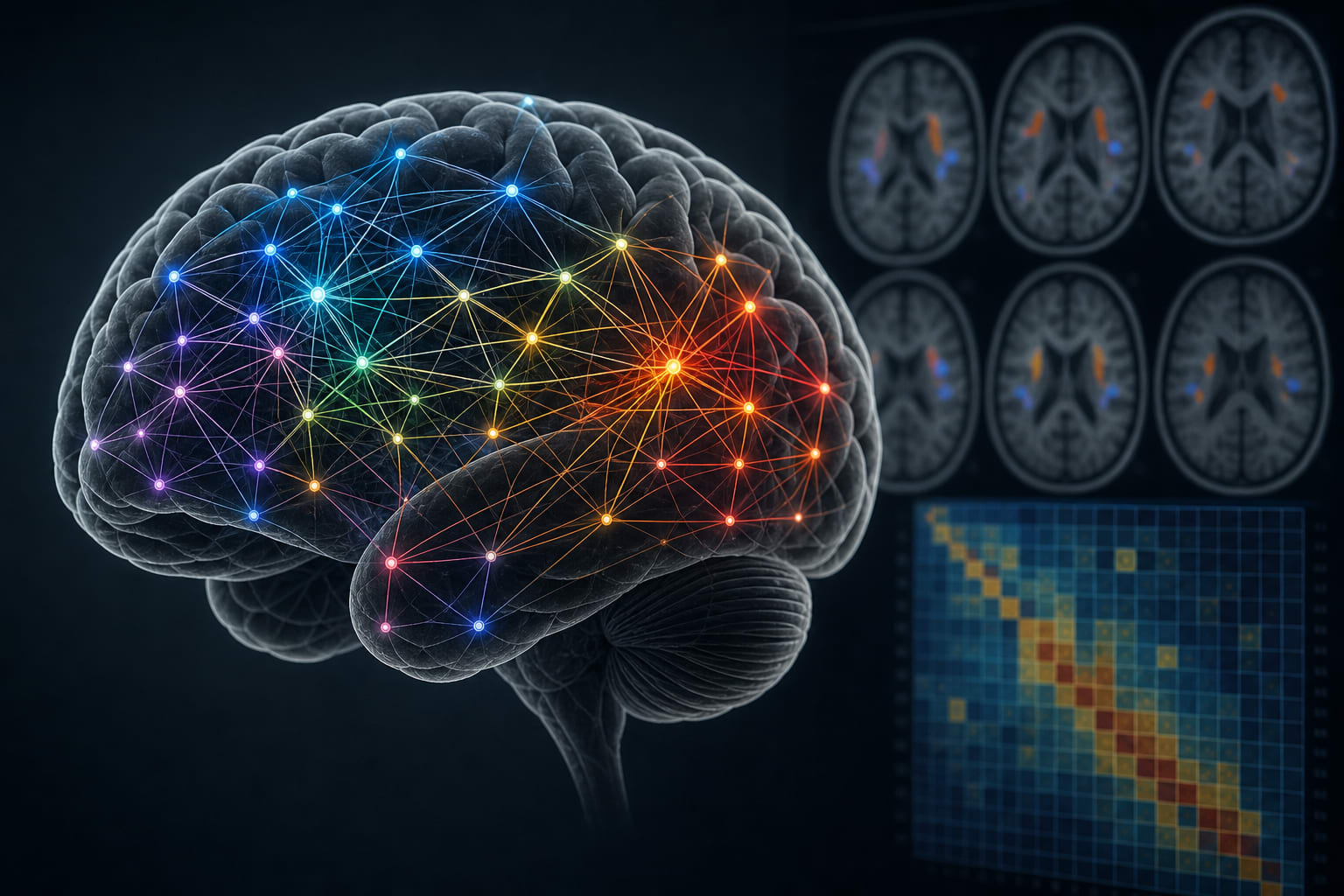
This study identifies brain networks associated with hyperactivity and impulsivity in children with ADHD, utilizing resting-state fMRI data. A predictive model based on functional connectivity matrices successfully correlates with symptom severity.

Background

ADHD is a prevalent neurodevelopmental disorder affecting approximately 8.0% of children globally, characterized by inattention, hyperactivity, and impulsivity. The disorder leads to significant functional impairments and is often accompanied by various comorbidities, impacting academic and social outcomes. Understanding the neural correlates of ADHD symptoms is crucial for developing objective diagnostic markers and improving treatment strategies.

Data Highlights

The study included 44 children with ADHD (mean age = 8.45 years). The CPM model predicted hyperactivity–impulsivity symptoms with a correlation of r = 0.48 (p = 0.001) based on SNAP-IV ratings and r = 0.49 (p = 0.0009) based on Conners ratings.

Key Findings

  • The CPM model effectively predicted hyperactivity–impulsivity symptoms in children with ADHD.
  • Stronger connectivity between the frontoparietal control network (FPN) and the dorsal attention network (DAN) was associated with greater symptom severity.
  • Weaker connectivity was observed between the FPN and both the ventral attention network (VAN) and the somatomotor network (SMN) in relation to symptom severity.
  • The findings suggest that whole-brain functional connectivity may serve as a preliminary neuroimaging marker for ADHD symptoms.
  • Current ADHD diagnosis primarily relies on clinical symptom reports, highlighting the need for objective markers.

Clinical Implications

The study's findings suggest that functional connectivity patterns may provide insights into the neural mechanisms underlying ADHD symptoms. This could pave the way for future research aimed at validating neuroimaging markers for ADHD diagnosis and treatment.

Conclusion

The research highlights the association between whole-brain functional connectivity and hyperactivity–impulsivity symptoms in children with ADHD, emphasizing the role of specific brain networks. Further validation is needed to establish these findings as reliable neuroimaging markers.

Related Resources & Content

  1. BMC Psychiatry (Springer) — Frequency-specific alterations in low-frequency functional connectivity in children with ADHD
  2. BMC Psychiatry (Springer) — Altered auditory attention and functional connectivity in the auditory cortex of children with Attention-Deficit/Hyperactivity Disorder
  3. BMC Psychiatry (Springer) — Brain–behavior relationships in task-based fMRI assessments of executive functions in children and adolescents with and without ADHD: a systematic review and ALE meta-analysis
  4. JAMA Psychiatry — Mapping ADHD Heterogeneity and Biotypes by Topological Deviations in Morphometric Similarity Networks
  5. Clinical Practice Guideline for the Diagnosis, Evaluation, and Treatment of Attention-Deficit/Hyperactivity Disorder in Children and Adolescents
  6. Current clinical guidance on ADHD diagnosis
  7. Cross-sectional mega-analysis of resting-state alterations associated with ADHD
  8. Resting-State Functional Connectivity Predicts Attention Problems in Children: Evidence from the ABCD Study - PMC
  9. A resting-state functional magnetic resonance imaging meta-analysis of differences in brain activity between children and adolescents with attention-deficit/hyperactivity disorder using activation likelihood estimation | European Child & Adolescent Psychiatry | Springer Nature Link
  10. Frequency-specific alterations in low-frequency functional connectivity in children with ADHD | BMC Psychiatry | Full Text
  11. Potential locations for non-invasive brain stimulation in treating ADHD: Results from a cross-dataset validation of functional connectivity analysis | Translational Psychiatry

Original Source(s)

Related Content