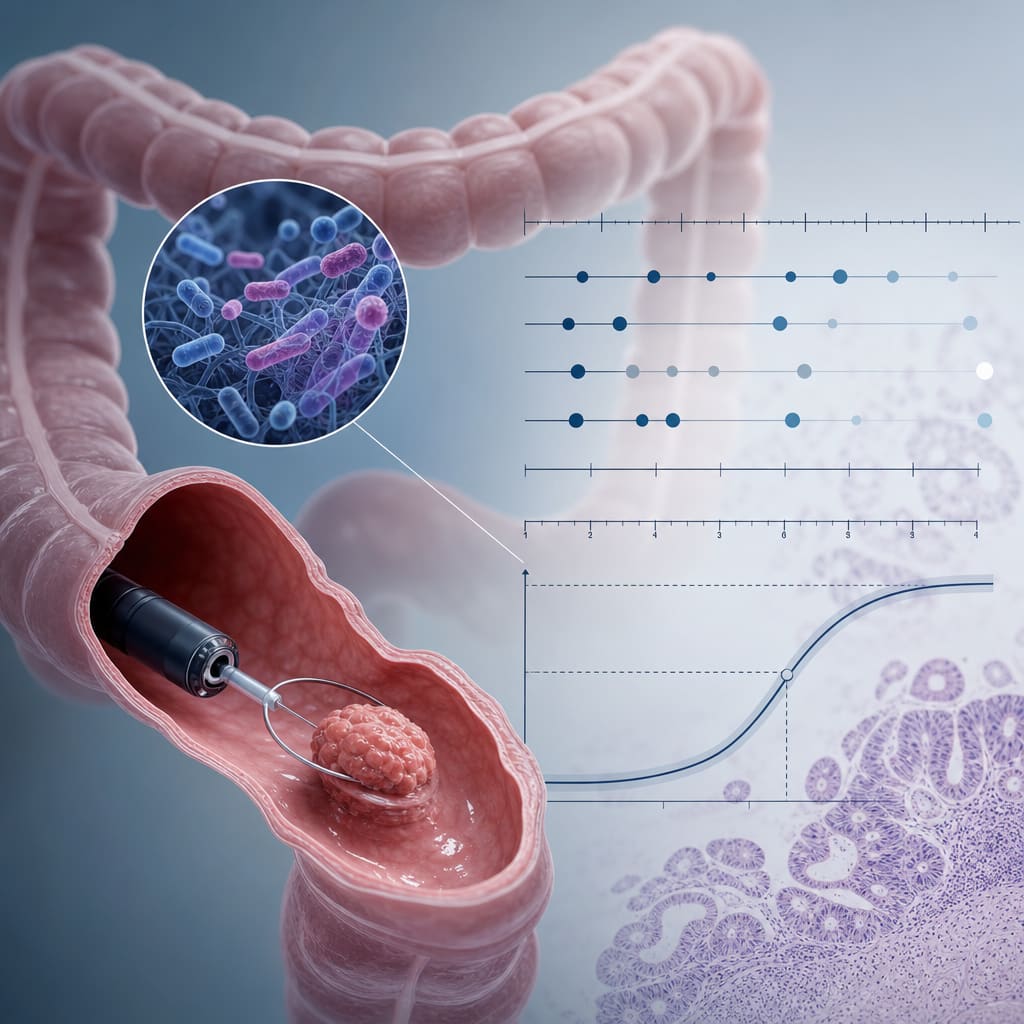
Retraction: Construction and validation of nomogram model for endoscopic submucosal dissection in patients with early colorectal cancer based on intestinal microflora and clinical pathological parameters
-
May 4, 2026
-
0 min
Clinical Report: Retraction of Nomogram for ESD in Early Colorectal Cancer
Overview
This report addresses the retraction of a study on a nomogram for endoscopic submucosal dissection (ESD) in early colorectal cancer patients. The retraction was due to concerns about data validity, which the authors could not satisfactorily explain.
Background
Colorectal cancer (CRC) is a significant global health issue, being the third most prevalent cancer and a leading cause of cancer-related mortality. Accurate risk stratification and treatment planning are crucial for improving patient outcomes, particularly in early-stage CRC where endoscopic techniques are increasingly utilized. The development of predictive tools, such as nomograms, aims to enhance decision-making in clinical practice.
Data Highlights
No numerical or trial data is available due to the retraction of the original study.
Key Findings
- The original study aimed to create a nomogram for predicting outcomes in ESD for early CRC.
- Concerns regarding the validity of the data led to the retraction of the study.
- The authors were unable to provide satisfactory explanations during the investigation.
- The retraction was approved by the Chief Editors of Frontiers in Medicine.
- This incident highlights the importance of data integrity in clinical research.
Clinical Implications
Healthcare professionals should remain cautious when interpreting findings from retracted studies. The need for robust validation of predictive models is critical to ensure patient safety and effective treatment planning in early colorectal cancer.
Conclusion
The retraction of the nomogram study underscores the necessity for rigorous data validation in clinical research. Ongoing efforts to develop reliable predictive tools are essential for advancing care in early colorectal cancer.
References
- Frontiers Editorial Office, Frontiers in Medicine, 2026 -- Retraction: Construction and validation of nomogram model for endoscopic submucosal dissection in patients with early colorectal cancer based on intestinal microflora and clinical pathological parameters
- Identifying Risk Factors for Lymph Node Metastasis in Early Colorectal Cancer: Development of a Predictive Nomogram and Risk Evaluation
- Developing a nomogram to assess risk factors for delayed bleeding following endoscopic submucosal dissection in colorectal tumor cases
- Forecasting Postoperative Complications After Transanal Total Mesorectal Excision in Middle and Low Rectal Cancer: Creation and Internal Validation of a Clinical Prediction Tool
- Evaluating the Prognostic Significance of Standard Blood Biomarkers for Three-Year Survival in Patients with Resectable Colorectal Cancer: A Clinical Nomogram Approach
- AGA Clinical Practice Update on Endoscopic Resection for Early Colorectal Cancer: Commentary
- Local recurrence rates of horizontal margin-positive en bloc endoscopic submucosal dissection of colorectal neoplasia: a meta-analysis
- State of the art and the future of microbiome-based biomarkers: a multidisciplinary Delphi consensus - ScienceDirect
This content is an AI-generated, fully rewritten summary based on a published scholarly article. It does not reproduce the original text and is not a substitute for the original publication. Readers are encouraged to consult the source for full context, data, and methodology.