The association between estimated glucose disposal rate and self-reported diabetic retinopathy: evidence from two independent cohorts and machine learning - Report - MDSpire
Conexiant’s news site is now MDSpire News. Learn more
Advertisement
Examining the Link Between Estimated Glucose Disposal Rate and Self-Reported Diabetic Retinopathy: Insights from Two Distinct Cohorts and Machine Learning Approaches
Clinical Report: Examining the Link Between Estimated Glucose Disposal Rate and Self-Reported Diabetic Retinopathy
Overview
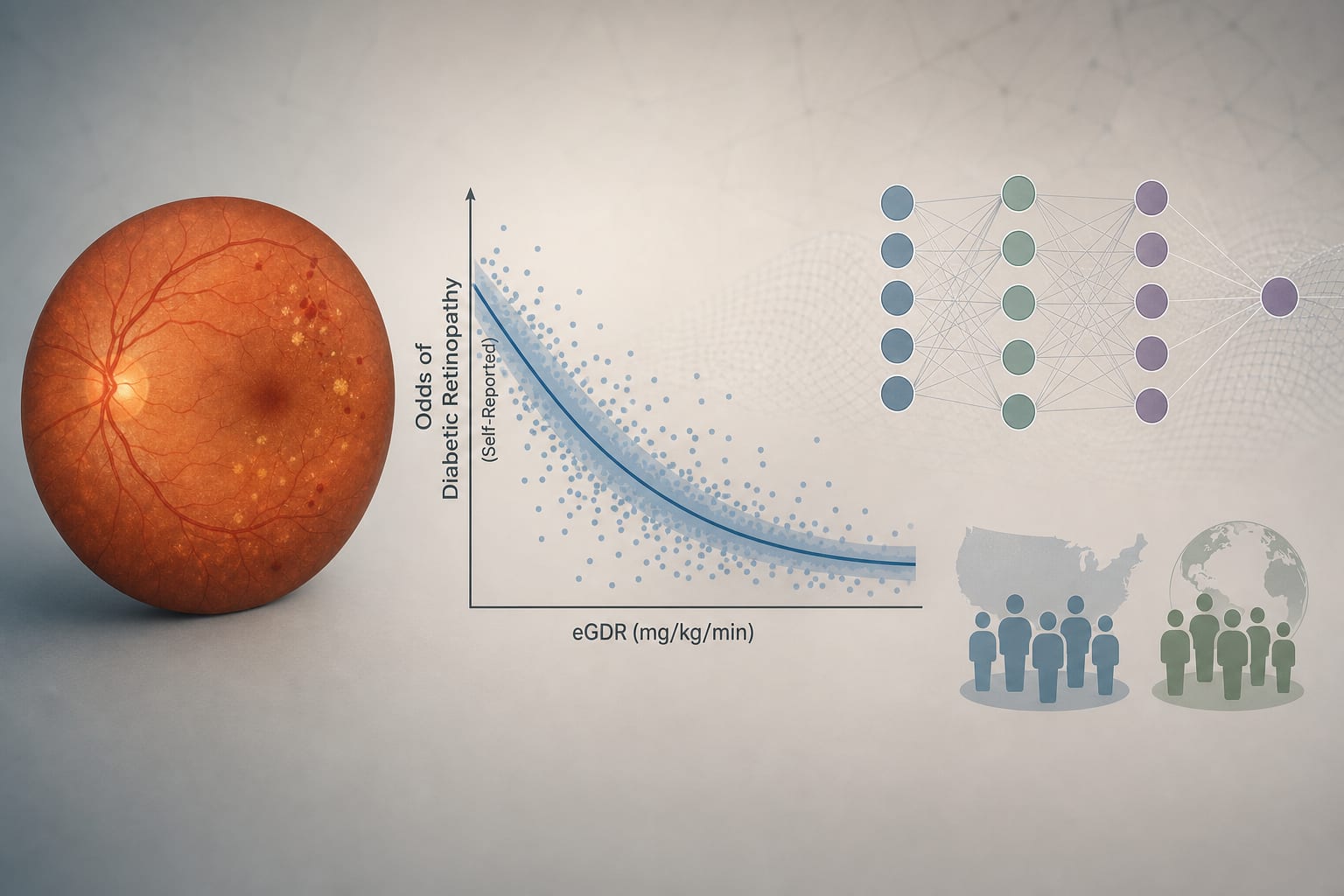
This study investigates the relationship between estimated glucose disposal rate (eGDR) and the prevalence of self-reported diabetic retinopathy (DR) using data from NHANES and a clinical cohort. Findings indicate a significant negative correlation between eGDR and DR prevalence.
Background
Diabetic retinopathy is a leading cause of vision impairment among individuals with diabetes, affecting approximately 160 million people globally. Insulin resistance is a critical factor in the pathogenesis of DR, yet the association between eGDR and DR prevalence has not been fully characterized.
Data Highlights
Measure
Value
Participants (NHANES)
1,536
Participants (Clinical Cohort)
297
Odds Ratio (eGDR and DR prevalence)
0.79
95% Confidence Interval
0.67–0.93
P-value
0.0049
XGBoost AUC
0.773
Random Forest AUC
0.764
Key Findings
eGDR shows a significant negative correlation with self-reported DR prevalence (OR = 0.79, P = 0.0049).
Subgroup and sensitivity analyses confirm the stability of the negative association between eGDR and DR.
The Boruta algorithm identifies eGDR as a robust feature in predicting DR prevalence.
XGBoost and random forest models demonstrate moderate predictive performance for DR prevalence estimation.
SHAP analysis indicates eGDR, body mass index, and income poverty as key determinants of self-reported DR prevalence.
Clinical Implications
The findings indicate a significant negative correlation between eGDR and DR prevalence.
Conclusion
This study highlights the association between lower eGDR and higher prevalence of self-reported diabetic retinopathy. Further prospective research is needed to explore the causal relationship between these factors.