ERYXSeg: a hybrid CNN architecture for robust and resource-aware wound segmentation - Report - MDSpire

ERYXSeg: a hybrid CNN architecture for robust and resource-aware wound segmentation

  • By

  • Trishaani Acharjee

  • Rajdeep Chatterjee

  • Mahendra Kumar Gourisaria

  • Manoj Sahni

  • Ernesto León-Castro

  • June 19, 2026

  • 0 min

Share

Clinical Report: ERYXSeg: An Integrated CNN Framework for Efficient and Reliable Wound Segmentation

Overview

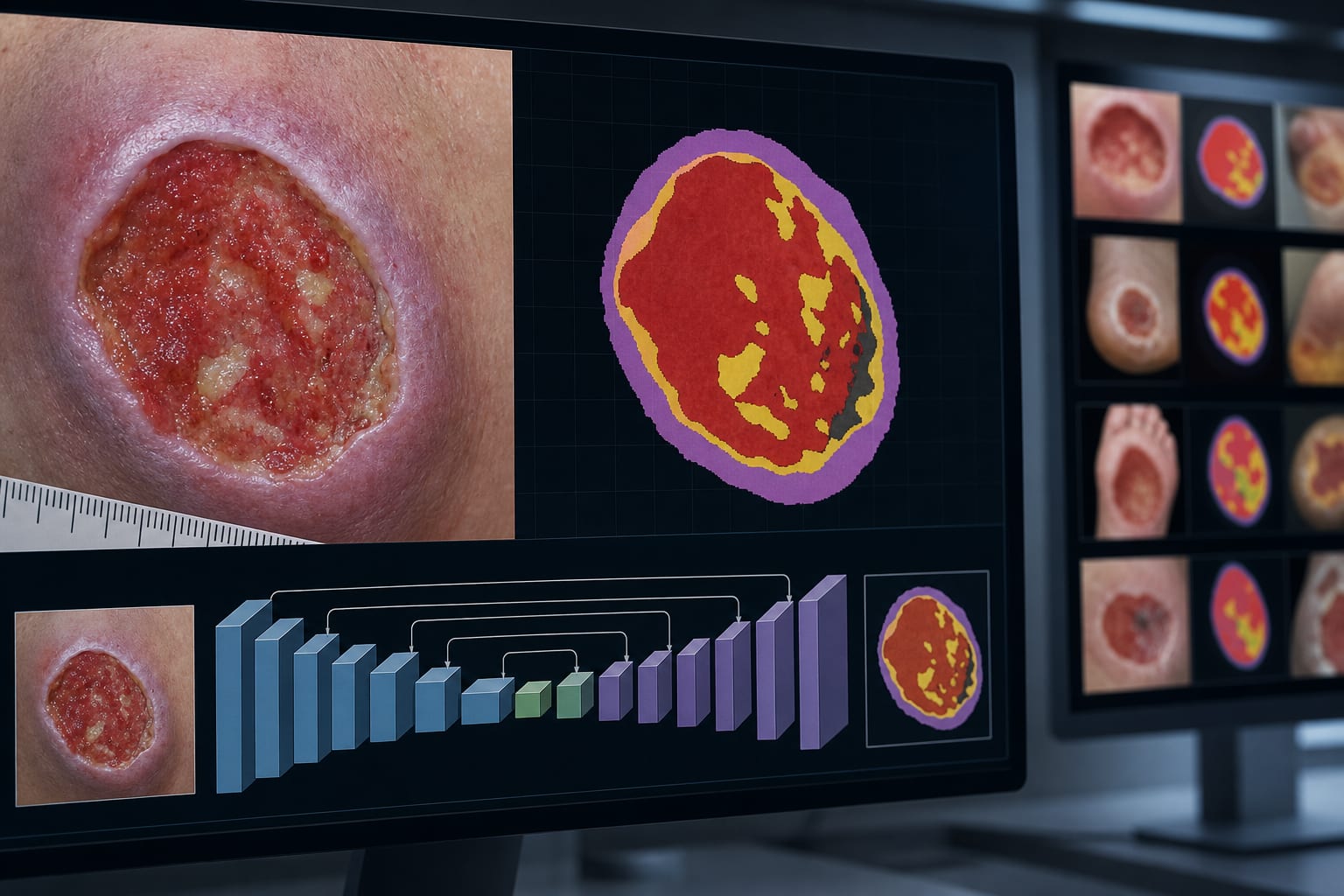
ERYXSeg is a novel deep learning architecture that enhances wound segmentation accuracy. It demonstrates high computational efficiency and generalization across various wound types.

Background

Accurate wound segmentation is crucial for effective treatment planning and monitoring of healing processes in clinical settings. Traditional methods are often time-consuming and subject to variability, necessitating automated systems that can provide reliable pixel-level analysis. The introduction of deep learning, particularly convolutional neural networks (CNNs), has the potential to improve accuracy and efficiency in wound image analysis.

Data Highlights

DatasetIoU ScoreDice Score
Foot Ulcer0.76330.8658
Curated Mixed Wound0.69100.8173

Key Findings

  • ERYXSeg outperforms state-of-the-art models in wound segmentation.
  • Achieved highest reported IoU and Dice scores for foot ulcer and mixed wound datasets.
  • Attention-gated skip connections are important for spatial reconstruction.
  • Mobile Inverted Bottleneck Convolution (MBConv) blocks are important for feature extraction.
  • Model demonstrates generalization across diverse wound types.
  • High computational efficiency qualifies ERYXSeg for clinical deployment.

Clinical Implications

The implementation of ERYXSeg in clinical practice could enhance the accuracy of wound assessments. Its efficiency allows for analysis in clinical settings.

Conclusion

ERYXSeg represents an advancement in automated wound segmentation, combining performance with applicability in clinical settings.
Related Resources & Content

  1. Deep Learning Approaches for Automated Image Segmentation and Evaluation of Treatment Outcomes in Metastatic Ovarian Cancer, Springer, 2025 -- https://link.springer.com/article/10.1007/s11548-025-03484-0
  2. PrysmNet: A System for Polyp Refinement Utilizing Salience and Multimodal Approaches for Consistent Cross-Domain Segmentation, npj Digital Medicine, 2026 -- https://www.nature.com/articles/s41746-026-02345-7
  3. DeepSeg: A Deep Learning Framework for Automated Segmentation of Brain Tumors in Magnetic Resonance FLAIR Imaging, Springer, 2020 -- https://link.springer.com/article/10.1007/s11548-020-02186-z
  4. Prevention and Treatment of Pressure Ulcers/Injuries: Clinical Practice Guideline | APTA -- https://www.apta.org/patient-care/evidence-based-practice-resources/cpgs/prevention-treatment-pressure-ulcers-injuries?utm_source=openai
  5. Deep learning in chronic wound segmentation: a comprehensive review and meta-analysis, The Visual Computer, 2025 -- https://link.springer.com/article/10.1007/s00371-025-04133-y?utm_source=openai
  6. npj Digital Medicine — Enhanced Mamba Filtering Networks for Precise Segmentation of Hepatocellular Carcinoma Lesions in Abdominal CT Scans
  7. Prevention and Treatment of Pressure Ulcers/Injuries: Clinical Practice Guideline | APTA
  8. Deep learning in chronic wound segmentation: a comprehensive review and meta-analysis | The Visual Computer | Springer Nature Link
  9. The Effect of Telemedicine Interventions on Patients with Diabetic Foot Ulcers: A Systematic Review and Meta-Analysis of Randomized Controlled Trials - PubMed

Original Source(s)

Related Content