Life-threatening multiorgan immune-related toxicities complicated by sepsis after anti-PD-1 therapy with complete tumor regression: a case report and literature review - Report - MDSpire
Conexiant’s news site is now MDSpire News. Learn more
Advertisement
Severe Multisystem Immune-Related Adverse Events with Concurrent Sepsis Following Anti-PD-1 Treatment Resulting in Complete Tumor Regression: A Case Study and Review of Existing Literature
Severe Multisystem Immune-Related Adverse Events with Concurrent Sepsis Following Anti-PD-1 Treatment
Overview
This case study presents a 73-year-old man who developed severe multisystem immune-related adverse events (irAEs) following anti-PD-1 therapy. The management involved a multidisciplinary approach, including corticosteroids and intravenous immunoglobulin (IVIG).
Background
Immune checkpoint inhibitors (ICIs) like pembrolizumab are increasingly used in treating head and neck squamous cell carcinoma (HNSCC). However, they can lead to severe irAEs that may affect multiple organ systems. Understanding and managing these adverse events is crucial.
Data Highlights
No numerical data or trial data were provided in the article.
Key Findings
A 73-year-old male developed severe multisystem irAEs after a single dose of pembrolizumab and nab-paclitaxel.
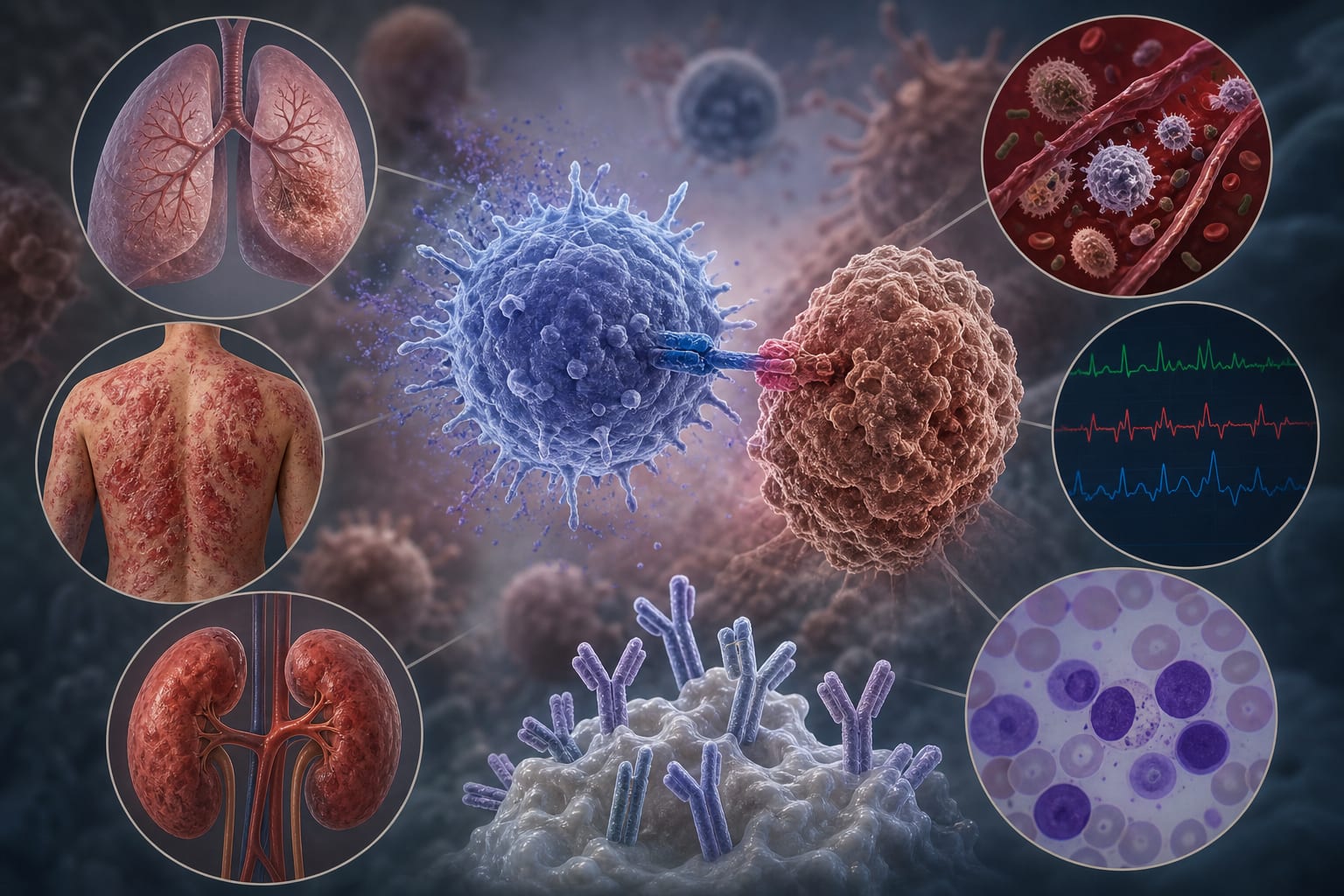
Symptoms included Stevens–Johnson syndrome, renal failure, pneumonitis, and recurrent sepsis.
Multidisciplinary management included corticosteroids and two courses of IVIG.
The patient achieved complete tumor regression after one treatment cycle.
Organ function recovered, and the patient remained disease-free for 6 months.
Clinical Implications
This case emphasizes the need for rapid diagnosis and a multidisciplinary approach in managing severe irAEs. The use of IVIG in cases where immunosuppression is complicated by infection risk is noted.
Conclusion
The case highlights the complexity of managing severe irAEs in patients receiving anti-PD-1 therapy.
by Jun Dong, Lijun Zhang, Lei Yu, Jun Wang, Jijie Huang, Xiaoyan Wu, Ping-An Wu, Suling Chen, Xixi Chen, Wenjuan Zhu, Yuan Qu, Jishi Li, Victor Ho Fun Lee