Investigating association of triglycerides with hemodynamic parameters in patients with Low cardiovascular risk using 4D flow MRI - Report - MDSpire

Investigating association of triglycerides with hemodynamic parameters in patients with Low cardiovascular risk using 4D flow MRI

  • By

  • Weiling Wang

  • Shuangqi Fu

  • Yong Xiang

  • Yingjiao Shen

  • Wei Wang

  • Jianyu Li

  • Ling Luo

  • June 24, 2026

  • 0 min

Share

Clinical Report: Examining the Relationship Between Triglyceride Levels and Hemodynamic Factors

Overview

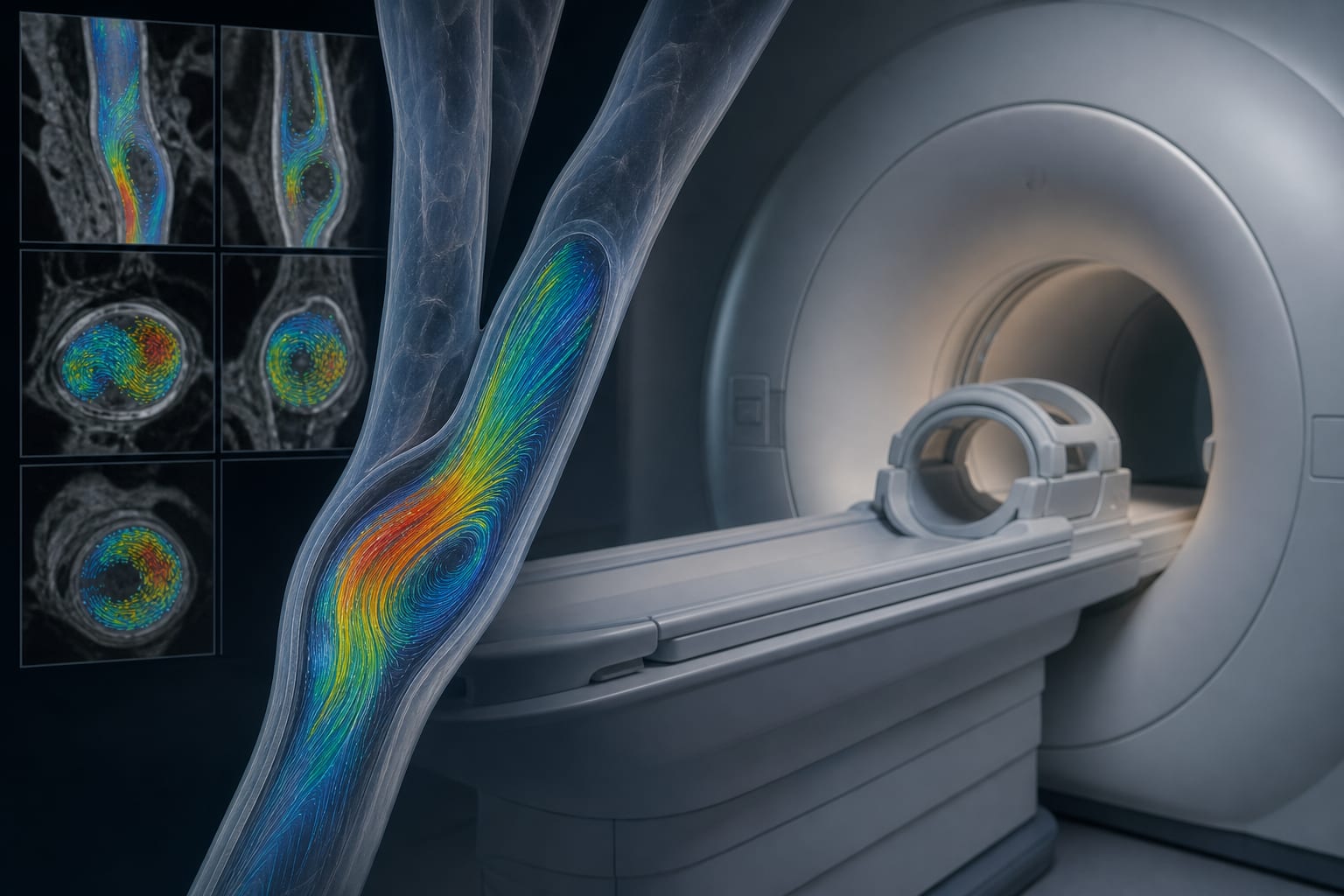
This study investigates the association between triglyceride levels and carotid hemodynamics in low cardiovascular risk patients using 4D Flow MRI. Significant differences in wall shear stress parameters were found in patients with severely elevated triglyceride levels.

Background

Cardiovascular disease (CVD) is a major global health issue, with hypertriglyceridemia identified as a significant risk factor. Understanding the relationship between triglyceride levels and hemodynamic factors is crucial in low-risk populations.

Data Highlights

Triglyceride GroupWSSmax (Pa)WSSmean (Pa)
Normal TG (<1.7 mmol/L)0.29 ± 0.100.20 ± 0.06
Elevated TG (1.7–5.64 mmol/L)0.29 ± 0.100.20 ± 0.06
Severely Elevated TG (≥5.65 mmol/L)0.44 ± 0.140.28 ± 0.08

Key Findings

  • Significant differences in WSSmax and WSSmean were observed across triglyceride groups.
  • In the severely elevated TG group, WSSmax and WSSmean were significantly higher than in the normal and elevated TG groups (p < 0.001).
  • Mixed-effects models showed that triglyceride levels were independently associated with WSSmax and WSSmean after adjusting for covariates.
  • The study included 180 participants aged 55 years or younger with low cardiovascular risk.
  • 4D Flow MRI was utilized to measure hemodynamic parameters effectively.

Clinical Implications

The findings indicate that elevated triglyceride levels may influence carotid hemodynamics.

Conclusion

This study highlights the independent association between triglyceride levels and carotid wall shear stress parameters in individuals with severely elevated triglycerides.

Related Resources & Content

  1. Author(s)/Org, Source, Year -- Title
  2. European Radiology — Utilizing MR 4D Flow to Assess Left Atrial Acceleration Factor for Distinguishing Advanced Left Ventricular Diastolic Dysfunction
  3. European Radiology — Validation of 4D Flow MRI for Assessing Grading of Left Ventricular Diastolic Dysfunction Compared to Echocardiography
  4. Pediatric Cardiology — Influence of 4D-Flow CMR Metrics on the Functional Assessment of Fontan Circulation
  5. European Radiology — Factors Related to Demographics and Cardiovascular Risks Influencing Blood Flow Dynamics in the Left Atrium and Left Atrial Appendage
  6. 2026 Guideline on the Management of Dyslipidemia - Professional Heart Daily
  7. Formulation-Specific Cardiovascular Outcomes with High-Dose Eicosapentaenoic Acid: A Systematic Review and Meta-analysis | American Journal of Cardiovascular Drugs | DeepDyve
  8. Artificial intelligence in 4D flow MRI: Review of technological aspects and clinical applications - ScienceDirect

Original Source(s)

Related Content