Clinical Report: Direct Histological Assessment of Thyroid Nodules via Ultrasonography
Overview
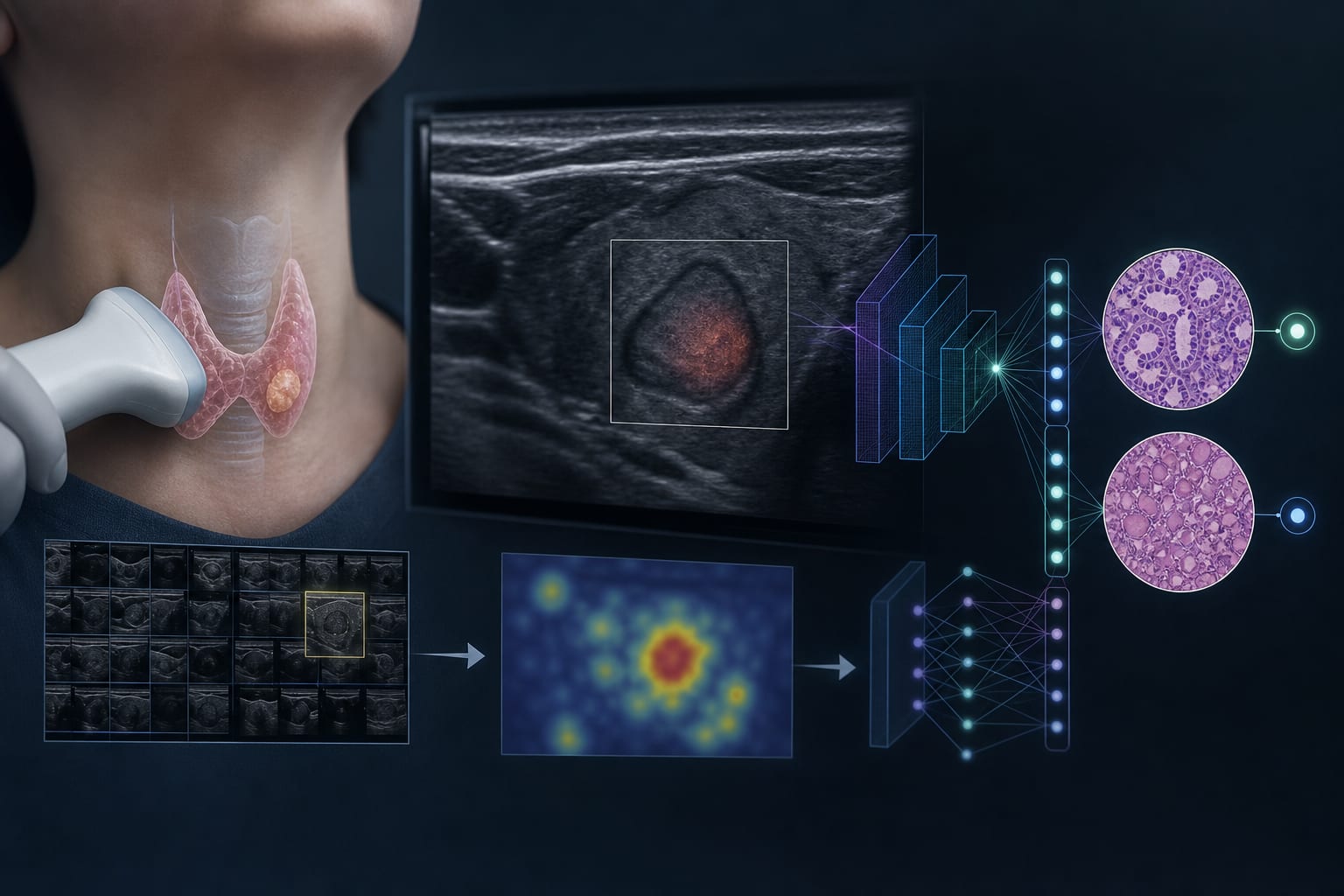
This study presents a novel deep learning framework, ThyUS2Path, for the direct inference of histological status from thyroid ultrasonography. The framework demonstrated superior performance compared to existing methods, potentially enhancing the diagnostic accuracy for thyroid cancer.
Background
The management of thyroid nodules via ultrasonography is critical due to the rising incidence of thyroid cancer, which has increased 2.4-fold over the last 30 years. Accurate diagnosis is essential to minimize unnecessary procedures and improve patient outcomes. Traditional methods face challenges due to overlapping features between benign and malignant nodules, highlighting the need for advanced diagnostic tools.
Data Highlights
Metric
Value
Images Used
6014
Patients
603
External Test Set AUC
0.70~0.80
AUPRC
0.78~0.83
Key Findings
ThyUS2Path achieved five-fold cross-validation AUCs of 0.754 ± 0.035 and 0.735 ± 0.029.
The framework outperformed Maxpool and Meanpool methods significantly.
Good prediction performance was observed in the external test set with AUROCs of 0.70~0.80.
ThyUS2Path links ultrasound phenotypes directly to histological reports.
The approach is non-invasive and may augment clinicians' capabilities in thyroid cancer diagnosis.
Clinical Implications
The ThyUS2Path framework could streamline the diagnostic process for thyroid nodules, reducing the reliance on invasive procedures like fine needle aspiration. This may lead to improved patient management and resource allocation in healthcare settings.
Conclusion
The study demonstrates that deep learning can effectively enhance the diagnostic accuracy of thyroid nodules through ultrasonography, potentially transforming clinical practices in thyroid cancer diagnosis.