The blood glucose trajectories among non-diabetic patients with total joint arthroplasty: clinical characteristics and predictors - Report - MDSpire

The blood glucose trajectories among non-diabetic patients with total joint arthroplasty: clinical characteristics and predictors

  • By

  • Peifang Li

  • Guihua Miao

  • Qin Wang

  • Liqun Wang

  • Ning Ning

  • Jiali Chen

  • June 25, 2026

  • 0 min

Share

Blood Glucose Patterns in Non-Diabetic Individuals Undergoing Total Joint Arthroplasty

Overview

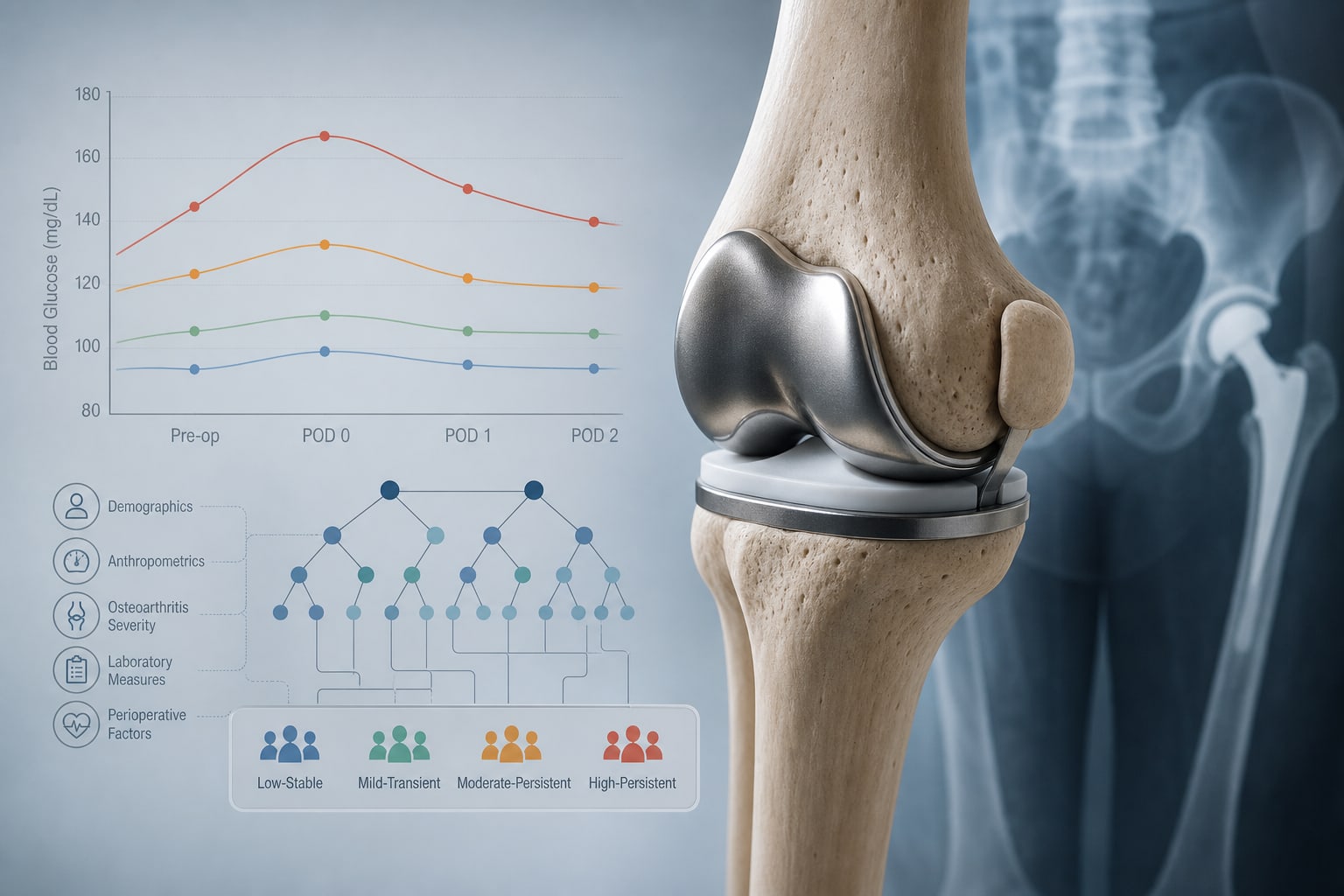
This study identified three distinct blood glucose trajectory groups in non-diabetic patients undergoing total joint arthroplasty (TJA) and developed a random forest model to predict these trajectories. The model achieved an accuracy of 78.3%.

Background

Total joint arthroplasty (TJA) is increasingly performed, particularly among elderly patients with comorbidities that elevate the risk of postoperative complications. Blood glucose fluctuations during the perioperative period can lead to serious complications, including infections and prolonged hospital stays.

Data Highlights

GroupDescriptionPercentage
Group 1Normal blood glucose, stable49.5%
Group 2Postoperative blood glucose slightly increased with minor fluctuations41.7%
Group 3Hyperglycemia with significant fluctuations8.8%

Key Findings

  • Three blood glucose trajectory groups were identified: stable normal, slightly increased, and hyperglycemic with fluctuations.
  • The random forest model predicted blood glucose trajectories with an accuracy of 78.3%.
  • Key predictors included age, RBC count post-surgery, and hypertension.
  • The incidence of postoperative hyperglycemia in TJA patients is reported to be 40%.

Clinical Implications

Monitoring blood glucose levels in non-diabetic patients undergoing TJA is essential.

Conclusion

This study identifies blood glucose trajectories in TJA patients.
Related Resources & Content

  1. Author(s)/Org, Source, Year -- Title
  2. Author(s)/Org, Source, Year -- Title
  3. Author(s)/Org, Source, Year -- Title
  4. Author(s)/Org, Source, Year -- Title
  5. Author(s)/Org, Source, Year -- Title
  6. Knee Surgery, Sports Traumatology, Arthroscopy — Increased Postoperative Pain Levels Observed in Younger Patients and Smokers Following Knee Arthroscopy: A Clinical and Experimental Investigation of Synovial Metabolism
  7. 2026 ADA Diabetes Standards of Medical Care Clinical Guideline Summary - American Diabetes Association Guidelines - Guideline Central
  8. Higher Blood Glucose Levels on the Day of Surgery Are Associated with an Increased Risk of Periprosthetic Joint Infection After Total Hip Arthroplasty - PubMed
  9. Impact of perioperative glucocorticoids on glycemic control, PONV, and acute pain after primary bilateral total knee arthroplasty: a systematic review and meta-analysis of randomized controlled trials | Journal of Orthopaedic Surgery and Research | Springer Nature Link

Original Source(s)

Related Content