Generating Question Prompt Lists From Electronic Health Record Data Using Large Language Models: Iterative Evaluation Study - Report - MDSpire

Generating Question Prompt Lists From Electronic Health Record Data Using Large Language Models: Iterative Evaluation Study

  • By

  • Zhe He

  • Balu Bhasuran

  • Mia Liza A Lustria

  • Karim Hanna

  • Michael Killian

  • Cindy Shavor

  • Mandy Dailey

  • Sai Sidharth Manikandan

  • Xiao Luo

  • July 9, 2026

  • 0 min

Share

Creating Lists of Inquiry Prompts from EHR Data Utilizing Large Language Models

Overview

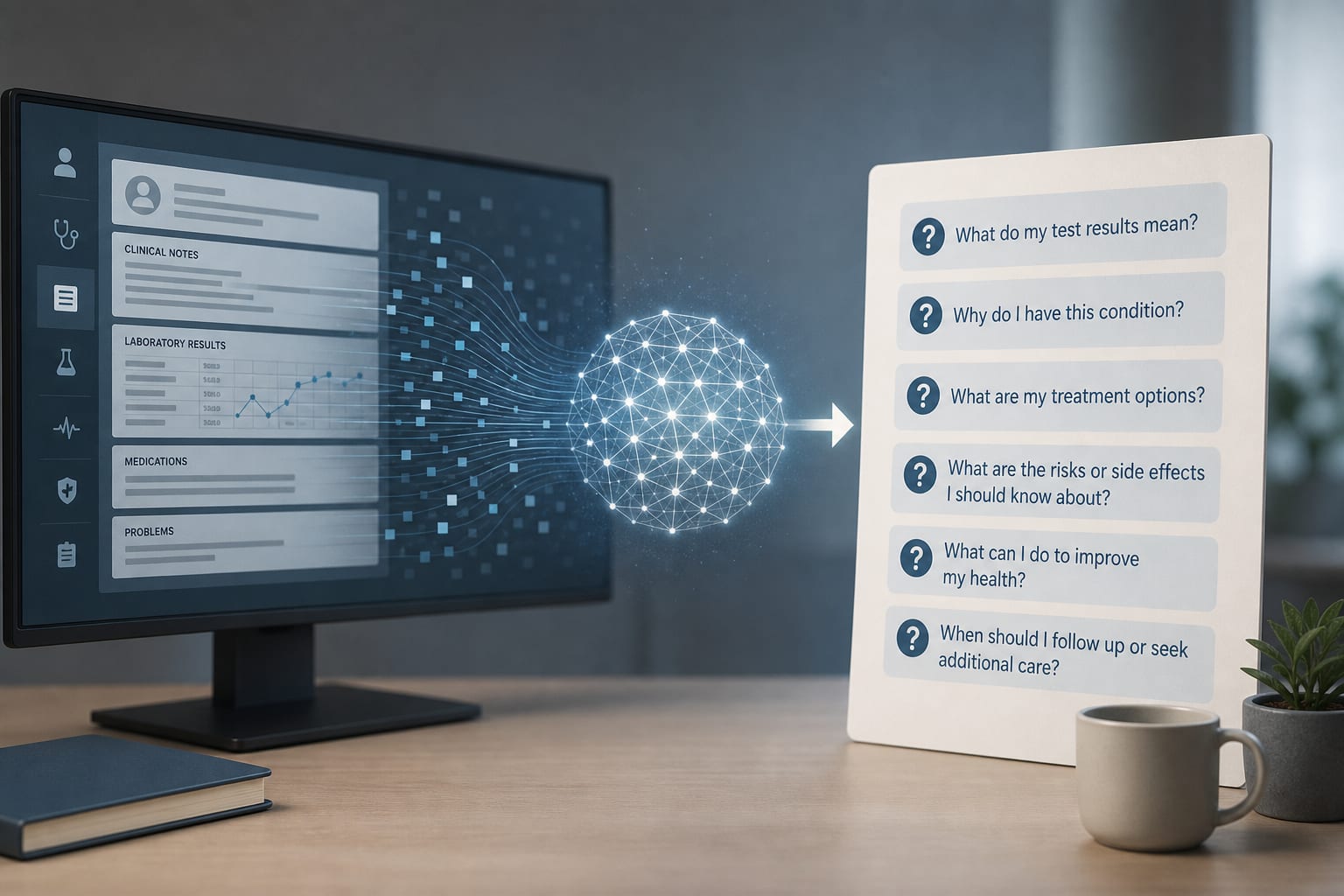
This study explores the use of large language models (LLMs) to generate tailored question prompt lists (QPLs) from electronic health record (EHR) data.

Background

The 21st Century Cures Act mandates that patients have near real-time access to their health records, including laboratory results, through electronic health record systems. However, the presentation of these results often lacks clarity, leading to potential misinterpretation, especially among vulnerable populations. Question prompt lists have been shown to improve patient communication, but traditional methods are often static and generic, highlighting the need for more dynamic, personalized approaches.

Data Highlights

No numerical or trial data was provided in the source material.

Key Findings

  • LLMs can generate tailored question prompt lists based on individual patient data.
  • Access to laboratory results through patient portals does not guarantee understanding.
  • Static QPLs limit patient engagement and do not reflect current clinical contexts.
  • Older adults and those with limited health literacy are particularly affected by the challenges of understanding lab results.

Clinical Implications

The integration of LLMs in EHR systems may facilitate more effective patient-clinician communication by providing personalized inquiry prompts.

Conclusion

Utilizing LLMs to create dynamic question prompt lists from EHR data may enhance understanding and communication during clinical encounters.

Related Resources & Content

  1. Lye CT, Forman HP, Daniel JG, Krumholz HM, J Am Med Inform Assoc, 2018 -- The 21st Century Cures Act and electronic health records one year later: will patients see the benefits?
  2. Pillemer F, Price RA, Paone S, et al., PLoS One, 2016 -- Direct release of test results to patients increases patient engagement and utilization of care.
  3. Witteman HO, Zikmund-Fisher BJ, Clin Chem Lab Med, 2019 -- Communicating laboratory results to patients and families.
  4. Keinki C, Momberg A, Clauß K, et al., Patient Educ Couns, 2021 -- Effect of question prompt lists for cancer patients on communication and mental health outcomes: a systematic review.
  5. Cadamuro J, Cabitza F, Debeljak Z, et al., Clin Chem Lab Med, 2023 -- Potentials and pitfalls of chatgpt and natural-language artificial intelligence models for the understanding of laboratory medicine test results.
  6. npj Digital Medicine — Evaluating clinical AI summaries with large language models as judges
  7. Journal of Medical Internet Research (JMIR) — Benchmark Integrity and Reasoning-Trace Errors in Medical Question Answering With Large Language Models: Mixed Methods Study With Sparse Autoencoders
  8. DIGITAL HEALTH — Factors shaping the adoption of large language models among hospital administrative staff: A cross-sectional survey study
  9. Frontiers in Medicine — Assessing multiple-choice question quality in internal medicine: a comparative analysis of three large language models against expert consensus
  10. Evaluating clinical AI summaries with large language models as judges
  11. Benchmark Integrity and Reasoning-Trace Errors in Medical Question Answering With Large Language Models
  12. Factors shaping the adoption of large language models among hospital administrative staff
  13. Assessing multiple-choice question quality in internal medicine
  14. When would a delay in fulfilling a request for access, exchange, or use of EHI be considered an interference under the information blocking regulation?
  15. A scoping review of studies on secure messaging through patient portals: persistent challenges and potential solutions | npj Health Systems
  16. Marketing Submission Recommendations for a Predetermined Change Control Plan for Artificial Intelligence-Enabled Device Software Functions | FDA

Original Source(s)

Related Content