SEMA4A signaling in macrophage subpopulations and its implication in osteoarthritis - Report - MDSpire

SEMA4A signaling in macrophage subpopulations and its implication in osteoarthritis

  • By

  • Yue Qiu

  • Shuzhong Huang

  • Bo Yu

  • Baochen Wei

  • Tianyu Ren

  • Xiaofan Yang

  • Zhanying Shi

  • Zhaolan Wei

  • June 5, 2026

  • 0 min

Share

Clinical Report: The Role of SEMA4A Signaling in Macrophage Subtypes and Its Relevance to Osteoarthritis

Overview

Revise to emphasize the specific role of SEMA4A in macrophage interactions and its implications for OA.

Background

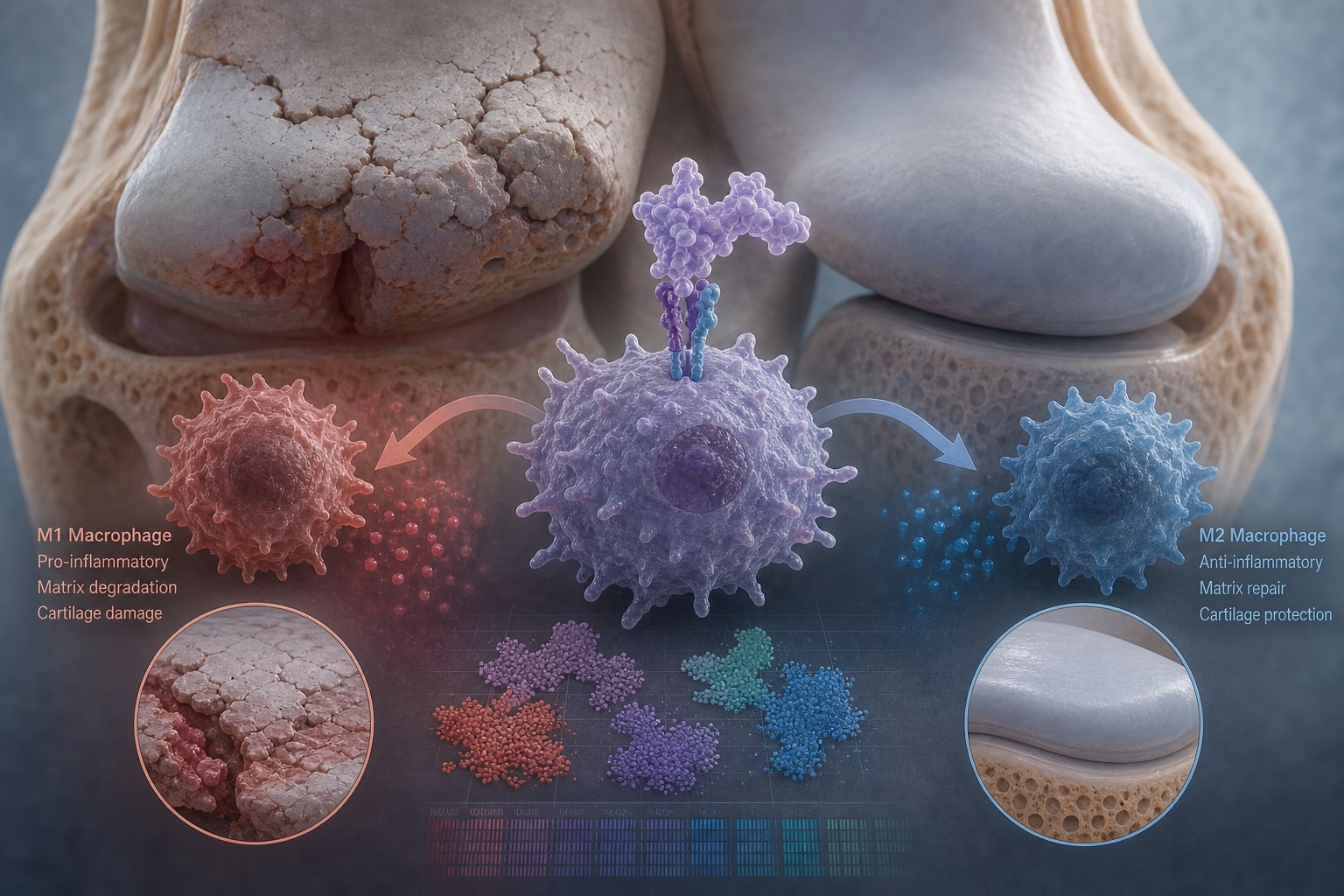
Osteoarthritis is a prevalent degenerative joint disease affecting millions globally, characterized by cartilage degradation and low-grade inflammation. Macrophages play a crucial role in OA pathogenesis, with an imbalance in M1 and M2 polarization contributing to disease progression. Understanding the signaling pathways involved in macrophage interactions can provide insights into potential therapeutic targets for OA.

Data Highlights

This study utilized single-cell transcriptomic data from 6 normal and 12 OA samples to analyze macrophage interactions and identified SEMA4A as a critical gene in this process.

Key Findings

  • SEMA4A was identified as the only overlapping key gene in macrophage communication during OA progression.
  • M1 macrophages were found to be the dominant signal senders in the SEMA4A–PLXNB2 interaction.
  • There was a dynamic expression pattern of SEMA4A along the macrophage pseudotime trajectory.
  • SEMA4A–PLXNB2 signaling may amplify the inflammatory microenvironment in osteoarthritic joints.
  • The study provides single-cell-level evidence for the inflammatory mechanisms of OA.

Clinical Implications

The findings suggest that targeting the SEMA4A–PLXNB2 signaling pathway may offer a novel therapeutic approach to modulate macrophage polarization and reduce inflammation in OA. Further validation of this pathway could lead to new strategies for managing OA-related symptoms and progression.

Conclusion

The SEMA4A–PLXNB2 signaling pathway is integral to the inflammatory network in OA and represents a promising target for future therapeutic interventions.

Related Resources & Content

  1. Frontiers in Immunology, 2026 -- Integrative multi-omics identifies MSR1 as a programmed cell death and extracellular matrix hub gene in osteoarthritis with hesperidin targeting potential
  2. Clinical Rheumatology, 2020 -- The Role of Osteoimmunology in Rheumatoid and Psoriatic Arthritis: Investigating Tofacitinib's Impact on Bone Health
  3. Frontiers in Immunology, 2026 -- The mechanism of action and therapeutic potential of macrophages in osteoporosis: from polarization balance to targeted regulation
  4. Osteoarthritis Clinical Practice Guidelines | American College of Rheumatology
  5. Basic Research in Cardiology — Serum Amyloid A's Role in HFpEF and Associated Cardiometabolic Disorders
  6. Effectiveness and safety of intra-articular interventions for knee and hip osteoarthritis based on large randomized trials: A systematic review and network meta-analysis
  7. Osteoarthritis Clinical Practice Guidelines | American College of Rheumatology
  8. Frontiers | Unraveling the spatial and signaling dynamics and splicing kinetics of immune infiltration in osteoarthritis synovium

Original Source(s)

Related Content