Interleukin-15 correlates with cytotoxic immune networks in cervical tuberculous lymphadenitis - Report - MDSpire

Interleukin-15 correlates with cytotoxic immune networks in cervical tuberculous lymphadenitis

  • By

  • Soumaya Bchiri

  • Khadija Bahrini

  • Rosane M. B. Teles

  • Ameni Ben Alaya

  • Houssem Eddine Kamel

  • Julie West

  • Kimia Rategh

  • Asma Bouzekri

  • Eya Bousalem

  • Rim Ouni

  • Meriem Fassatoui

  • Helmi Mardassi

  • Neira Dekhil

  • Issam Ben Belghith

  • Rym Lahiani

  • Emna Romdhane

  • Meriem Ben-Ali

  • Soumaya Rammeh

  • Asma Ferjani

  • Mamia Ben-Saleh

  • Mohamed-Ridha Barbouche

  • Robert L. Modlin

  • Chaouki Benabdessalem

  • June 3, 2026

  • 0 min

Share

Clinical Report: Association of Interleukin-15 with Cytotoxic Immune Networks in Cervical Tuberculous Lymphadenitis

Overview

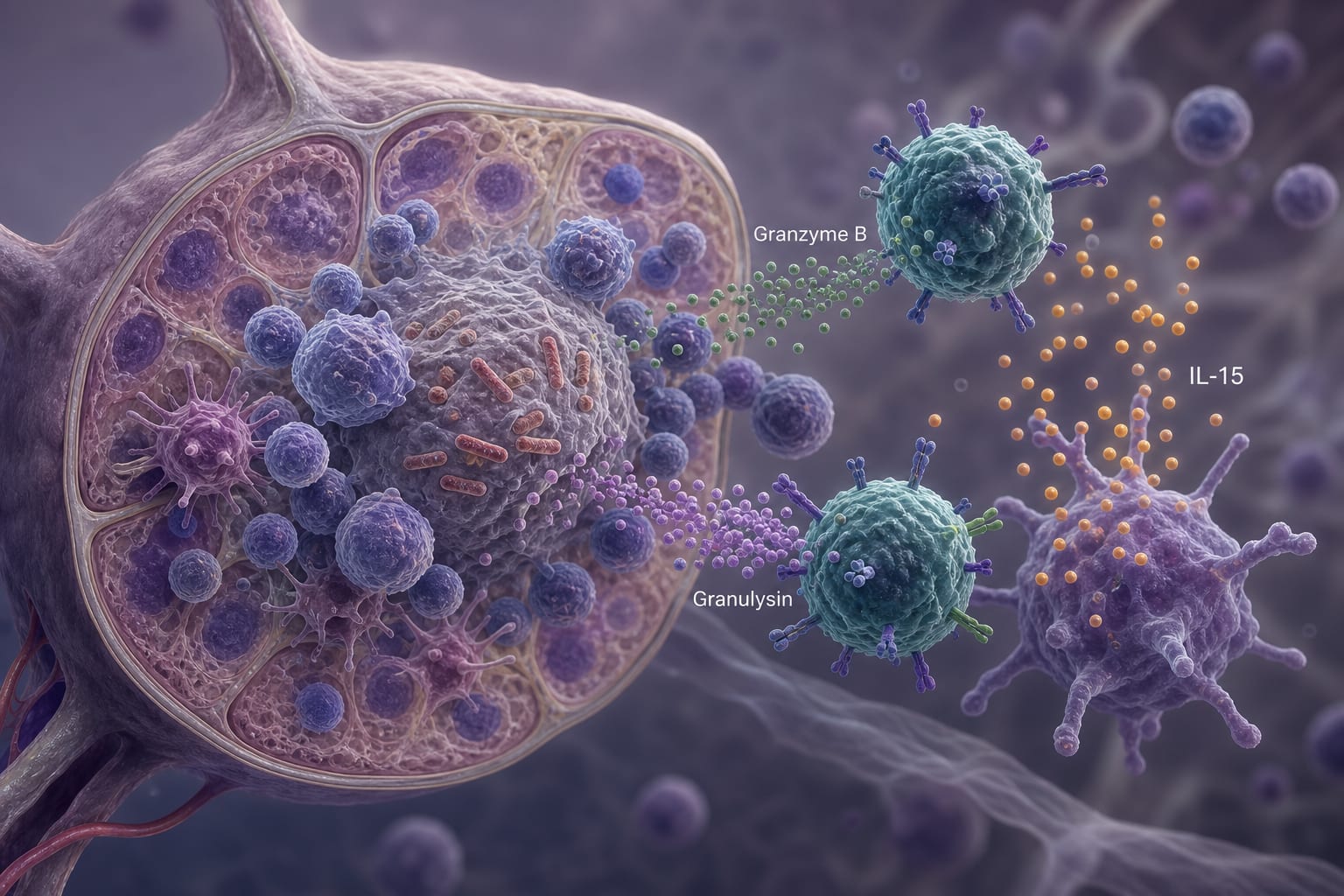
This study identifies interleukin-15 (IL-15) as a central organizer of cytotoxic immune responses in cervical tuberculous lymphadenitis (CTL). Elevated IL-15 levels correlate with cytotoxic effector genes and bacillary burden, suggesting its potential as a biomarker for CTL.

Background

Cervical tuberculous lymphadenitis (CTL) is a significant extrapulmonary manifestation of tuberculosis, which has seen an increase in incidence, particularly in regions like Tunisia. Understanding the immune mechanisms involved in CTL is crucial for improving diagnostic and therapeutic strategies, as timely management can significantly affect patient outcomes.

Data Highlights

ParameterCTL (n=60)CNTL (n=44)P-value
IL-15 transcripts in bloodElevatedNormal0.0003
IL-15 transcripts in lymph nodesElevatedNormal0.0007
Circulating IL-15 concentrationsHigherLower< 0.0001
Correlation with cytotoxic effector genesStrongN/AN/A

Key Findings

  • IL-15 is a highly connected hub in the cytotoxic immune network of CTL.
  • Elevated IL-15 levels were found in both blood and lymph nodes of CTL patients.
  • Circulating IL-15 concentrations correlate with bacillary burden as measured by GeneXpert.
  • IL-15 and IL-15Rα are expressed in CD68+ macrophages within granulomatous regions.
  • CTL exhibits a structured cytotoxic immune program enriched for key effector molecules.

Clinical Implications

The identification of IL-15 as a central cytokine in CTL suggests its potential as a biomarker for diagnosis and monitoring treatment response. Clinicians should consider the role of IL-15 in the immune response to enhance understanding and management of CTL.

Conclusion

IL-15 plays a pivotal role in orchestrating cytotoxic immune responses in cervical tuberculous lymphadenitis, highlighting its potential as a biomarker and therapeutic target in managing this condition.

Related Resources & Content

  1. Blood Cancer Journal, 2015 -- IL-10 induces the development of immunosuppressive CD14+HLA-DRlow/− monocytes in B-cell non-Hodgkin lymphoma
  2. Frontiers in Immunology, 2026 -- Target receptor expression dictates the selective intra-tumoral targeting of CD8+ T cells by eciskafusp alfa in matched PBMCs and TILs from CPI-naïve patients
  3. Frontiers in Immunology, 2026 -- The role and mechanisms of multiple immunoregulatory cells in pulmonary tuberculosis
  4. WHO consolidated guidelines on tuberculosis: module 3: diagnosis
  5. WHO operational handbook on tuberculosis. Module 4: treatment and care
  6. Frontiers in Immunology — Exhausted CD4+T cells are associated with CCL4-driven immunosuppressive macrophage accumulation in enzootic bovine leukosis
  7. WHO consolidated guidelines on tuberculosis: module 3: diagnosis
  8. WHO operational handbook on tuberculosis. Module 4: treatment and care
  9. Single-cell transcriptomics of cervical lymph node tuberculosis reveals cellular heterogeneity and enhanced cellular communication | BMC Immunology | Full Text

Original Source(s)

Related Content