Transforming Metabolic Interference into Homeostatic Recovery: Modifying Hepatic Stellate Cell Energy Dynamics for the Reversal of Liver Fibrosis
-
By
-
Xinyu Lu
-
Zilong Li
-
September 7, 2026
Transforming Metabolic Interference into Homeostatic Recovery: Modifying Hepatic Stellate Cell Energy Dynamics for the Reversal of Liver Fibrosis
Background
Liver cirrhosis results from chronic liver diseases leading to hepatic fibrosis. Understanding the mechanisms of fibrosis and potential reversibility is crucial for improving patient outcomes. The role of hepatic stellate cells (HSCs) in fibrosis progression underscores the need for targeted therapeutic strategies.
Data Highlights
No numerical data or trial data provided in the source material.
Key Findings
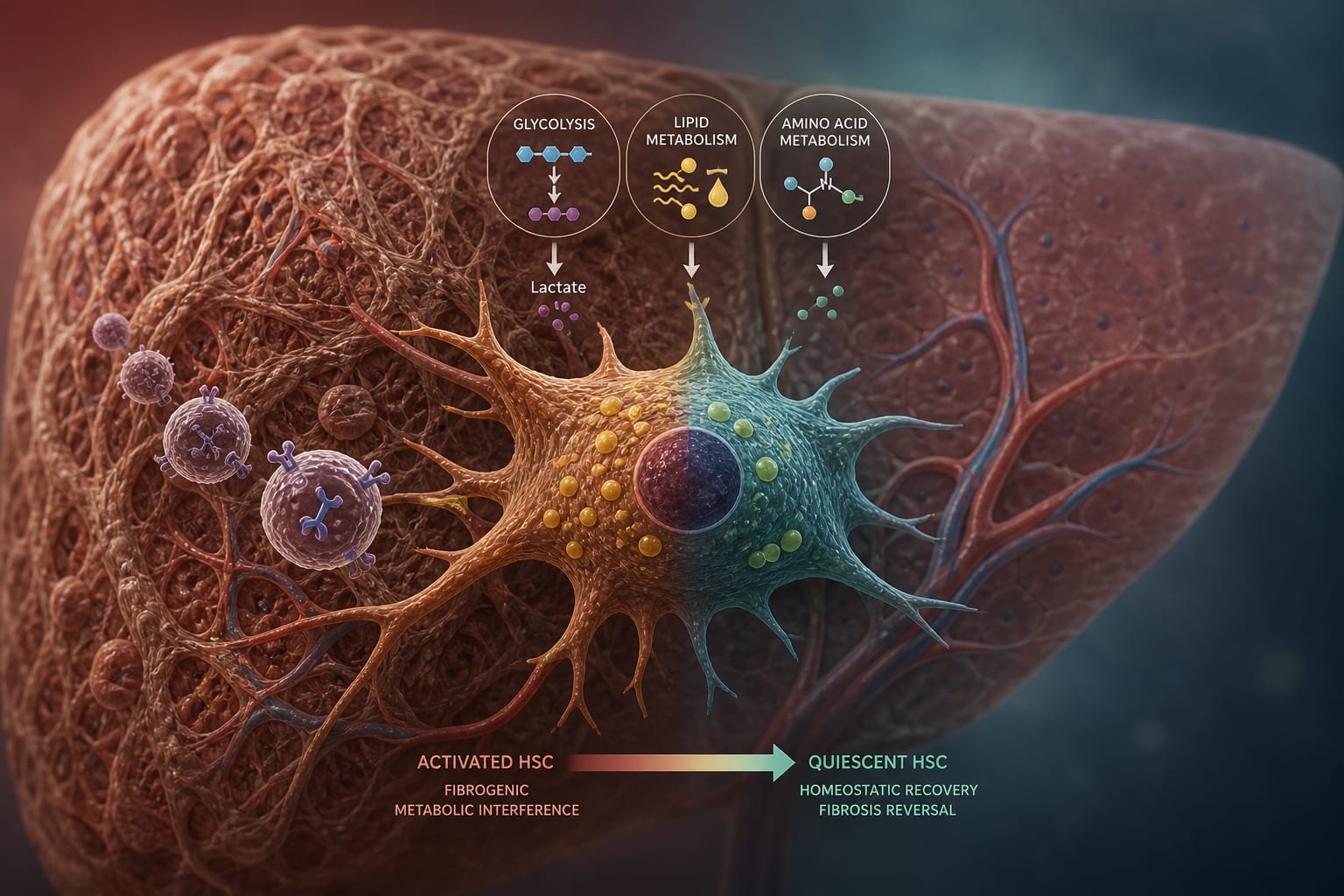
- Lactate from glycolysis acts as an epigenetic signal via histone lactylation, sustaining fibrogenic gene expression.
- Activated HSCs release GLUT1-containing exosomes that can reprogram adjacent quiescent cells, facilitating the fibrotic phenotype.
- HSC activation shows stage-specific metabolic vulnerabilities, with early activation relying on lipophagy for fatty acid oxidation.
- Fully activated HSCs exhibit a 'dual hypermetabolic' state involving glycolysis and tricarboxylic acid cycle activity.
- Clinical-stage agents like EVT0185, VDR agonists, and ROCK2 inhibitors have shown early promise in restoring metabolic homeostasis.
- Future anti-fibrotic strategies should focus on stage-specific metabolic signatures and selective metabolic modulators.
Clinical Implications
Understanding the metabolic dynamics of HSCs may inform the development of targeted therapies for liver fibrosis.
Conclusion
Insights into HSC metabolic reprogramming present a potential avenue for developing therapies against liver fibrosis.
Related Resources & Content
- Frontiers in Immunology, 2026 -- Strategies to promote liver fibrosis amelioration with involvement of restorative macrophages
- Frontiers in Immunology, 2026 -- Targeting macrophages in liver fibrosis
- Frontiers in Oncology, 2026 -- Liver cirrhosis and hepatocellular carcinoma: chronological decoupling of biochemical clearance and mechanical regeneration signals a systems biology hypothesis on programed deconstruction failure
- BMJ Open Gastroenterology, 2023 -- Liver fibrosis in metabolic dysfunction-associated steatotic liver disease: epidemiology, risk stratification and therapeutics
- EASL–EASD–EASO Clinical Practice Guidelines on the management of metabolic dysfunction-associated steatotic liver disease (MASLD) - Journal of Hepatology, 2024
- A Phase 3, Randomized, Controlled Trial of Resmetirom in NASH with Liver Fibrosis | New England Journal of Medicine, 2024
- AASLD/IDSA 2023 Clinical Practice Guidance Update for Testing, Managing, and Treating Hepatitis C Virus Infection
- EASL–EASD–EASO Clinical Practice Guidelines on the management of metabolic dysfunction-associated steatotic liver disease (MASLD) - Journal of Hepatology
- A Phase 3, Randomized, Controlled Trial of Resmetirom in NASH with Liver Fibrosis | New England Journal of Medicine
- AASLD/IDSA 2023 Clinical Practice Guidance Update for Testing, Managing, and Treating Hepatitis C Virus Infection
Based on findings from:
From metabolic antagonism to homeostatic restoration: rewiring hepatic stellate cell bioenergetics for liver fibrosis reversal
Xinyu Lu, Zilong Li. Frontiers In Medicine, 2026.
https://www.frontiersin.org/journals/medicine/articles/10.3389/fmed.2026.1912158/full
This content is an AI-generated, fully rewritten summary based on a published scholarly article. It does not reproduce the original text and is not a substitute for the original publication. Readers are encouraged to consult the source for full context, data, and methodology.