Editorial: Tumor microenvironment and personalized therapy of gastrointestinal cancer Ⅱ - Report - MDSpire
Coming Soon: Introducing MDSpire News. Learn more
Conexiant’s news site is now MDSpire News. Learn more

Editorial: The Role of Tumor Microenvironment in Tailored Treatments for Gastrointestinal Cancer II

  • By

  • Xinxin Wang

  • Jianming James Tang

  • Shuang Yang

  • Shuo Li

  • September 8, 2026

Share

Clinical Report: The Role of Tumor Microenvironment in Tailored Treatments for Gastrointestinal Cancer II

Overview

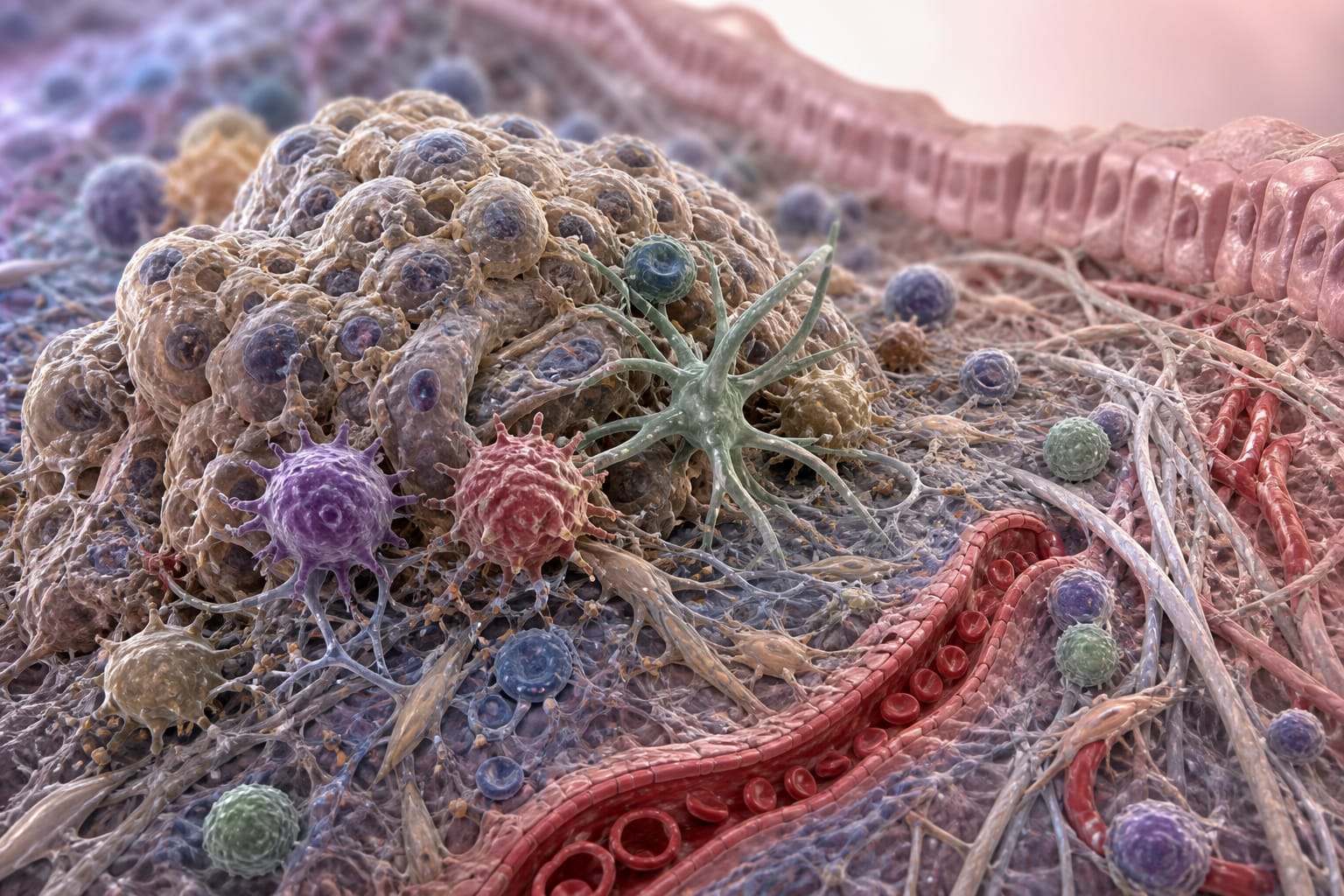
This editorial discusses the tumor microenvironment (TME) in personalized treatment strategies for gastrointestinal cancers, highlighting recent findings on how systemic and local factors can influence patient outcomes and treatment efficacy.

Background

Gastrointestinal cancers present significant challenges due to their biological and clinical heterogeneity, leading to poor outcomes despite advancements in treatment. Understanding the interactions between tumors and their microenvironment is crucial for developing personalized therapies.

Data Highlights

No numerical data available in the source material.

Key Findings

  • The tumor microenvironment significantly influences cancer progression and treatment response.
  • A preoperative nomogram developed by Bai et al. predicts postoperative complications in gastric cancer patients.
  • Chen et al. found that the C-reactive protein-to-albumin ratio on postoperative day 3 can predict severe complications after radical gastrectomy.
  • The pan-immune-inflammation value (PIV) is associated with survival outcomes in gastric cancer, demonstrating its prognostic relevance.
  • The C-reactive protein-albumin-lymphocyte (CALLY) index shows improved prognostic performance compared to traditional inflammatory markers in colorectal cancer.
  • Wang et al. reported significant differences in immune cell infiltration between preoperative biopsies and resected tumor tissues.

Clinical Implications

Integrating systemic inflammatory markers and body composition assessments into preoperative evaluations may inform individualized management strategies.

Conclusion

Continued research in the tumor microenvironment is essential for advancing personalized cancer care.

Related Resources & Content

  1. Frontiers in Immunology, 2026 -- Community Series in Tumor Microenvironment and Metabolic Reprogramming in Cancer: Volume II
  2. Frontiers in Oncology, 2026 -- Exploring the tumor microenvironment in resectable lung cancer
  3. Frontiers in Endocrinology, 2026 -- Changes in Metabolic Characteristics Associated with Gastrointestinal Tract Cancers, Volume II
  4. Frontiers in Immunology, 2026 -- Molecular pathways and signaling molecules in cancer therapy: advances and innovations
  5. ASCO Publications -- Immunotherapy and Targeted Therapy for Advanced Gastroesophageal Cancer: ASCO Living Guideline
  6. ASCO -- First results of nivolumab (NIVO) plus ipilimumab vs NIVO monotherapy for MSI-H/dMMR metastatic colorectal cancer from CheckMate 8HW.
  7. Immunotherapy and Targeted Therapy for Advanced Gastroesophageal Cancer: ASCO Living Guideline | ASCO Publications
  8. First results of nivolumab (NIVO) plus ipilimumab (IPI) vs NIVO monotherapy for microsatellite instability-high/mismatch repair-deficient (MSI-H/dMMR) metastatic colorectal cancer (mCRC) from CheckMate 8HW. - ASCO
  9. Circulating Tumor DNA Testing in Solid Tumors and Lymphoma: ASCO Guideline | JCO Oncology Practice

Original Source(s)

Related Content