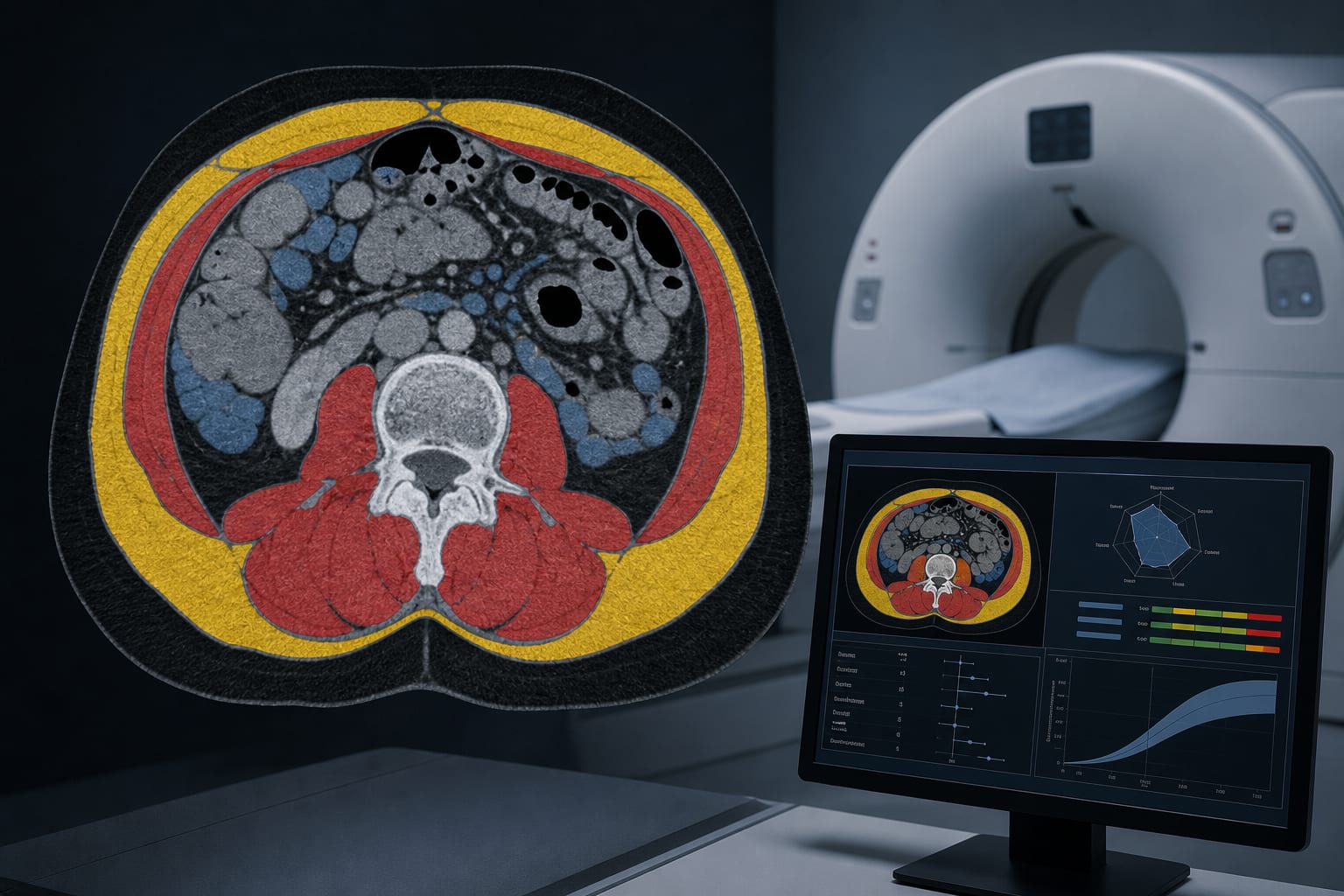
Development and validation of a CT-based body composition model for predicting adverse outcomes in small bowel obstruction - Report - MDSpire

Development and validation of a CT-based body composition model for predicting adverse outcomes in small bowel obstruction

  • By

  • Yanan Shi

  • Zhendong Wang

  • Xiaojuan Tian

  • Feng Wu

  • Xiaole Ma

  • Kai Jia

  • Jiansheng Guo

  • Tian Yao

  • He Huang

  • Yuntong Guo

  • June 1, 2026

  • 0 min

Share

Clinical Report: CT-Derived Body Composition Framework for SBO Outcomes

Overview

This study developed a CT-derived body composition model to predict adverse postoperative outcomes in small bowel obstruction (SBO) patients. Key findings indicate that low skeletal muscle density is a significant predictor of complications such as sepsis and ICU admission.

Background

Small bowel obstruction is a common surgical emergency with unpredictable postoperative outcomes. Current risk models based on clinical parameters lack precision, necessitating a more comprehensive approach that includes body composition and systemic inflammation. Understanding these factors can improve risk stratification and patient management in surgical settings.

Data Highlights

OutcomeAdjusted Odds Ratio (aOR)95% Confidence Interval (CI)p-value
Postoperative Sepsis4.581.61–13.040.004
ICU Admission3.761.55–9.130.003
Postoperative Complications3.731.59–8.710.002

Key Findings

  • Low skeletal muscle density (SMD) is a potent predictor of adverse outcomes in SBO patients.
  • Prolonged time from symptom onset to surgery correlates with increased risk of complications.
  • Longer operative duration and lower serum albumin levels are significant risk factors.
  • Elevated D-dimer and greater resected bowel length are associated with worse postoperative outcomes.
  • The predictive model demonstrated strong discriminative ability with AUC values ranging from 0.72 to 0.84.

Clinical Implications

The developed nomogram can aid clinicians in early postoperative risk stratification for SBO patients, allowing for targeted monitoring and resource allocation. Incorporating body composition metrics into routine assessments may enhance the predictive accuracy of postoperative outcomes.

Conclusion

This study presents a validated multidimensional nomogram that integrates body composition and clinical factors to predict adverse outcomes in SBO patients, highlighting the importance of comprehensive risk assessment in surgical care.

Related Resources & Content

  1. Frontiers | Development and validation of a CT-based body composition model for predicting adverse outcomes in small bowel obstruction, 2026 -- Frontiers in Medicine
  2. Obesity Surgery — Comparative Analysis of Small Intestine Length Assessment via 3D CT Volumetry and In Vivo Laparoscopic Techniques with Pre-marked Graspers, 2025
  3. A Predictive Nomogram for Short- and Long-Term Outcomes in Colon Cancer Utilizing CT Body Composition Analysis, 2025
  4. European Radiology — Prognostic Value of Serum Tumor Markers and CT Body Composition Analysis in Colorectal Cancer Surgical Patients, 2024
  5. Obesity Surgery — A Novel Nomogram for Forecasting Early Weight Loss Results in Obese Patients After Laparoscopic Sleeve Gastrectomy
  6. American College of Radiology
  7. Frontiers | Development and validation of a CT-based body composition model for predicting adverse outcomes in small bowel obstruction

Original Source(s)

Related Content