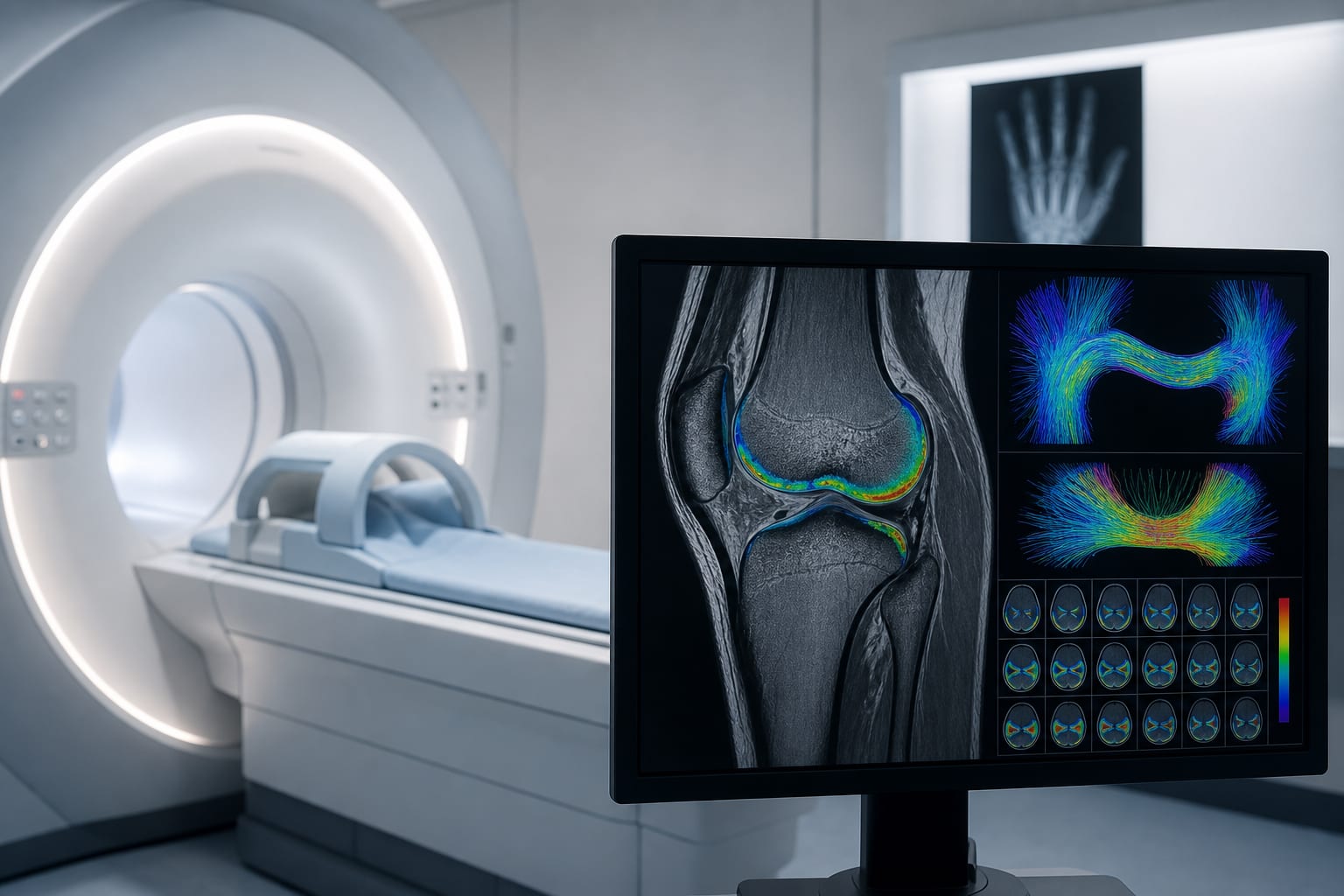
Clinical Report: Assessing Pediatric Knee Cartilage Growth Patterns Using DTI
Overview
This study establishes normative diffusion tensor imaging (DTI) biomarkers for knee cartilage development in children aged 6-12 years, highlighting significant sex-specific differences. Findings indicate that fractional anisotropy (FA) values correlate strongly with bone age, while apparent diffusion coefficient (ADC) values decrease with increasing bone age.
Background
Understanding pediatric knee cartilage development is crucial for early detection of pathological changes that could lead to growth retardation and skeletal deformities. Diffusion tensor imaging (DTI) provides a quantitative assessment of cartilage microstructure, which may enhance monitoring of cartilage development in children. This study focuses on a critical age range (6-12 years) where cartilage is particularly sensitive to disease.
Data Highlights
Measure
Findings
FA Values
Increased significantly with age and bone age (p < 0.001)
Correlation with Bone Age
Boys: r = 0.843; Girls: r = 0.789
ADC Values
Decreased with increasing bone age (Girls: r = -0.702; Boys: r = -0.511; p < 0.001)
SNR Correlation
Positively correlated with age and bone age
Reproducibility
ICC for FA/ADC > 0.94
Key Findings
FA values increased significantly with age and bone age (p < 0.001).
Girls exhibited higher FA values than boys across all age groups (p < 0.05).
ADC values in the growth plate decreased with increasing bone age.
SNR correlated positively with age and bone age.
Excellent reproducibility of DTI measurements was confirmed (ICC > 0.94).
Clinical Implications
The findings indicate that DTI biomarkers can be utilized for monitoring knee cartilage development in pediatric populations.
Conclusion
DTI biomarkers reflect pediatric knee cartilage maturation and correlate with bone age.