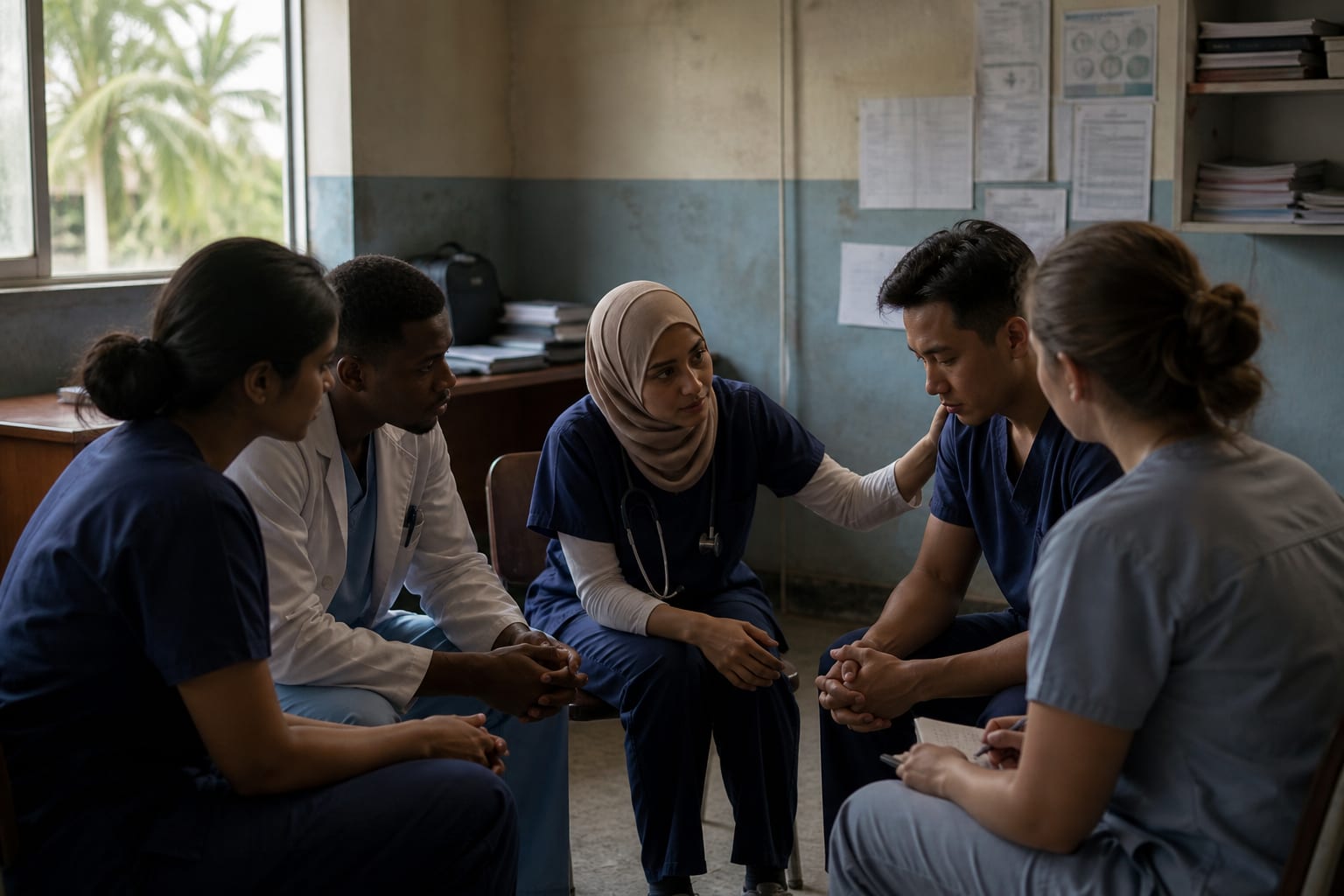
RESIST: Strengthening Resident Resilience in Resource-Limited Settings
-
By
-
Sayed K. Ali
-
Ali K. Chandani
-
Falak Sayed
-
Zohray Talib
-
October 9, 2026
Clinical Report: RESIST: Strengthening Resident Resilience in Resource-Limited Settings
Overview
RESIST is a structured, cost-conscious initiative developed at Aga Khan University Hospital in Nairobi to integrate resiliency into residency programs in a low- and middle-income setting. Its six domains address rest and workload, emotional and peer support, resident skills, institutional culture and psychological safety, faculty mentorship, and ongoing measurement. The article reports that staffing and workload measures were followed by reduced resident attrition and lower self-reported burnout, without providing numerical outcome estimates.
Background
Residency programs in low- and middle-income countries face constraints including limited educational funding, inadequate faculty development infrastructure, and workforce shortages. The source describes these conditions as contributing to trainee stress, burnout, anxiety, and depression, with potential effects on communication, errors, and patient satisfaction. It cites burnout in 95.4% of healthcare workers at Kenya’s largest government referral hospital and high burnout risk in 47.3% of residents at a Kenyan tertiary academic teaching center. Evidence on developing and sustaining resiliency initiatives in low-resource settings remains limited, while approaches reported in higher-resource settings include mindfulness, mentorship, workload regulation, and organizational interventions.
Data Highlights
| Measure or context | Reported finding | Source detail |
|---|---|---|
| Burnout among healthcare workers | 95.4% | Kokonya et al., at Kenya’s largest government referral hospital |
| High risk of burnout among residents | 47.3% | Residents at a tertiary academic teaching center in Kenya |
| RESIST staffing measure | Four part-time locum junior providers | Covered additional shifts, academic half-days, and weekends |
| RESIST outcomes reported | Reduced resident attrition and lower self-reported burnout | Monitored metrics after implementation; numerical estimates were not provided |
| Institutional context | ACGME-I accreditation in 2020 | AKUH Nairobi became Africa’s first institution to attain ACGME-I accreditation, according to the article |
Key Findings
- RESIST was developed at Aga Khan University Hospital, Nairobi, after the institution attained ACGME-I accreditation in 2020.
- The six RESIST domains are adequate rest and manageable workloads; emotional and collegial support; resident skills development; institutional culture and psychological safety; faculty mentorship and role modeling; and ongoing measurement with iterative improvement.
- Four part-time locum junior providers were used to cover additional shifts, academic half-days, and weekends; the article reports reduced resident fatigue while maintaining protected educational time.
- After implementation, monitored metrics showed reduced resident attrition and lower self-reported burnout; the article does not provide numerical effect estimates.
- Peer-support groups, faculty mentorship, community mental health partnerships, and structured debriefing after critical clinical events were used to support residents, particularly where counseling access was limited.
- The article identifies departmental conflict, high patient volumes, workforce shortages, work–personal life challenges, and maladaptive coping, including substance use, as factors associated with burnout in the cited Kenyan studies.
Clinical Implications
The article describes workload tracking, additional clinical coverage, protected educational time, access to rest and supervision, peer support, mentorship, and debriefing as components used in the RESIST initiative. It notes that programs with greater resource constraints might adapt coverage through rotating elective coverage or task-shifting; it also reports that a less expensive electronic health record reduced documentation burden, although this was not originally part of RESIST.
Conclusion
RESIST presents a six-domain framework for incorporating resiliency into residency training in a resource-limited setting. The reported implementation outcomes include reduced attrition and lower self-reported burnout, while the article notes that evidence on long-term maintenance of such initiatives remains limited.
Related Resources & Content
- Article source, RESIST: Strengthening Resident Resilience in Resource-Limited Settings, year not provided
- ACGME, Common Program Requirements (Residency), 2026
- Comparative Efficacy of Interventions for Burnout in Physician Residents: A Systematic Review and Network Meta-Analysis of Randomized Controlled Trials, 2026
- World Federation for Medical Education, Postgraduate Medical Education standards, 2023
- World Health Assembly, resolution on health and care worker mental health and well-being, 2025
- Journal of General Internal Medicine — Strengthening the HIV Care Workforce Through Residency Training Pathways
- ASCO Publications — Resiliency among nursing staff in an inpatient medical oncology unit.
- ASCO Publications — Resiliency among nursing staff in an inpatient medical oncology unit.
- ASCO Publications — Promoting resilience in stress management within patients with early stage breast cancer.
- ACGME Common Program Requirements (Residency)
- Comparative Efficacy of Interventions for Burnout in Physician Residents: A Systematic Review and Network Meta-Analysis of Randomized Controlled Trials
- ACGME Common Program Requirements (Residency)
- Comparative Efficacy of Interventions for Burnout in Physician Residents: A Systematic Review and Network Meta-Analysis of Randomized Controlled Trials.
- Burnout Affects Nearly One in Two Postgraduate Resident Doctors in India: A Systematic Review and Meta-analysis | International Journal of Medical Students
Based on findings from:
RESIST: Addressing Resident Resiliency in Low-Resource Settings
Sayed K. Ali, Ali K. Chandani, Falak Sayed, Zohray Talib. Journal Of General Internal Medicine, 2026.
https://link.springer.com/article/10.1007/s11606-026-10896-4
This content is an AI-generated, fully rewritten summary based on a published scholarly article. It does not reproduce the original text and is not a substitute for the original publication. Readers are encouraged to consult the source for full context, data, and methodology.