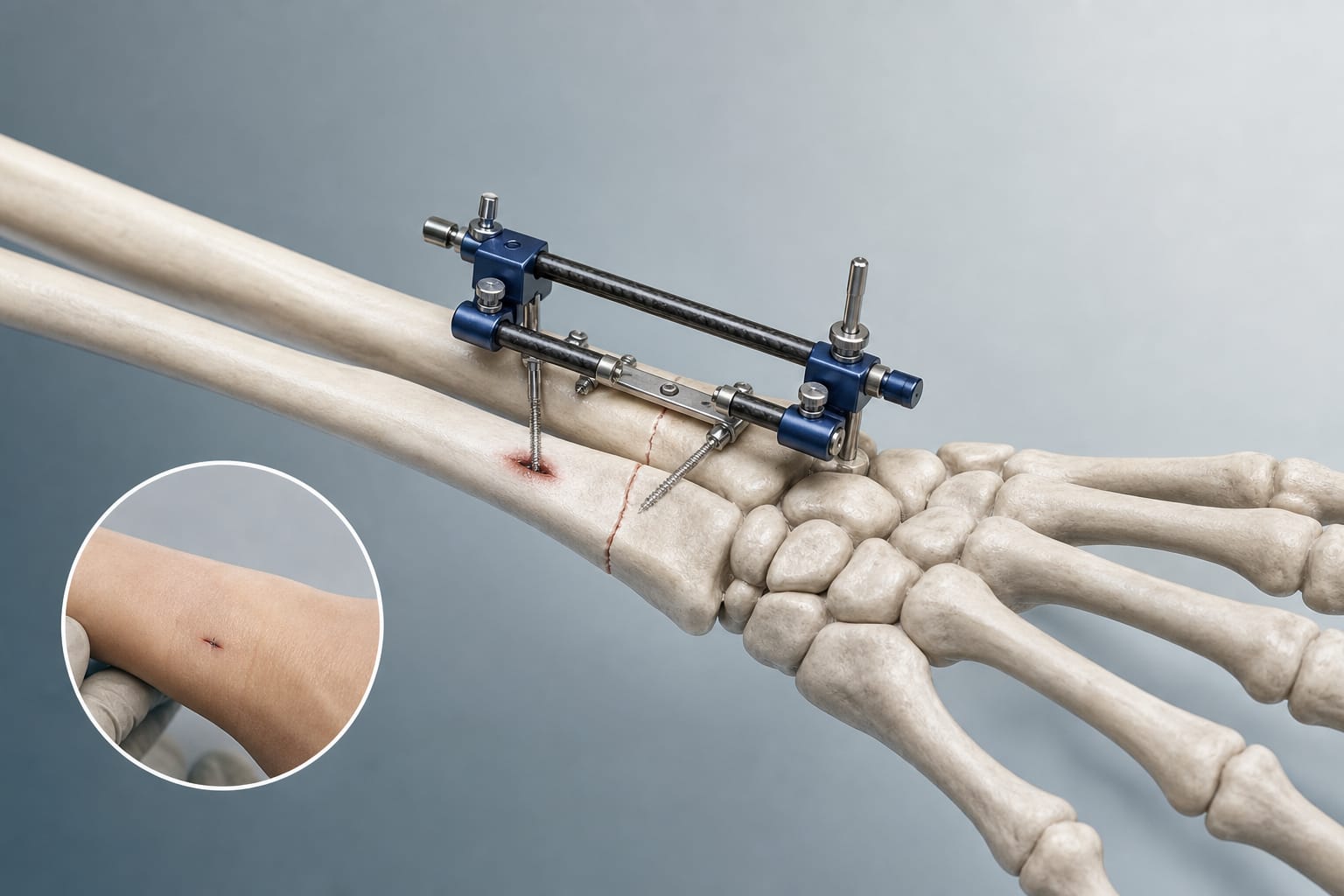
Clinical efficacy of STMIPO in the management of distal one-third fibular fractures - Report - MDSpire

Clinical efficacy of STMIPO in the management of distal one-third fibular fractures

  • By

  • Wei Li

  • Yang Li

  • Quankui Zhuang

  • Song Shao

  • July 6, 2026

  • 0 min

Share

Clinical Report: Effectiveness of STMIPO Technique in Treating Distal Fibular Fractures

Overview

The STMIPO technique shows reduced surgical incision length and intraoperative blood loss compared to traditional ORIF in treating distal one-third fibular fractures. Both techniques resulted in comparable postoperative ankle AOFAS scores and successful osseous union.

Background

Ankle fractures account for approximately 10% of all fractures. The anatomical reduction of the fibula is crucial for ankle joint stability. Traditional treatment methods, such as open reduction and internal fixation (ORIF), often involve significant soft tissue trauma, impacting healing. The STMIPO technique offers a minimally invasive alternative that aims to balance fracture reduction quality with soft tissue preservation.

Data Highlights

ParameterSTMIPO GroupORIF Group
Operation TimeNot specifiedNot specified
Fracture Healing TimeNot specifiedNot specified
Intraoperative Blood LossReducedHigher
Length of IncisionSmallerLarger
Postoperative ComplicationsFewerMore

Key Findings

  • STMIPO technique resulted in smaller surgical incisions compared to ORIF.
  • Intraoperative blood loss was lower in the STMIPO group.
  • Postoperative complications were fewer in the STMIPO group.
  • Both STMIPO and ORIF groups achieved osseous union of the fibula.
  • No significant difference in postoperative ankle AOFAS scores between the two groups.

Clinical Implications

The STMIPO technique offers benefits in terms of incision size and blood loss while maintaining comparable functional outcomes.

Conclusion

The STMIPO technique presents a minimally invasive option for treating distal one-third fibular fractures, demonstrating advantages in surgical parameters while achieving similar healing outcomes.

Related Resources & Content

  1. Anwar et al., Archives of Orthopaedic and Trauma Surgery, 2021 -- To Repair or Not to Repair? The Impact of Fixing a Small Posterior Malleolar Fragment on Rotational Stability in Trimalleolar Fractures
  2. Evaluation of the PRECICE Magnetic Intramedullary Compression Nail for Treating Long Bone Nonunions: An Initial Study, 2019
  3. Utilization of Double-Plate Fixation Technique to Mitigate Varus Collapse in AO Type C3 Supra-Intercondylar Distal Femur Fractures, 2023
  4. Archives of Orthopaedic and Trauma Surgery — Clinical and functional outcomes of fracture pattern-driven plate osteosynthesis technique for comminuted patellar fractures using multiple miniplates
  5. Fibula, multifragmentary C fracture: lateral bridging plate
  6. Immediate Weight-Bearing Compared with Non-Weight-Bearing After Operative Ankle Fracture Fixation
  7. Limb Fractures Treated With the Novel Plate Osteosynthesis Application Technique: Second to Minimally Invasive Plates osteosynthesis

Original Source(s)

Related Content