Clinical Report: Dynamic Gait Management in Parkinson's Disease Through Adaptive Deep Brain Stimulation
Overview
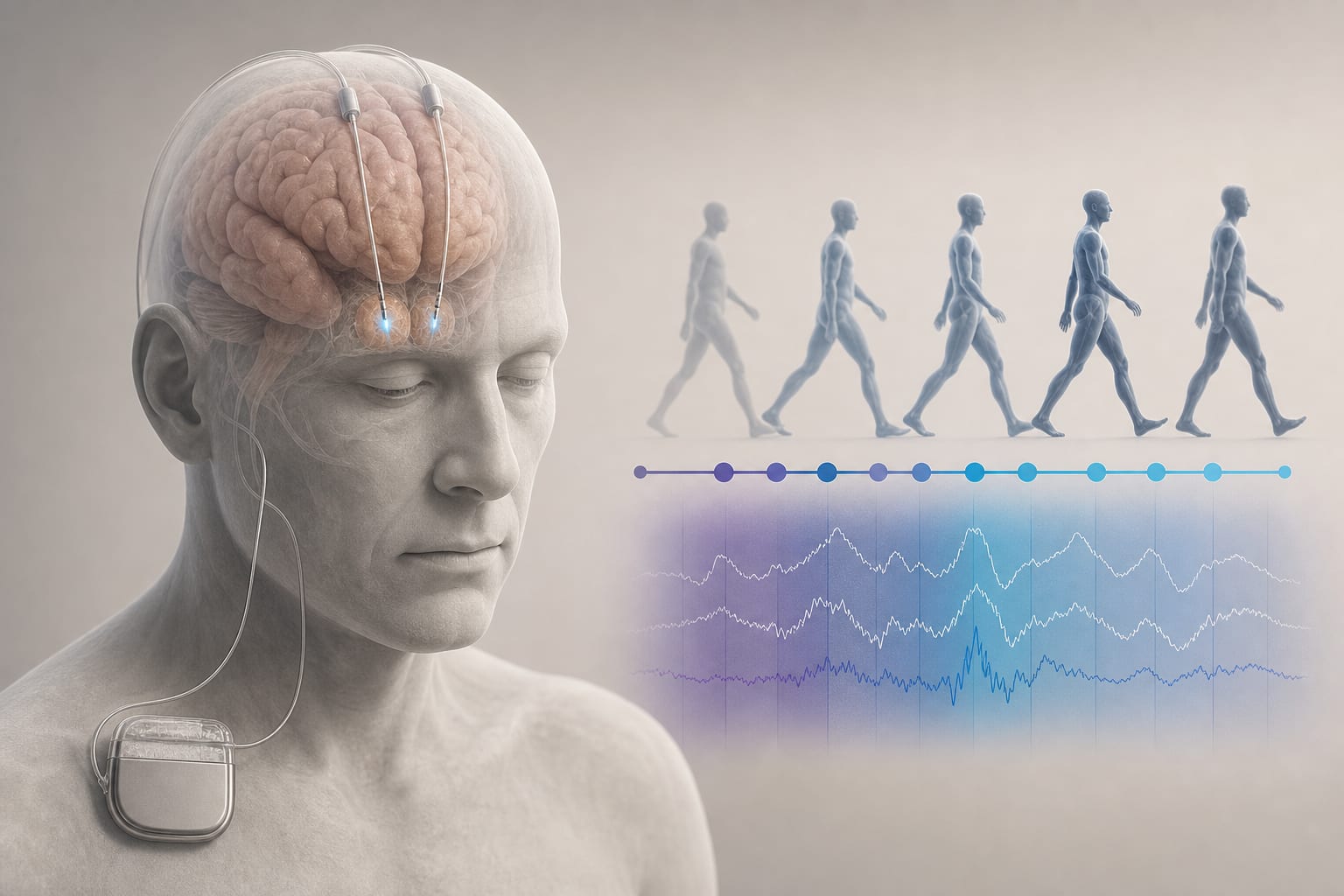
This study investigates the feasibility of adaptive deep brain stimulation (aDBS) synchronized to gait phases in patients with Parkinson's disease (PD). Results indicate that aDBS can improve gait metrics while maintaining overall symptom control, presenting a promising advancement in managing gait disturbances associated with PD.
Background
Gait disturbances in Parkinson's disease significantly impact patients' quality of life and independence, often leading to increased fall risk. Traditional deep brain stimulation (DBS) therapies have shown diminishing efficacy over time, necessitating innovative approaches to enhance gait outcomes without compromising other motor functions. The introduction of aDBS, which adjusts stimulation based on real-time neural signals, represents a potential breakthrough in addressing these complex motor challenges.
Data Highlights
Metric
cDBS
aDBS
Step-length variability
Higher
Reduced
Step-time variability
Higher
Reduced
Gait symmetry
Lower
Improved
Key Findings
Adaptive DBS (aDBS) synchronizes stimulation to discrete phases of the gait cycle.
Patients exhibited unique frequency bands correlating with contralateral leg swing during gait.
Acute application of aDBS improved gait symmetry and reduced variability compared to conventional DBS.
Long-term home use of aDBS maintained symptom control while improving gait metrics.
Patients tolerated rapid stimulation adjustments without adverse effects.
Clinical Implications
The findings suggest that aDBS could be a viable option for managing gait disturbances in PD, potentially enhancing patient mobility and reducing fall risk. Clinicians should consider integrating aDBS into treatment plans for patients with persistent gait issues despite conventional therapies.
Conclusion
The study demonstrates the feasibility and potential benefits of gait-phase synchronized aDBS in improving gait disturbances in Parkinson's disease. This innovative approach may represent a significant advancement in the management of motor symptoms in PD.
by Kenneth H. Louie, Jannine P. Balakid, Jessica E. Bath, Seongmi Song, Hamid Fekri Azgomi, Jacob H. Marks, Julia T. Choi, Philip A. Starr, Doris D. Wang