Effects of a clinical metagenomics intervention on clinical outcomes, healthcare costs, and health-related quality of life in patients with sepsis or septic shock: results of the randomized-controlled DigiSep trial - Report - MDSpire

Effects of a clinical metagenomics intervention on clinical outcomes, healthcare costs, and health-related quality of life in patients with sepsis or septic shock: results of the randomized-controlled DigiSep trial

  • By

  • Thorsten Brenner

  • Annabell Skarabis

  • Stefan J. Schaller

  • Thilo von Groote

  • Christian Putensen

  • Ulf Günther

  • Martin Sauer

  • Sebastian O. Decker

  • Fabian Dusse

  • Manfred Weiss

  • Klaudiusz Suchodolski

  • Tim-Philipp Simon

  • Peter Rosenberger

  • Onnen Moerer

  • Matthias Unterberg

  • Jens-Christian Schewe

  • Hendrik Bracht

  • Selina Hutzl

  • Manuel Feißt

  • Ursula Marschall

  • Patrick Brandenburg

  • Philip Stevens

  • Juliana Schmidt

  • Mathias W. Pletz

  • Marc M. Berger

  • June 30, 2026

  • 0 min

Share

Clinical Report: Impact of a Metagenomics-Based Clinical Intervention on Patient Outcomes

Overview

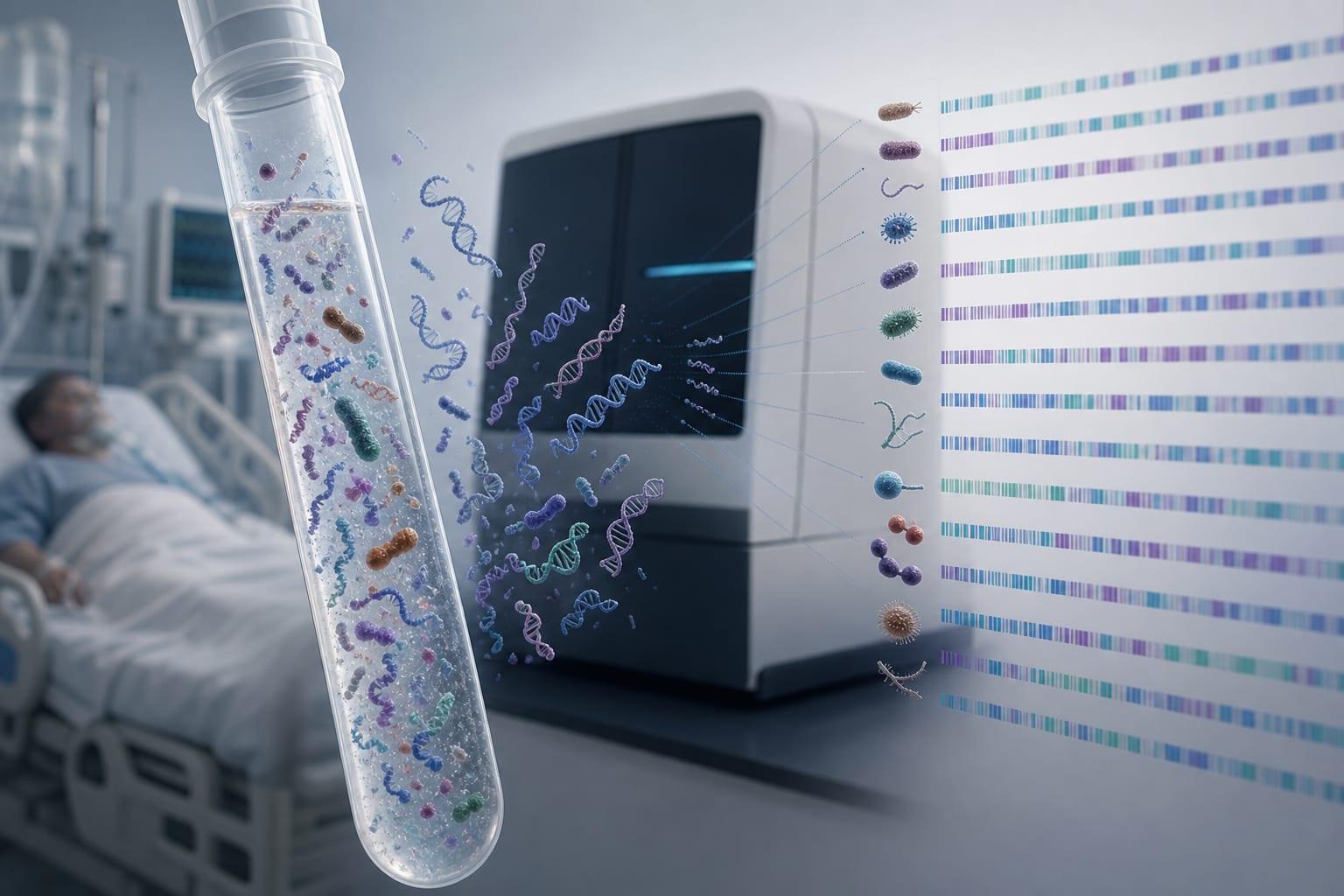
The DigiSep trial evaluated the impact of metagenomic next-generation sequencing (mNGS) on patient outcomes in sepsis or septic shock. The primary endpoint was not improved in the intervention group.

Background

Sepsis is a leading cause of mortality in critically ill patients, with early identification of pathogens being crucial for effective treatment. Traditional culture-based diagnostics have limitations, prompting interest in mNGS as a potential alternative for pathogen detection. The DigiSep trial aimed to assess the effectiveness of mNGS in improving clinical outcomes in sepsis management.

Data Highlights

No numerical data or trial data provided in the source.

Key Findings

  • The primary endpoint of the DigiSep trial, the DOOR/RADAR score, was not improved in the intervention group.
  • mNGS diagnostics showed a positivity rate of 70.5%, compared to 19.4% for blood cultures in previous studies.
  • Expert recommendations suggested that mNGS findings could lead to treatment adjustments in 32.6% of cases.
  • Inadequately treated patients exhibited significantly worse outcomes compared to those receiving appropriate treatment.

Clinical Implications

The findings from the DigiSep trial highlight the need for further studies to confirm the potential benefits of mNGS in optimizing treatment for sepsis. Clinicians should consider the limitations of traditional diagnostics and the exploratory nature of mNGS findings when making treatment decisions.

Conclusion

The DigiSep trial did not demonstrate a significant improvement in the primary endpoint with mNGS.

Related Resources & Content

  1. Intensive Care Medicine, 2017 -- Economic and Performance Assessment of Molecular Pathogen Detection in Patients with Severe Infections
  2. Critical Care (Springer), 2025 -- Predictive enrichment using biomarkers in studies of critically-ill patients with sepsis: a systematic review
  3. Intensive Care Medicine, 2024 -- Utilization of Bayesian Dosing Software to Attain Optimal Antibiotic Levels in Critically Ill Pediatric and Adult Patients with Sepsis
  4. Infection, 2022 -- Evaluating the Effects of a Sepsis Quality Improvement Initiative in the Emergency Department: A Pre- and Post-Intervention Analysis
  5. Surviving Sepsis Campaign Adult Guidelines | SCCM
  6. IDSA/ASM 2024 Guide to Utilization of the Microbiology Laboratory for Diagnosis of Infectious Diseases
  7. Approaches to developing and implementing a molecular diagnostics stewardship program for infectious diseases: an ASM Laboratory Practices Subcommittee report | Journal of Clinical Microbiology
  8. The DigiSep Trial (ID 1249749) - BioProject - NCBI
  9. Improved pathogen identification in sepsis or septic shock by clinical metagenomic sequencing - ScienceDirect
  10. Effect of Metagenomic Next-Generation Sequencing on Clinical Outcomes of Patients With Severe Community-Acquired Pneumonia in the ICU: A Multicenter, Randomized Controlled Trial - ScienceDirect
  11. Metagenomic analysis of microbial cell-free DNA from plasma of patients with suspected infections: performance and therapeutic impact in clinical routine - ScienceDirect
  12. Surviving Sepsis Campaign Adult Guidelines | SCCM
  13. IDSA/ASM 2024 Guide to Utilization of the Microbiology Laboratory for Diagnosis of Infectious Diseases
  14. Approaches to developing and implementing a molecular diagnostics stewardship program for infectious diseases: an ASM Laboratory Practices Subcommittee report | Journal of Clinical Microbiology
  15. ESCMID - Nutzen der Metagenom-Sequenzierung bei Sepsis

Original Source(s)

Related Content