Combined biofeedback and vestibular rehabilitation therapy for vestibular migraine: clinical efficacy and neurobiochemical correlates - Report - MDSpire

Combined biofeedback and vestibular rehabilitation therapy for vestibular migraine: clinical efficacy and neurobiochemical correlates

  • By

  • Tengteng Zhang

  • Ying Zhang

  • Jinghui Sun

  • Luting Lv

  • Hongwei Wang

  • He Zhang

  • Jie Li

  • Jiandong Wang

  • Zhidan Yu

  • Shuqin Wu

  • June 23, 2026

  • 0 min

Share

Clinical Report: Integrating Biofeedback with Vestibular Rehabilitation for Managing Vestibular Migraine

Overview

This study evaluates the efficacy of combined biofeedback and vestibular rehabilitation therapy in patients with vestibular migraine (VM). Results indicate that this integrated approach improves clinical outcomes compared to individual therapies.

Background

Vestibular migraine is a common cause of recurrent vertigo, yet treatment options remain limited. The integration of biofeedback with vestibular rehabilitation may offer a non-pharmacological approach to managing this condition.

Data Highlights

GroupTotal Effective Ratep-value
Routine Intervention (A)67.57%-
Vestibular Rehabilitation (B)75.68%-
Biofeedback Therapy (C)78.38%-
Combined Therapy (D)94.59%0.035

Key Findings

  • Combined therapy achieved a total effective rate of 94.59%, higher than other groups.
  • Group D showed improvements in anxiety and depression scores.
  • Vertigo disability and balance function improved in the combined therapy group.
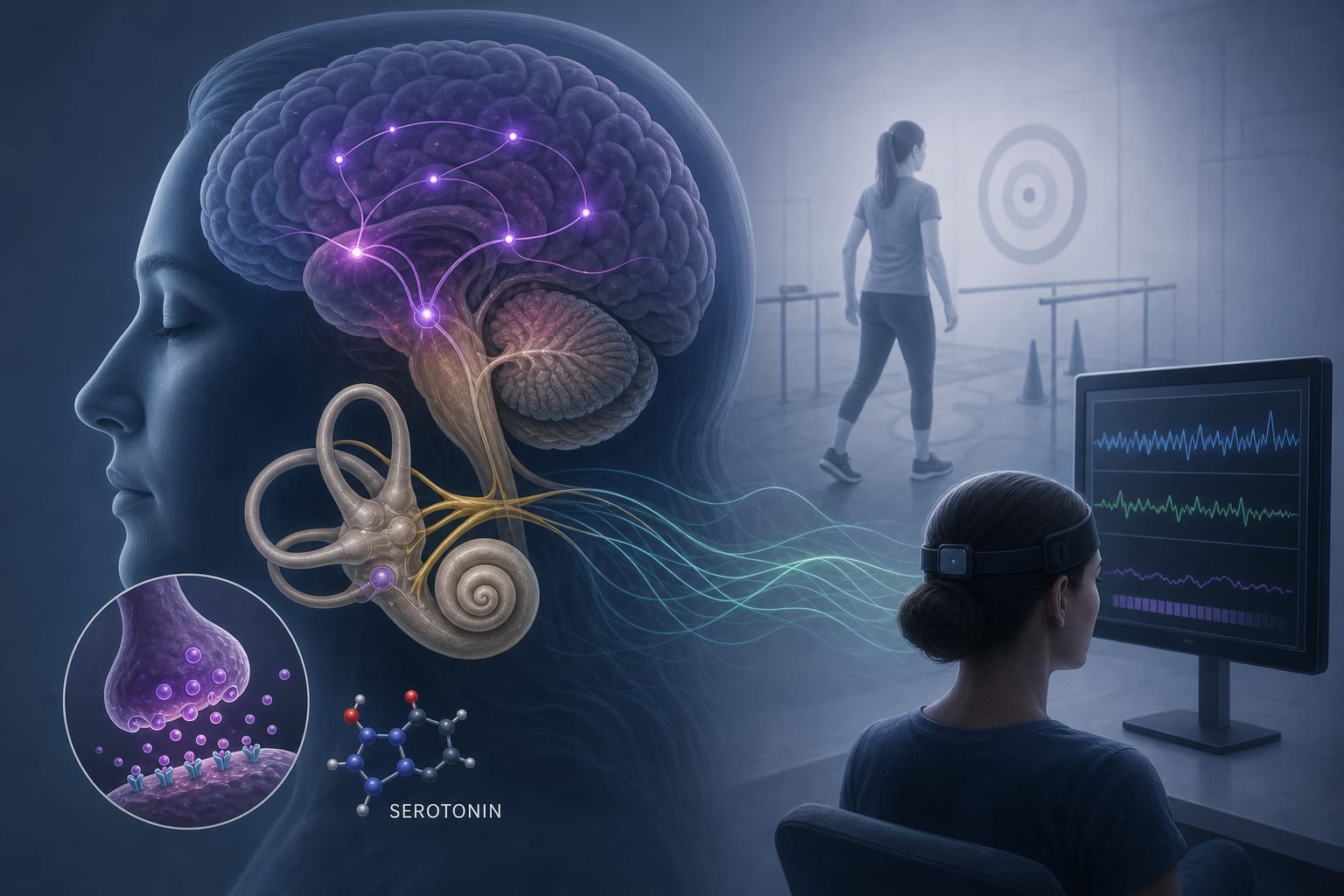
  • Serum levels of 5-hydroxytryptamine and γ-aminobutyric acid increased, while calcitonin gene-related peptide and acetylcholine levels decreased in Group D.
  • Vestibular function parameters improved with combined therapy.

Clinical Implications

The findings indicate that integrating biofeedback with vestibular rehabilitation may improve treatment outcomes for patients with vestibular migraine.

Conclusion

The study supports the use of combined biofeedback and vestibular rehabilitation as a treatment strategy for vestibular migraine.
Related Resources & Content

  1. Frontiers in Neurology, 2026 -- Editorial: Vestibular migraine: pathophysiology, diagnosis, and management
  2. Frontiers in Neurology, 2026 -- Concurrent VVOR and VORS profiling reveals a threshold-dependent VOR suppression deficit in vestibular migraine
  3. Frontiers in Neurology, 2026 -- Objective oculomotor, vestibular, reaction time, and cognitive signatures of vestibular migraine
  4. PMC, 2021 -- Vestibular migraine: Diagnostic criteria (Update): Literature update 2021
  5. Headache, 2024 -- A placebo controlled, randomized clinical trial of galcanezumab for vestibular migraine: The INVESTMENT study
  6. Frontiers in Neurology — The interictal symptom burden in vestibular migraine—a condition in need of recognition
  7. Vestibular migraine: Diagnostic criteria (Update): Literature update 2021: Consensus document of the Bárány Society and the International Headache Society - PMC
  8. A placebo controlled, randomized clinical trial of galcanezumab for vestibular migraine: The INVESTMENT study - Sharon - 2024 - Headache: The Journal of Head and Face Pain - Wiley Online Library
  9. | www.nature.com/scientificreports --- | ---OPEN

Original Source(s)

Related Content